
Alex in Wonderland
Last time, we introduced the idea of co-locating transmission lines alongside train tracks to unlock renewable energy in the Southwest and create an electrified rail network. Two birds with one stone! Read that post HERE before jumping into this one.
Oh, by the way... do you like to boogie? Want to support climate activism? Come out to Nocturnal: An Earth Night Party at SILO in Bushwick on Earth Day, 4/22. We're throwing a joint fundraiser rager for NYC-DSA Ecosocialists, Planet Over Profit, and Hot Girls Organize. It's gonna be a hoot 🦉
Now, let's return to our little escapist thought experiment.
POV: You are still the President
Ah, yes. The year is 2028 and you are a one-woman Executive Branch. You've got a supermajority in Congress and unfettered powers gifted to your office by dimwitted, deposed, diapered adversaries.
The plan: build the Silver Bullet Express to unlock new renewables, form a national energy grid, and make high-speed rail a reality... all in one fell swoop.
But questions remain. What's the best approach? What emerging technologies should be considered? How do we balance financial prudence with overall impact?
Leadership is all about delegation, so, Madame President, go ahead and pick up the phone—yes, the giant gold rotary phone on your giant gold desk—and tell whoever answers to send in the experts posthaste.
(You make the call.)
Not a moment later, a muffled knock sounds at the door. "Enter!" you call out presidentially. The door swings open... but no one is there. Stand up to get a better view; now watch in disbelief as three small animals sprint into the middle of the Oval Office: a Cat, a Mole, and a Pink Rabbit.
"How unusual," you remark, "Woke really is back! Well, guys, whatcha got for me?"
The Cat slinks forward first. A lanky grey tabby with enormous eyes and ears, she hoists herself onto her hind legs and, wobbling unsteadily, begins to speak.
"Helluva idea you've got here, Madame President—and so utterly simple to execute! There's just one word you need to know: catenary."
"Catenary?" you repeat.
"Catenary! As in, overhead wires that supply a constant stream of electricity to a train, tram, or bus equipped with a pantograph."
"A pantograph?"
"That's right, a pantograph! Mounted to the roof of your train, tram, or bus, a pantograph connects the catenary wire to your vehicle, allowing electrons to flow! Ever been to San Fran, Madame President? The trolleys they got there are powered by catenary lines. We can do the whole country just like that!"
"So your plan is to operate high-speed trollies across the country? And what about the transmission lines?'
"Not trollies. High-speed locomotives. Just like they do over in Japan, France, Spain, and China. As for transmission—why, that's the beauty of it: transmission lines and catenary wires can share the same poles! You just put one right on top of the other. Yes, ma'am, catenary's got heaps of advantages..."
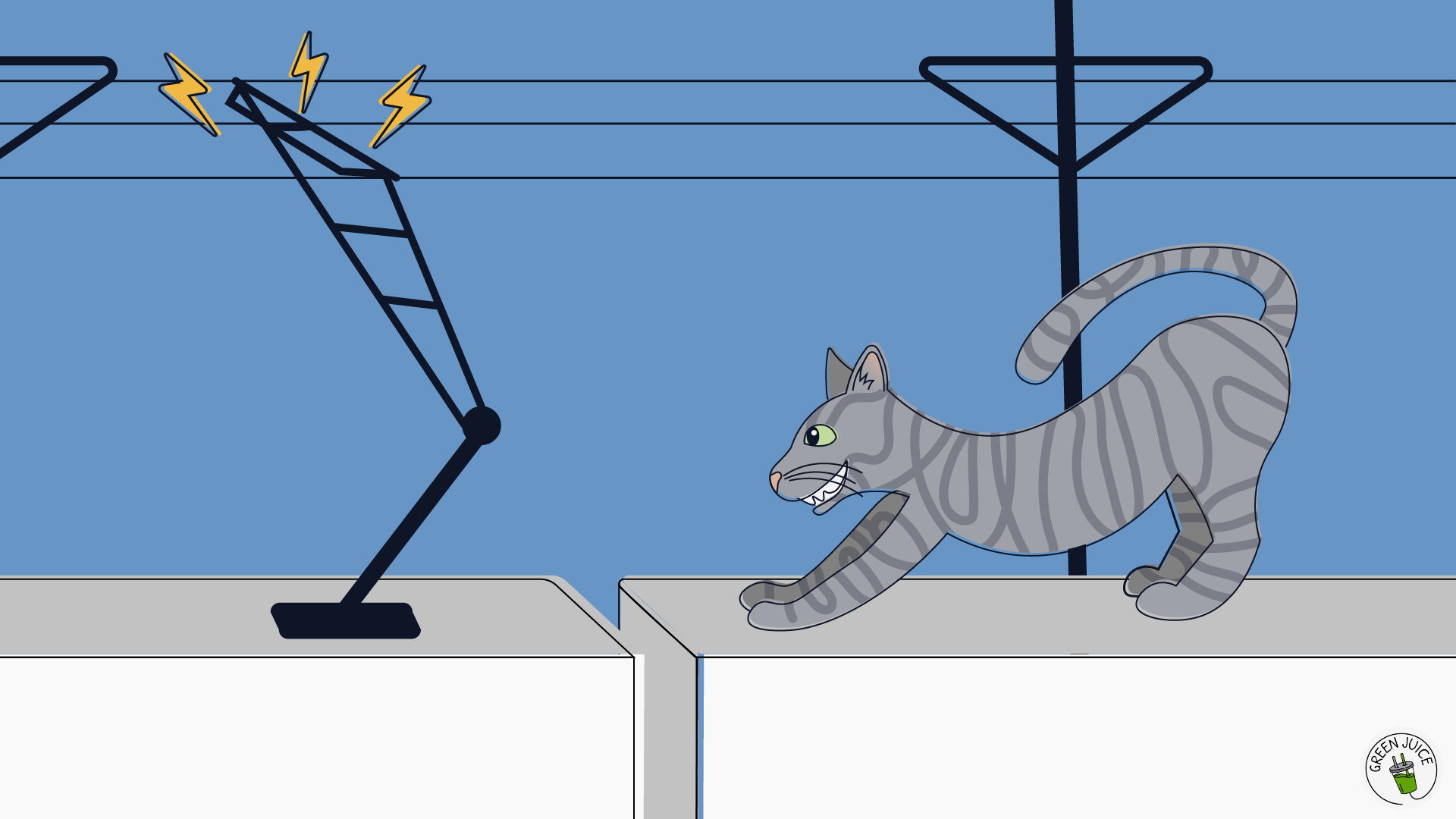
The Cat's plan: overhead catenary lines to co-locate transmission and electrify trains
Why catenary makes sense
A catenary system takes advantage of the existing railroad track network, with its federally granted Rights-of-Way, to co-locate High-Voltage Transmission Lines (HVTL) alongside railroad tracks. Right-of-Way corridors typically extend beyond the tracks themselves—33 feet on either side of the tracks is common. That's enough space to fit all the construction equipment required to build this whole thing out.
What it would look like
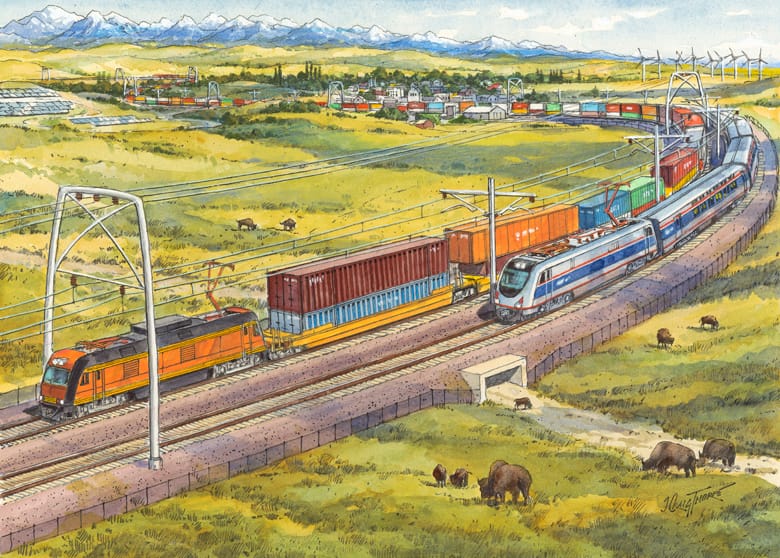
See the picture above, courtesy of our friends over at Solutionary Rail. A standard power line, like you see on the side of the highway, has three wires. A catenary system adds one more. But the fourth wire isn't another high-voltage transmission line. It's a lower-voltage wire designed not to fry the train's electronics.
Substations = currency exchange for electricity
To make a catenary system work, you'd need to build a bunch of substations, one every 20 to 30 miles of track. That's because electricity loses steam as it travels. You wouldn't want to power a train in Montana with electricity generated in Michigan: you'd lose too much power during transmission.
Substations are kind of like a currency exchange for electricity. They don't generate any power themselves—instead, they convert electricity from one form to another by altering the current and adjusting the voltage. Different machines prefer different currents at different voltages. In this case, we need to convert electricity from its "raw" form to what our electric trains need to run efficiently.
We're getting into the weeds here, I know. But this is an important part of the project. That's because building all these substations would create new markets for renewable energy. Here's an example.
A tiny town in Kansas
Picture this: a tiny town in rural Kansas with nothing going on but a mediocre high school basketball team and a noisy, dirty freight train that barrels past twice a day. Suddenly, a brand new substation gets built right next to the train tracks. That substation will need to be powered, and the U.S. government is very interested in buying up any renewable electricity that can help meet the demand. Our little town takes out a big old low-interest government loan and begins to build wind, solar, and batteries—enough to power their substation, plus even more to sell energy to the grid, which the transmission lines will carry to Kansas City and beyond. Our town uses the money they make to build a new basketball arena and hire the best coach in Kansas. Three years later, they're winning the state title. Talk about a win-win.
...
The Cat, thus concluding her speech, collapses into a circle and falls soundly to sleep.
Next, the Mole makes a beeline straight for your feet. "Eek!" you shriek, as he scurries up your leg all the way to your shoulder. He brings his snout to your ear and whispers:
"Madame President... I implore you... do not attempt to build the Silver Bullet Express using a catenary system. It would be a grave error!"
"Get off me, fucker!" you shout, swatting the Mole onto the desk where he lands with a dull thud. Gingerly, the Mole brushes himself off, tents his little claws, and starts to speak.
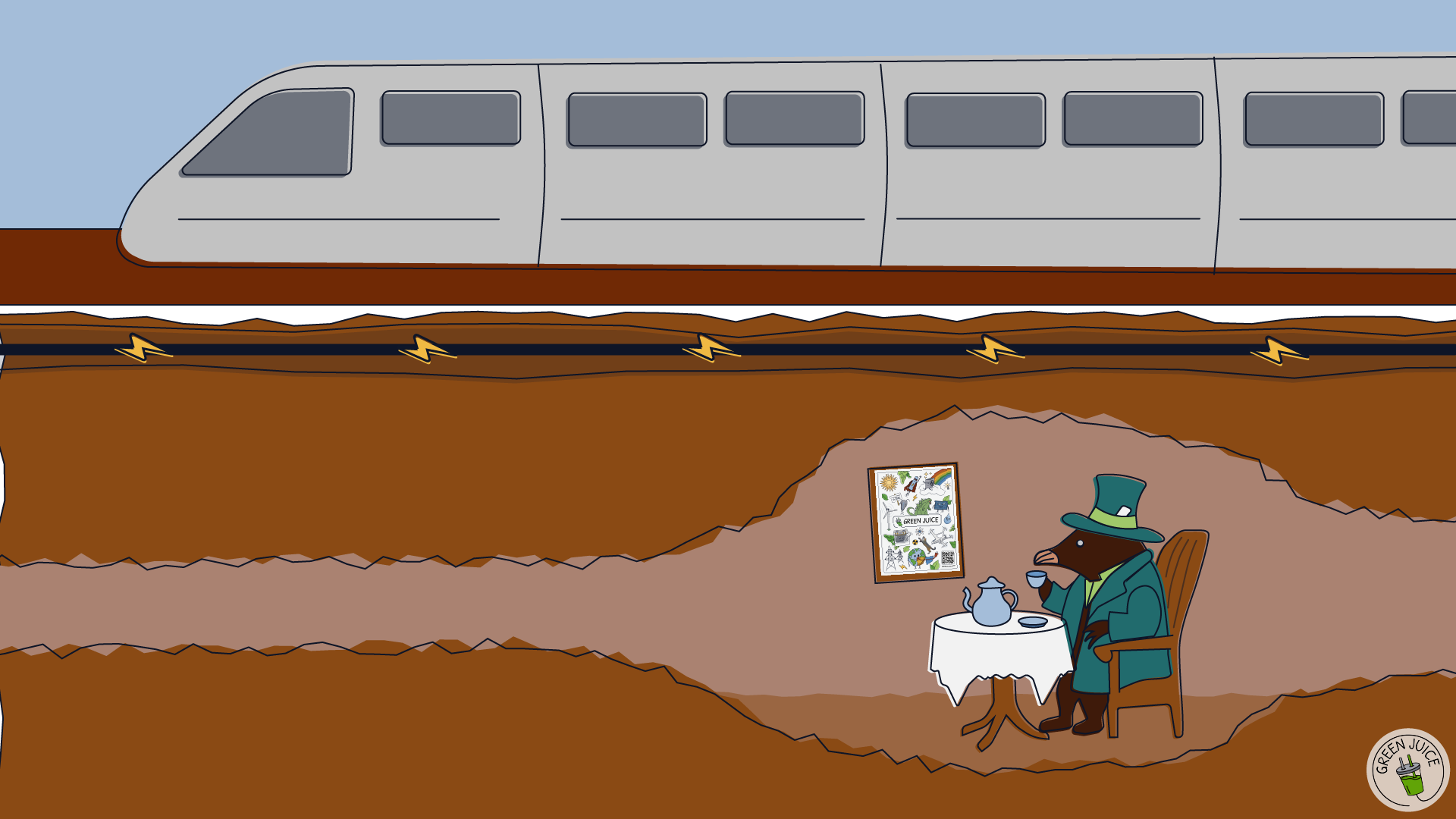
"Catenary presents many challenges... many challenges... and it's outdated technology, to boot. The best way to build transmission is to bury the lines underground. Underground, out of sight... nice and quiet... Underground, so much easier... and cost competitive..."
"Well, go on then," you say.
The Mole's plan: Bury cables next to trains and highways
The issue isn't just local landowners
Co-locating transmission lines along existing rail corridors makes part of this process easier: because of their Rights-of-Way, you won't have to deal with annoying local landowners.
But other parties get a say: local governments and municipalities, state regulators, environment groups... and the railroad companies themselves.
Why does it matter if the railroads object? Well, because...
In the U.S., almost all the train tracks are privately owned
There are approximately 140,000 miles of steel railroad track crisscrossing this country. But unlike almost every other country on Earth, 95% of it's owned by a handful of massive freight rail conglomerates.
I'll say that again, because it bears repeating: in Europe, in Russian, in India, in China—everywhere, basically, except for the U.S., Canada, and Australia—railroad tracks are owned and maintained by the State, not by for-profit corporations.
This is the single biggest reason why America doesn't have high-speed rail today. It's why less than 40% of long-distance Amtrak trains arrive on time. And it's why less than 1% of America's mainline railroad track is electrified.
Let's take a quick detour.
In the U.S., highways are publicly owned; train tracks are not
Guess which enormous American infrastructure system is publicly owned and maintained? Yup, it's the U.S. Interstate Highway System!
Imagine if Ford, Dodge, and Chevrolet owned every highway in America. That's the situation with the railroads.
Railroad track owners must pay for track repairs and maintenance costs. Class I railroads (the largest class of railway carrier in the U.S. by revenue generation) spent $26.8 billion on infrastructure in 2023 alone.
That bill gets passed onto their customers, which drives up the cost of shipping goods by freight rail.
Conversely, cruising down the highway is "free". This cost disparity, starting as soon as the Interstate system was built in the 50s, precipitated a massive shift away from shipping goods by rail and onto semi-trucks.
The amount of freight trucking we do in this country today is staggering. Trucks in the U.S. move approximately a trillion ton-miles of freight (a ton-mile is one ton of freight carried one mile) over distances greater than 500 miles. Put another way: there are a lot of extremely heavy trucks traveling great distances.
This is a bad system. Because of pollution, of course, and because trucks cause traffic deaths and congestion (all of which incur heavy costs subsidized by the public). But also because heavy trucks absolutely destroy our highways.
Trucks are responsible for a whopping 40% of the damage done to our nation’s roads by vehicles… yet they account for just 10% of the total miles driven. For every mile they drive, large trucks incur a road repair cost of about 66 cents… yet they effectively pay only four cents per mile. This already expensive problem is only getting worse: without rail electrification on the horizon, the total tonnage for trucking is forecasted to grow almost 45% by 2045.
Of course, our highway system isn't actually free.
In 2024, total road and highway spending in the U.S. eclipsed $200 billion. The American public contributed $21 billion to that total through general tax revenues—to say nothing of the road tolls, fees, and motor fuel taxes many car drivers are responsible for paying.
The solution is obvious: the public should own and maintain our railroads, just as we own and maintain our highways. Taking that $26.8 billion off the books for rail operators would allow freight shipping prices to come down, thus incentivizing a mode shift from trucks to trains. Fewer heavy trucks on the road would in turn bring down the cost of highway and road spending.
...but I've gotten us way off track. Let's get back to the Mole's big idea.
Railroads, regulators, and randos tend to prefer underground cables
The thing about overhead transmission lines is they can be quite tall. Up to 200 feet tall, visible for miles. As we know from wind turbines, some people absolutely can't stand when you build infrastructure that they might occasionally have to look at.
If a municipality refuses let you build a transmission line, you can sometimes build around them. But if the monocled railroad magnate who owns the tracks refuses, well, you're shit outta luck.
This is why it's often easier to build transmission lines underground... though it's still ridiculously hard. Next week, we'll talk more about the SOO Green transmission line, an underground project that's been delayed for a decade.
How buried High-Voltage Transmission works
Instead of stringing your wires up on poles, you dig trenches and bury a high-voltage transmission cable in an underground corridor.
Until quite recently, underground lines were way more expensive to construct than overhead lines. However, breakthroughs in horizontal drilling technology (thanks, fracking!) have meaningfully brought down costs. Today, buried HVDC lines are often cost-competitive with overhead lines—partly because dealing with all the permitting bullshit really adds up. Sound familiar?
Another reason undergrounding is cheaper: unlike overhead lines, below-ground cables don't require you to build a bunch of substations at 20-mile intervals; you just need two huge power stations at either end of the line. (If it's a really long line, you may need a few substations along the way.)
Sadly, this means buried transmission won't create a bunch of small markets for new renewable energy, a la our tiny town in Kansas.
"Eyes on the prize!" the Mole scolds. "We're on a quest to unlock more renewable energy in the Southwest than we could ever possibly use! But there is one downside..."
Buried transmission makes it harder to electrify trains
There's another bummer: if all your transmission lines are buried underground, you can't easily electrify your trains. There's no pole to easily slap on catenary, and something like an electrified third-rail, which we use in subways, isn't safe in a broader context.
"Wait, no electric trains?" you interject.
"Well... no... but... BUT... if we move away from electric trains, then we can bury our transmission lines along the highways, instead of next to railroad tracks! Highways have Rights-of-Way too, you know... And since they're publicly owned, that means no grumbling railroad tycoons to interfere with our plan..."
"But half the point is to have electric, high-speed trains!" you say.
The Mole, sensing he's lost the plot, begins to grope around the desk blindly, arms affixed in front of him. Soon enough he walks right off the edge and falls into the wastepaper basket.
Up hops the Pink Rabbit to replace him.
"The Mole's not wrong, MP. He's just short-sighted. We can have underground transmission and electric trains with one simple solution. And that solution is... batteries! Batteries are the new plastics. By the time your project hits the ground, the cheapest, smartest option will be battery-powered trains. It's inevitable!"
"I'm sorry, but are you... the Energizer Bunny?" you ask.
"Used to be. Once upon a time. Got blacklisted from Hollywood for being too Red," the rabbit says, twitching his nose testily. "Now I spend half the year in Shenzhen. The Chinese Century is so real, bro..."
"I'm sorry, but batteries can't possibly power a train across the country. That's absurd! Don't Teslas only get 300 miles of range?"
"Follow along with the Pink Rabbit," he says, and begins to speak.
The Pink Rabbit: Battery-powered trains
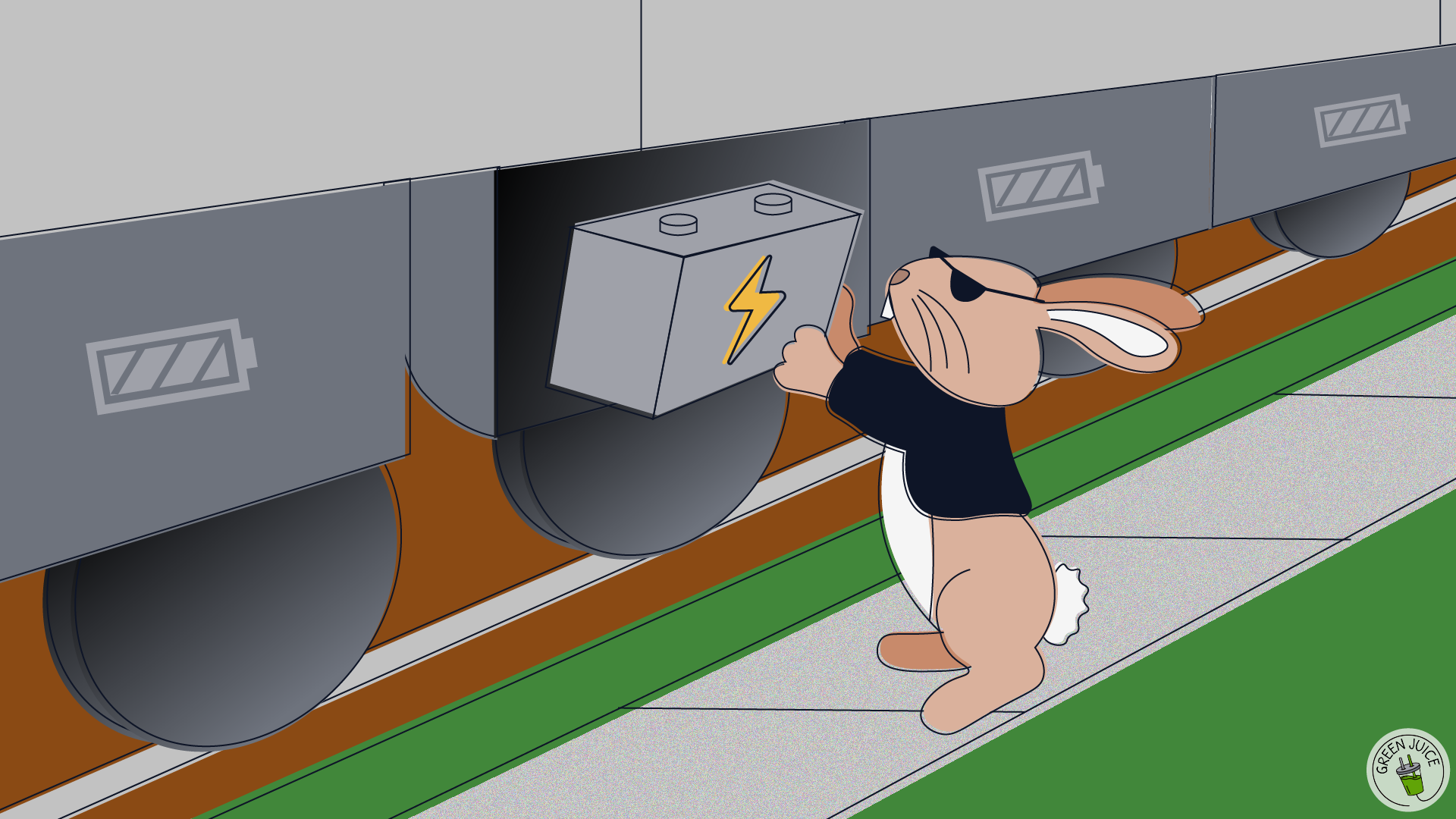
Battery-powered trains are real and only getting better
Battery-powered trains have existed since the 19th century, though early models used heavy lead-acid batteries and weren't very practical. A slew of innovations over the last 20 years have made batteries cheaper, safer, and more energy dense.
Today, fleets of battery-powered trains are operational in Germany, Japan, Denmark, and elsewhere. They recharge their batteries using catenary wires in the stations.
Batteries get better and better
In late 2024, Chinese battery giant CATL announced they've developed a lithium-sulphur battery with an energy density of 700 watt-hours per kilogram. To put that into perspective, a Tesla Cybertruck's battery has an energy density of about 280Wh/kg. An expert I spoke to claimed that a train car carrying 50 kilograms (about 110 lbs) of 700Wh/kg batteries could power an electric train for 400 miles.
We're still years away from seeing 700Wh/kg batteries in trains, but they're likely coming. We could hit densities of 1 kilowatt-hour per kilogram soon enough.
Diesel-electric trains can be converted into battery trains
Something we haven't talked about: locomotives today are all diesel-electric: a diesel engine spins a generator, producing electricity, which powers a motor on the train's wheels.
Converting diesel-electric trains to use catenary wires is possible, but expensive.
Much easier would be to convert diesel-electric trains into battery-powered trains. A Berkeley Lab study from 2021 found that retrofitting existing diesel-electric trains with batteries would be cost-competitive with diesel—and battery economics, as I'll keep mentioning, are only improving.
The upshot is that we could start retrofitting existing trains with batteries today, whereas for a purely catenary system, you'd need to wait until the whole train line was electrified—and then you'd need to procure new trains.
Regenerative braking makes battery trains possible
One last key piece here: regenerative braking is an old technology that allows vehicles to use the friction created by hitting the brakes to create extra electricity. This is actually how hybrid-electric cars recharge their batteries.
All modern trains use regenerative braking, but it's particularly helpful for battery-powered trains: regenerative braking can recover up to 30% of what would otherwise be wasted energy.
...
"So you see, AOC, by the time you've built catenary wires from Times Square to Tucson and replaced all your trains, batteries will be ascendant!"
At this, the Cat wakes up from her nap with a toothy yawn. The Mole climbs out of the wastepaper basket. The animals arrange themselves in a tidy row and look at you expectantly.
"My animal experts," you say, "you've each raised some excellent points today. But I wonder... would it not make sense to employ a combination of your approaches? Catenary wires when there are no objections, batteries and underground lines whenever we encounter bridges and tunnels and tricky terrain?"
"It wouldn't be my cup of tea," says the Cat.
"I just can't see it," says the Mole.
"I'm actually running late for my next meeting," says the Pink Rabbit.
One by one, the animals file out of the Oval Office.
That's fine by you. You can't please everybody. And it's time to get to work.

Member discussion