
Mining for critical mineral myths
Welcome back to Mythology Month, folks. In week 1, we capsized climate change myths. In week 2, we wrecked wind turbine myths.
Today we'll tread upon our rockiest terrain yet: myths embedded within the clean energy transition's growing demand for critical minerals and so-called rare-earth metals.
Mining is always dirty, even when we're doing it for the long-term health of the planet. For reasons both geological and post-colonial, many critical mineral supply chains rely on parts of the world with long histories of resource extraction for the global economy. There are very real issues we must contend with. The mining industrial complex doesn't need bullshit disinformation campaigns to sully its good name.
Yet the myths surface anyways. They're spewed by evil conservative think tanks like the Heartland Institute (funded by ExxonMobile and the Koch Bros, among other luminaries). They're regurgitated by business leaders with obvious conflicts of interest, like the chairman of Toyota who recently claimed his hybrids are 3x cleaner than Electric Vehicles. They're internalized by well-meaning people who'd prefer to believe there's a world in which we can avoid this nasty business altogether.
As a white American, I feel pretty sus making a pro-mining argument. But I don't think we can avoid it. So we must do it better, safer, more equitably, and in ways that mitigate the worst harms. There's also a very real chance that in just a couple decades, we'll be able to scale the whole operation way, way down.
We better start from the beginning.
We're toddlers trapped in a hot car
Contrary to what our federal government believes, burning coal and oil and leaking natural gas is flooding our atmosphere with greenhouse gases (GHG). These gases form an invisible barrier that lets in the sun's heat but prevents it from returning to space. It's like a big, gassy net.
Humans, so young in our development, are not unlike a wittle baby trapped in a hot car with the windows closed on a summer afternoon. Heat seeps in through the windows, but once inside it cannot escape. The temperature of the car rises.
"Open the windows!" the rational baby screams, banging on the glass.
I agree. But rather unfortunately, humans are emitting more greenhouse gases today than ever before. 38 billion metric tons in 2025 alone, a 1.1% increase over 2024.
So before we can even think about cracking a window, we must first stop making the windows of our car even thicker by emitting ever more greenhouse gases into the atmosphere.
Here's how we do that.
Step 1: Electrify Everything
About 80% of the GHG we emit come from just four sectors:
- Generating dirty electricity
- Industrial processes (making chemicals and cement, oil and gas extraction, etc)
- Transportation
- Heating and cooling buildings
Step 1 is to Electrify Everything that currently relies on burning coal, oil, and gas. If we can electrify our industries, transportation, and buildings—and, crucially, power all of it with renewable forms of energy—then we can reduce the amount of GHG we emit by 80%.
This is the thesis of the clean energy transition. Fully retrofitting our fossil fueled-society is going to be tough sledding, but once we've transitioned, we'll never need to burn another lump of coal or gallon of gasoline again.
"But just reducing emissions won't open the windows in our hot car metaphor!" the attentive reader cries.
Right you are. The clean energy transition only prevents the car from getting even hotter. It also doesn't touch the 20% of emissions that come from agriculture, land use, and cow burps.
Yes, humans have big, big problems. And limited time to solve them. I'm not trying to freak everyone out, now, but it sure looks like another El Niño is brewing, which likely means the next few years will be the hottest ever recorded.
So, we need to start somewhere. The clean energy transition is the foundation for everything to come.
There is some good news: the technology to transition already exists.
But it requires some funky ingredients.
Clean energy technology requires weird stuff
Like crafting magic weaponry in a roleplaying video game, manufacturing clean energy technologies requires special, hard-to-find ingredients.
Maybe you, too, have vague memories of staring at the periodic table postered to the wall of your high school chemistry class. If so, you may recall that every element is unique in its chemical composition... and therefore imbued with unique properties:
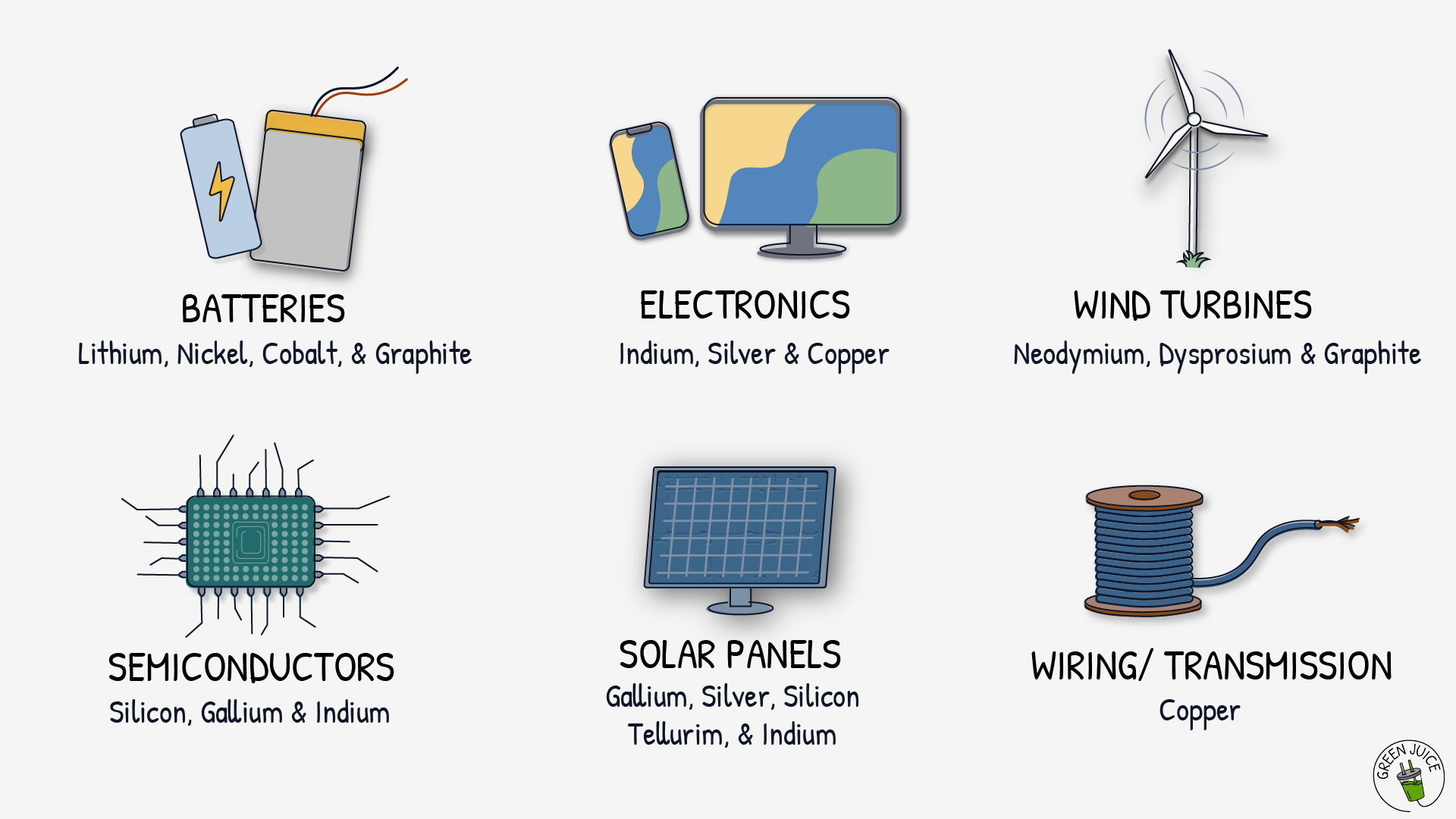
- Copper and aluminum are excellent conductors of electricity—crucial for building transmission and distribution power lines
- Lithium, nickel, cobalt, graphite (made from carbon), and manganese have high energy densities, stabilities, and reversible electrochemical properties—an ideal fit for batteries
- Rare earth metals like neodymium, dysprosium, and praseodymium produce strong magnetic fields relative to their size—great for wind turbine generators
- Silicon, gallium, indium, tellurium, and silver have semiconductor or photon-conversion efficiencies that common metals like iron can’t match—which is why we use them in solar panels
Where are these critical minerals mined today?
Many countries around the world mine for critical minerals. But enormous quantities of a handful of key minerals come from just a few places:
- >70% of all cobalt is mined in 🇨🇩 Democratic Republic of Congo
- >50% of all nickel is mined in 🇮🇩 Indonesia
- >70% of all rare-earth metals are mined in 🇨🇳 China
- ~25% of all copper is mined in 🇨🇱 Chile
- ~50% of all lithium is mined in 🇦🇺 Australia
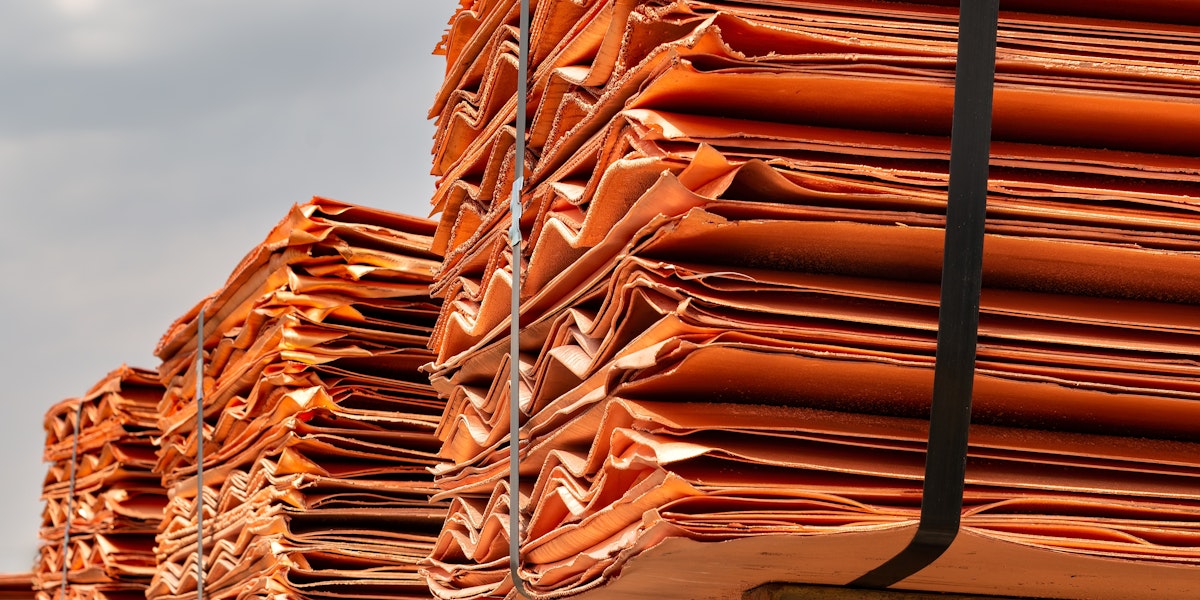
For more detailed information on this subject, I recommend this 2025 report from the International Energy Agency (IEA):

Okay, we're already running long here. Let's crack open some myths.
Myth 1: Most mineral mines use child labor
God, I've given myself a tough assignment here. But this just isn't true.
That's not to say the use of child labor in mines isn't a real thing. It very much is. One million children are estimated to work in mines and quarries around the world.
But there is nuance. Child labor is overwhelmingly concentrated in what are called artisanal and small-scale mines (ASM). These are small, unregulated, often illegal mines. They're not limited to critical minerals, either. The majority of child labor occurs in artisanal gold mines in places like rural Tanzania.
Child labor has, however, been documented in artisanal cobalt mines in the DRC. It's a known problem. The DRC government recently suspended artisanal copper and cobalt mineral processing in an attempt to address the issue.
The counterpoint to ASM are industrial-scale mines, which are generally financed and operated by multinationals working under agreements with host governments. That's not to say conditions are great at industrial-scale mines: they're still very dangerous, and many miners around the world, especially in informal sectors, earn just a few dollars a day.
This Al Jazeera mini-documentary, uploaded 2 months ago, gives a glimpse into the conditions for some folks at a mine in the DRC that's financed with Chinese outside investment.
Myth 2: Making clean energy tech is worse for the environment/climate than our current system
There's a kernel of truth here. The environmental cost of manufacturing clean energy technology is often more impactful than the comparative cost of manufacturing dirty tech.
“A typical electric car requires six times the mineral inputs of a conventional car,” writes the International Energy Agency (IEA), “and an onshore wind plant requires nine times more mineral resources than a gas-fired plant of the same capacity.”
(The above quote is borrowed from an old but relevant episode of Volts.)
The problem with this argument is that it completely ignores the three giant fucking elephants in the room:
A. Clean energy tech doesn't need fossil fuels to operate
While the initial cost of production is higher, you won't need to feed your EV gasoline once a week for the next fifteen years.
A quote from that article with the Toyota chairman:
Studies by the International Council on Clean Transportation show that electric cars produce about 60 to 68% fewer emissions over their lives than gas-powered or hybrid cars. This is assuming an average global electricity mix.
That last sentence—"assuming an average global electricity mix"—refers to the fact that our electricity grid is still mostly powered by fossil fuel-powered electricity. This is the Toyota guy's argument: it's bad to charge an EV with dirty electricity. And yeah, that's true.
But once we clean up our grid, EVs suddenly produce up to 80% fewer lifetime emissions than combustion-engine cars. That number will actually improve as minerals recycling technology gets better and better.
B. An astonishing amount of resources goes into extracting, processing, and shipping fossil fuels
Fun fact: 40% of all global shipping is devoted to simply moving fossil fuels around. 40%! What a colossal waste of resources. The impact of all this—including the fuel needed to power all that shipping—is rarely considered when calculating a product's carbon lifecycle assessment.
Collectively, oil and gas operations account for 15% of total energy-related emissions, per the IEA. That's the equivalent of 5.1 billion metric tons of greenhouse gas emissions every single year that switching to clean energy generation would mostly wipe out.
C. Fossil fuels are wildly inefficient
Don't forget that two-thirds or more of the energy dormant in fossil fuels is lost as waste heat when they're burnt. Two-thirds! Or more! 70% of the gasoline you put in your car does not actually power your car.
This segues nicely into our next myth.
Myth 3: We will need to mine an infinite number of critical minerals
Not true for a few reasons. Let's start with this one:
Because fossil fuels are so inefficient—because we need to constantly extract, refine, and ship 60–70% more fossil fuels than the amount of energy we actually need—electrification can dramatically reduce the total energy needed to provide the same services.
Another reason: materials recycling will continue to improve. We don't know by how much and how quickly, but China and others are working on it. One review estimates by 2039, closed-loop recycling could meet ~50% of cobalt demand, for instance.
A third: currently, Electric Vehicle batteries need to be replaced every 10–20 years, once they're deemed too degraded for safe use in a car. But we don't need to throw those old batteries away! They can still provide years of benefit by plugging into the energy grid and helping to store solar and wind energy for use overnight and at peak times.
Myth 4: We're gonna run out of critical minerals
I think this myth comes from a poor naming choice. Rare-earth metals are actually relatively abundant in the Earth's crust.
Most minerals are more common than believed, mostly because we haven't been looking very hard for them until recently.
But now the worldwide search for critical minerals is well underway, and new technologies are making it easier to find them. The world's largest Lithium deposit, for example. was recently discovered underneath a super-volcano right here in the U.S. (though its commercial viability is still being evaluated).
Another important caveat here is that battery chemistries, i.e. the chemical composition of what we broadly refer to as Lithium Ion batteries, is changing. Many batteries that previously required nickel, manganese, and cobalt (NMC) are being replaced by lithium iron phosphate (LFP) due to lower cost, better safety, and improved sustainability.
Myth 5: Deep-sea mining will be necessary to meet mineral demand
Trump loves the idea of deep-sea mining. Of course he does! It's incredibly destructive and wholly unnecessary.
As one academic paper succinctly puts it, "deep-sea mining is a multi-billion-dollar solution to problems that do not exist."
Phew. That was a doozy. Next time we'll conclude mythology month. I don't know what that post will be about yet. I am very tired now.
Read part 3 in this series!
 Jon
Jon

Member discussion