
Every Electric will pay you to use a battery
This post is #sponsored. Green Juice only partners with vetted allies in the fight against climate change and energy insecurity.
Every Electric is a company with a puzzling business model: they give away expensive home batteries *for free* to just about any New Yorker who wants one... and then they pay you to plug your stuff into it.
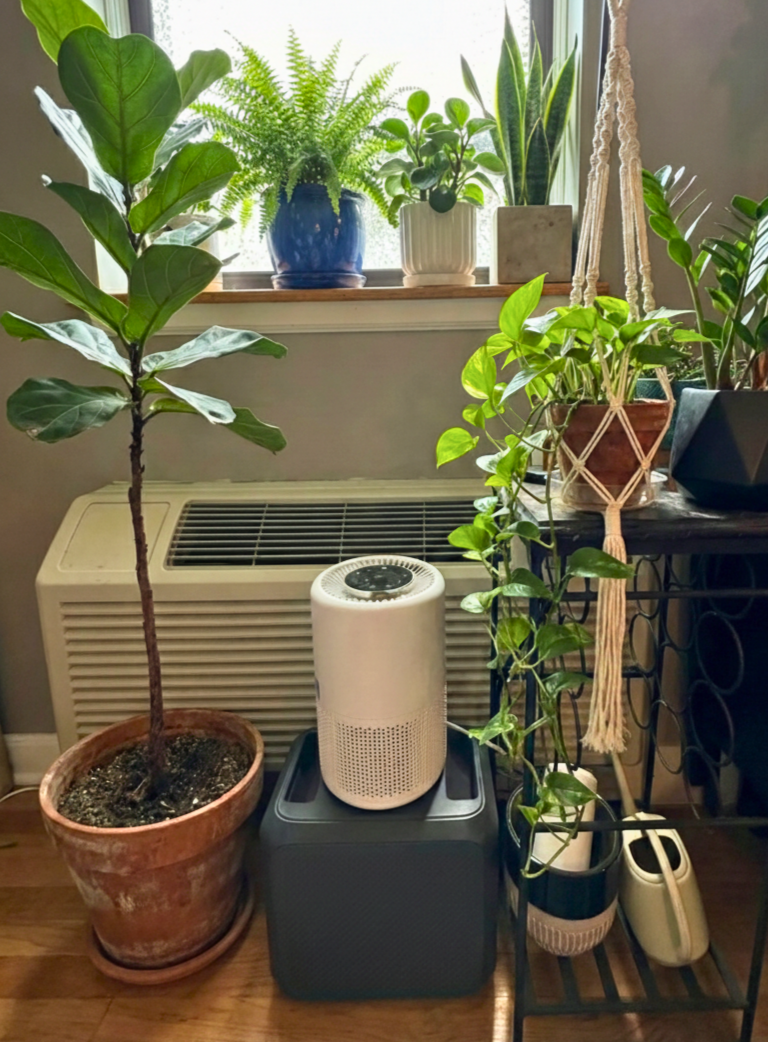
Specifically, they'll pay you to plug your air conditioning unit into one of their powerbanks—EE's term for their shoebox-sized, UL-certified batteries, like this handsome devil.
Plug your A/C into the powerbank, plug the powerbank into any wall outlet, live your life, forget you ever signed up for this program, and be pleasantly surprised when you get a check in the mail at the end of the summer for an average of $200 per household—or $150 per A/C unit.
Go ahead and smash that GET MY FREE BATTERY button if that's all you need to hear. Space is limited!
But if you're curious and/or confused about why they're doing this, how it works, and how such a program actually helps everyone in New York City keep the lights on—while lowering energy bills for all of us—then keep on readin', friend.
Why is Every Electric doing this?
The short answer is to help keep our energy grid balanced. Which is really important! Here's why:
- Our energy grid is struggling to keep up with growing demand for electricity.
- The grid struggles the most during certain peak times, like hot summer evenings when millions of New Yorkers get home from work and blast the A/C at the exact same time.
- These peaks are dangerous. If demand for electricity cannot be met by supply, then the whole grid might collapse in a cascading blackout. We never want that to happen, of course, but we especially don't want that to happen on a really hot summer day.
- To prevent cascading blackouts, grid operators use the following tools:
- When electricity demand starts to peak, grid operators fire up gas "peaker" plants to generate more electricity. The rub is that these peaker plants are highly polluting and super expensive. Using them even for a few hours causes the price of electricity to spike.
- If the peakers still can't meet demand, grid operators selectively shut off power to specific neighborhoods. This is called load shedding, and the neighborhoods most frequently targeted are, unsurprisingly, poor neighborhoods of color.
- If the grid is still in danger, operators can create brownouts by lowering the voltage of everyone's electricity. Voltage is kind of like water pressure: when it's lowered, the lights dim and appliances stop running properly. As a result, brownouts can permanently damage expensive appliances.
You may have noticed none of our blackout-prevention tactics are very good.
But thanks to new breakthroughs in battery technology, we finally have some promising solutions on the table. Enter Every Electric.
Meal-prepping for peak demand
The technical term for what Every Electric is doing is called load shifting. I don't love the name. It sounds weird and only makes sense to an energy geek.
So I dusted off my ad copywriter hat to come up with an alternative: energy meal-prepping.
You ever make a bunch of of breakfast burritos on Sunday night and stick 'em in the freezer? It's a great way to use a low-stress time of the week to ensure you have quick, cheap meals on hand when you're inevitably running around like a maniac on weekday mornings.
Energy meal-prepping works the same way. But in my metaphor, burritos represent electricity and your freezer represents a battery. Got it?
Energy burritos? Huh?
Right, it's still confusing. What we need is a diagram. Dr. Aarati, if you'd be so kind.
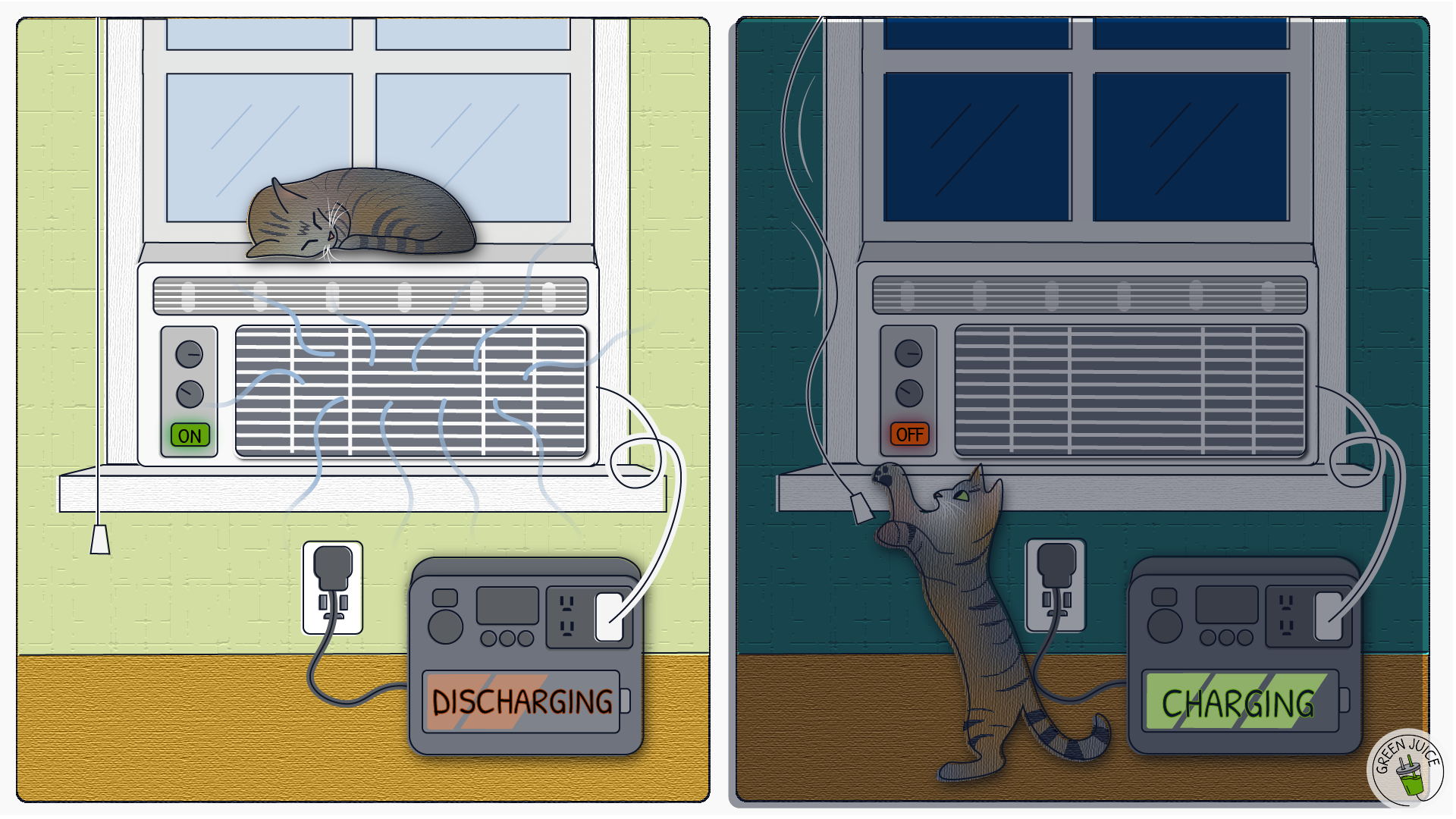
Here's the step-by-step process of how it works:
- In the middle of the night when demand is low (and therefore electricity is cheap), the battery automatically charges itself with energy from the grid.
- The next time you turn on the A/C, it will use the cheap energy stored in the battery instead of expensive electricity from the grid. Your A/C will become, quite literally, battery-powered.
- Once your A/C has drained the battery's juice, the battery will switch seamlessly to supplying the A/C with grid electricity. No need to unplug the A/C; you won't even notice it's happened.
- The battery will recharge itself again the next time electricity is cheap.
- Rinse and repeat, all summer long. In the fall, Every Electric will send you a big fat check for doing your part to keep the grid balanced and electricity prices lower for everyone.
How big a difference will the program make?
Can Every Electric really lower energy bills and help balance the grid?
The answer is definitely yes... but only if enough people sign up!
The more folks that plug in batteries, the bigger the benefits to the entire system.
To give you a sense of the scale required to make a difference, let's do a smidgen of math.
Let's say a dirty gas peaker plant in the Bronx has a power generating capacity of 100 megawatts per hour.
Meanwhile, the batteries Every Electric uses can store up to 2 kilowatt-hours of energy at a time.
1 megawatt = 1,000 kilowatts
Therefore, to replace one hour of running a 100 MW peaker plant, you'd need 50,000 households to adopt a battery.
50,000 sounds like a lot. But New York is a big place. There are around 3.3 million households in the city, and every single of one of them hates paying their utility bill.
How does Every Electric make money?
How does a company make money by giving away $900 batteries and then paying people to use them?
Well, first, a point of clarification: Every Electric isn't really giving away batteries so much as loaning them out for free. If you choose to leave the program (which you can do at any time), they're gonna ask for their battery back.
You do have the option, however, to purchase a battery outright from Every Electric for a sizable discount—$650 instead of the $899 retail price. Buying your battery unlocks an even higher rate of payment (an average of $250 per A/C unit!) and the money enables EE to loan out more batteries to more households.
But how do they make money?
The simplified answer is that Every Electric "buys" electricity when it's cheap and "sells" it when it's expensive. Buy low, sell high—classic stuff.
They can do this with the battery in my apartment, the one in your apartment, and with thousands of other batteries in apartments all across the city. By using software and a smart meter embedded within each battery, they can actually aggregate every battery's stored energy into one huge pool, which they can then sell to the electricity market for a wad of cash. Just like they were operating a real power plant.
Which... they kind of are. One might even call it a Virtual Power Plant. It's a real thing. VPPs, as they're often abbreviated, are about to hit the mainstream.
Here's how I described VPPs in a post from July:
Virtual Power Plants are like a school of tiny fish that arranges itself into the shape of one giant fish.
There's one final layer of nuance here: Every Electric is a partner in Con Ed's Smart Usage Rewards program, which funds independently operated companies to "enroll, compensate, and educate participants on how they can use less energy." So Con Ed is partially funding this effort. And I think that's beautiful.
Alrighty! I feel like we've pretty much addressed the "how" and the "why" of the matter. But I know there are more questions out there, so let's wrap up with a few rapid-fire Q&As.
Is the battery safe?
Look, I don't blame New Yorkers for having a negative association with lithium ion batteries. We've witnessed a number of tragic apartment fires caused by cheaply made, unregulated, illegally imported e-bike batteries.
But these are not those. These batteries are UL-certified. They have industrial-grade durability rated for over 10 years of daily use. They have smart sensors that monitor battery performance and health around the clock. And they use today's leading battery chemistry—Lithium Iron Phosphate (LFP)—which is inherently safer than earlier LI battery chemistries.
Is Every Electric a new company?
No, but they do have a new name. Last year, Every Electric operated as the Responsible Grid Project. I like the new name!
Will the battery fit in my apartment?
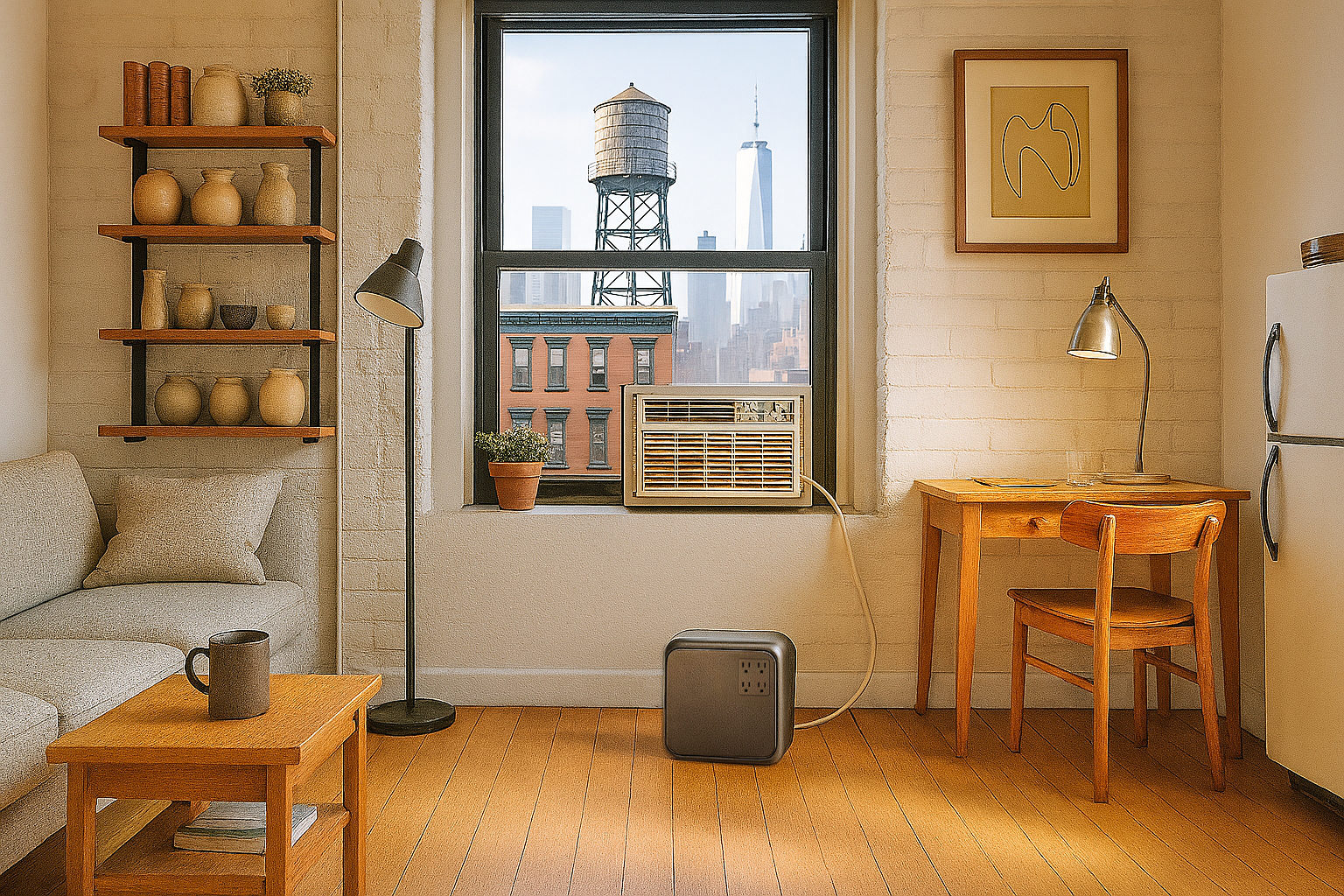
It's really quite small—roughly one cubic foot. Look how inconspicuous:
If balcony solar gets legalized, can I use a panel with my battery?
Now we're talking. There's currently a bill in the senate that would legalize balcony solar, also known as plug-in solar, in New York. Check out my posts on the subject if you'd like to learn more.
I asked Andrew, the co-founder and CEO of Every Electric, about how the batteries would work with plug-in panels. Here's what he said:
The SUNNY bill is exciting and will increase both our payout and have on-bill customer savings. When a plug-in panel is generating, it allows us to shift more energy while at the same time reducing the energy used by the household. If you got a panel today, you would have to plug both the solar panel and the battery into the wall. But we're developing software and hardware so that the panel can plug into the battery, which will be even more efficient.
Exciting times in the world of solar+storage.
For more FAQs, check out the Every Electric website.
Then get yourself a battery.



Member discussion