
The electricity farmers market

Last week's post was an introduction to public power. If you missed it, read that one here.
The New York Power Authority (NYPA) is one of ~2,000 publicly owned utilities in the U.S.
But unlike most of them, NYPA is prohibited from selling electricity to residential customers like you and me directly. They're only allowed to sell power to state- and public-sector buildings, agencies, and institutions.
We could pass a law to change this... but right now, that's just a pipe dream. (Not to be confused with Kathy Hochul's pipe reality.)
So, if NYPA can't sell their cheapo state power to regular folk, why are groups like NYC-DSA Ecosocialists and Public Power NY fighting so freaking hard to get NYPA to build more public renewables?
There are three good reasons. We'll start with the short version. It's the holiday season, after all.
- Supply and demand. When state orgs like the MTA buy power from NYPA, it means they're not buying power from the retail energy market. That leaves more supply for the rest of us, which can bring down costs. More on how this works below.
- NYPA sells power to munies, who then resell it to residents at cost. Some of NYPA's biggest electricity buyers are municipally owned utilities and rural coops around New York state. They act as middlemen, in a sense, buying cheap power from NYPA and distributing it locally.
- The REACH program. An important piece of the Build Public Renewables Act of 2023, the REACH program directs some of the money made by NYPA's renewable projects to lower utility bills for low- and middle-income families in disadvantaged communities. At least in theory, anyway...
I can tell you're positively salivating at the thought of more detailed information, so get out your bug spray and slip on your anti-tick socks, reader: we're getting into the weeds.
1. Supply and demand: energy is a finite resource
There's only so much electricity available on the grid at any given moment. This needn't be the case—we could build enough wind, solar, geothermal, hydro, and batteries to never have to worry about utility bills or energy security again. But until that glorious day dawns, we're trapped in a system of electricity prices that rise and fall based on supply and demand.
So, who is generating our power, and how do they decide what to charge us for it?
The electricity farmers market
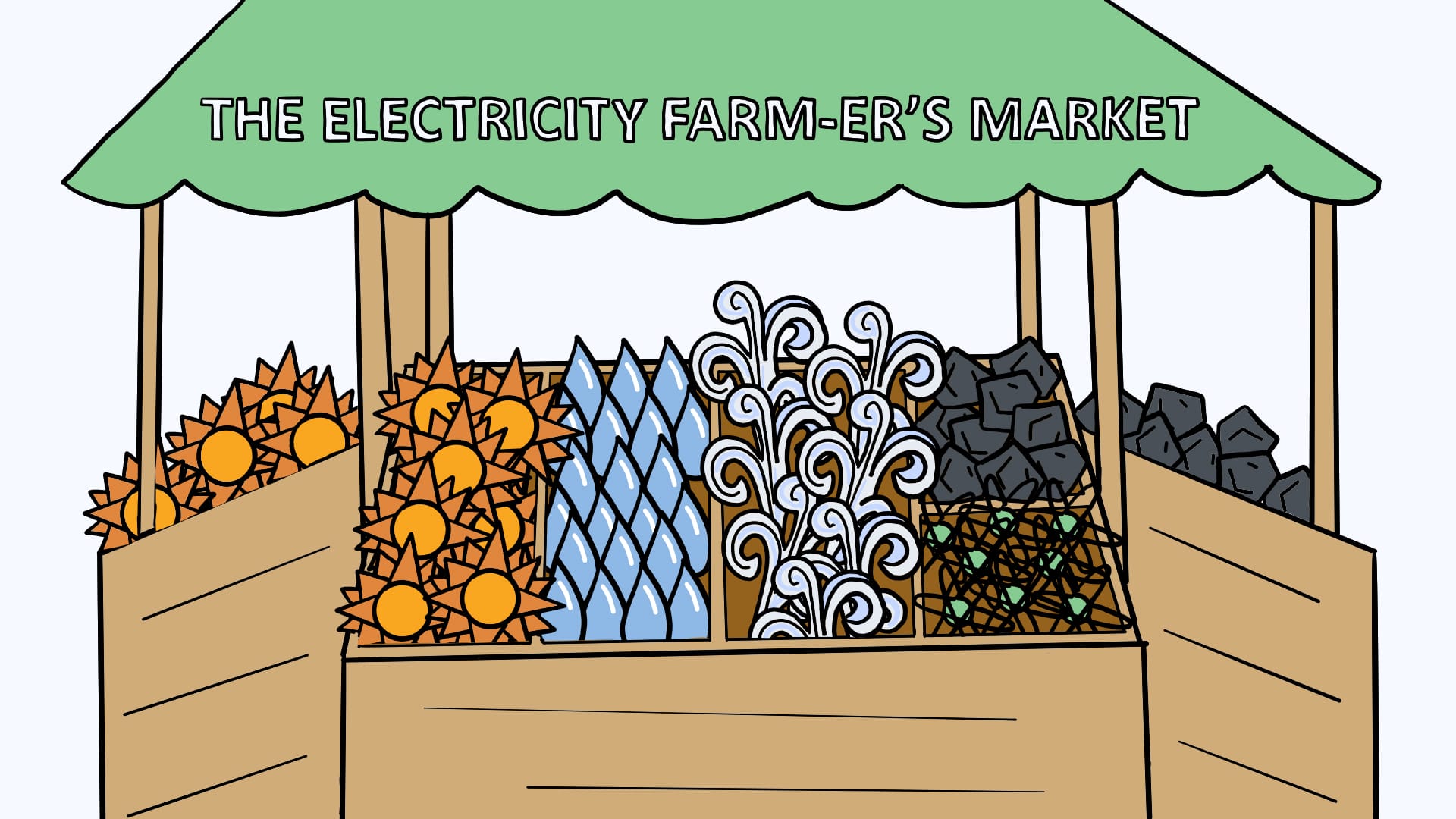
If you're a New Yorker, you may be surprised to learn that Con Ed does not generate your electricity. This is true of most of the big Investor-Owned Utilities around the country.¹
Instead, the majority of Americans buy electricity from for-profit companies called Independent Power Producers (IPP). IPPs own and operate the machines that produce power—mostly "natural" gas turbines and some renewables—and they sell what they produce at an electricity market.
An electricity market is kinda like a farmers market, with dozens of regional IPPs all hawking energy to customers... except for several key differences that subvert the whole metaphor:
- Residential customers don't get to pick which specific IPPs we buy power from.² There aren't any folding tables piled high with electric carrots and nuclear chard for sale by individual power farmers.
- Rather, all sales at the market are arranged by a third party called an ISO (Independent System Operator). The ISO's job is to make sure the cheapest electricity always gets sold first. And, since renewable energy is dirt cheap, the power made by solar, wind, nuclear, and hydro plants always sells out early. Renewables are like the apple cider doughnuts of the electricity farmers market.
- When the cheap stuff sells out, the ISO doesn't just close up for the day and ride the tractor on home: they tap into methane gas "peaker" plants, the dirtiest, most expensive energy producer we have.
Cool, so, we've got lots of power farmers selling homemade electricity at the market at prices they've set. Customers don't get to pick who we buy it from. So how is the price we end up paying for electricity determined?
One way to do it would be for everyone to pay the average price of all the electricity sold at the market that day. That'd be fair, right?
Not in America, buckeroo!
The way it works is that all the electricity gets priced the same as the most expensive watt of electricity sold at the market every day, regardless of how much cheap power was sold earlier.
It'd be like if the farmers market sold 500 granny smith apples for $.25 each and then a single Honeycrisp for $5... but everyone who bought an apple that day had to pay $5 per.
All of that's to say, when state- and public-sector orgs source their power from NYPA, it means more deliciously tart granny smith apples for the rest of us, and a smaller chance that the ISO taps into their secret cache of expensive, dirty, methane-y apples. No offense to Honeycrisp, the apple goat.
2. NYPA sells to munies, munies sell to folk
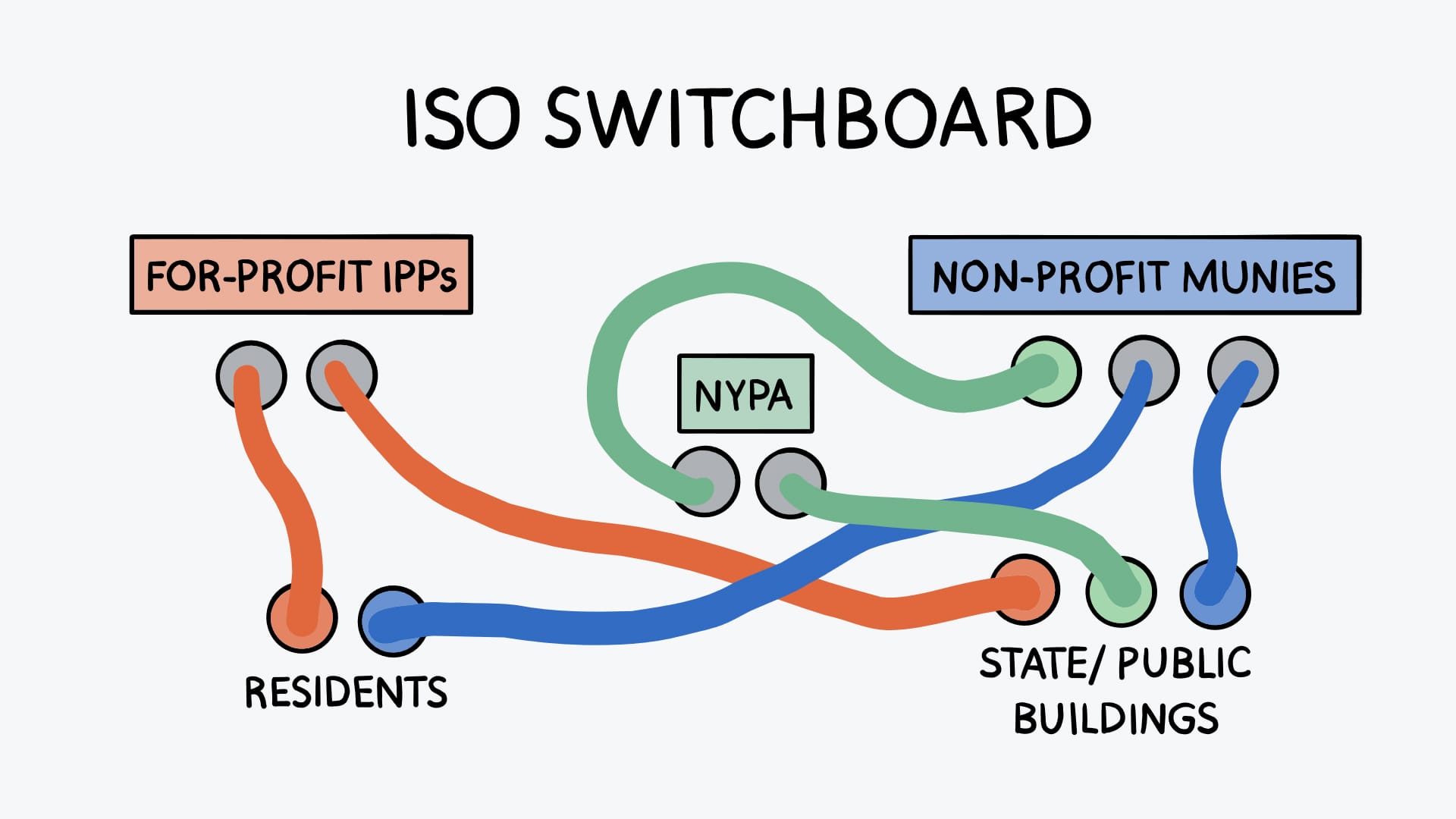
Municipally owned utilities and rural coops qualify as public-sector orgs, which means they can buy cheap power from NYPA and distribute it to their customers at cost.
...but why is NYPA's power so cheap, anyway?
Why is NYPA's power so cheap?
NYPA was founded by FDR to produce cheap hydropower electricity. The goal was for them to compete on price with the private utilities. Therefore, NYPA owns a lot of hydropower in upstate New York. Several gigawatts, plus "pumped storage", which is when you turn hydropower into a battery.
This foundation of guaranteed revenue partly explains why NYPA has been awarded an AA+ bond rating—among the best bond rating of any public utility in the country. Their sterling bond rating allows NYPA to borrow money for very low interest. NYPA can take out loans at around 3% interest and use the money to build renewable energy projects, which can be expensive upfront but then pay back your investment several times over.
NYPA needs to be doing way more of exactly this: using their amazing bond rating to take out huge loans that they turn into renewable energy.
Instead, at their board meeting yesterday, NYPA announced they're backtracking on their plan to build 7 GW, which is total bullshit. More on this next week.
BREAKING: @GovKathyHochul has cut 1.5 GW from the state's plan for public renewables. She claims to care about affordability, but she just got rid of 2500 good-paying green union jobs and took away utility bill discounts from thousands of New Yorkers. pic.twitter.com/c0pgy2Zwje
— Public Power NY (@publicpowerny) December 9, 2025
3. NYPA can directly lower energy bills for low-income households. But they're not doing it yet.
Included in the Build Public Renewables Act (BPRA) is a provision called that called REACH—Renewable Energy Access and Community Help. REACH turns a portion of the revenue NYPA makes from selling renewable energy into utility bill credits for low- and middle-income households in disadvantaged communities.
Awesome concept! Just a couple little snags:
- Despite the BPRA passing back in 2023, NYPA has yet to break ground on any of their renewable energy projects. They claim they'll get going in 2026. But until they're actually producing clean electricity, there's no money to be made, and thus no help for those who desperately need it.
- NYPA has not publicly articulated any of the details on how REACH will actually work. Like, how much revenue will go towards the REACH program? Who qualifies for the money? Which projects will fund the program?
It's all very opaque over there. Maybe that's because their CEO is a Republican and former lobbyist, appointed to his position by Governor Kathy Hochul. Maybe it's because utility companies are culturally very conservative, unwilling to act with the aggressiveness and urgency that this moment demands.
What we could really use is a new piece of legislation that makes NYPA's decision-making process more democratic. A bill that would allow knowledgable folks from outside the org to weigh in on how much public power we should be building, and how quickly it gets built.
You could call it something like, I dunno, The Public Power Democracy Act. Has a nice ring to it, don't you think?
Read part 3 of this series!
 Jon
Jon
¹ In about 1/3 of the country, utility companies are "vertically integrated", meaning they can generate and distribute electricity. The rest of the IOUs are distribution-only utilities.
² The sort-of exception here are RECs, which I've written about previously.

Member discussion