
A clean energy odyssey
Apologies for the late post this week! I was up in Albany, NY yesterday alongside 1,500 other pissed off people demanding Governor Kathy Hochul tax the richest people to ever live instead of the poor. It's pretty simple: Trump just gave the richest New Yorkers another $12 billion in federal tax cuts—it's one of the biggest wealth transfers in this country's history—right when New York City stares down a multibillion dollar budget deficit. We just want millionaires to pay a slightly higher share of taxes. They can afford it! Look at this chart:
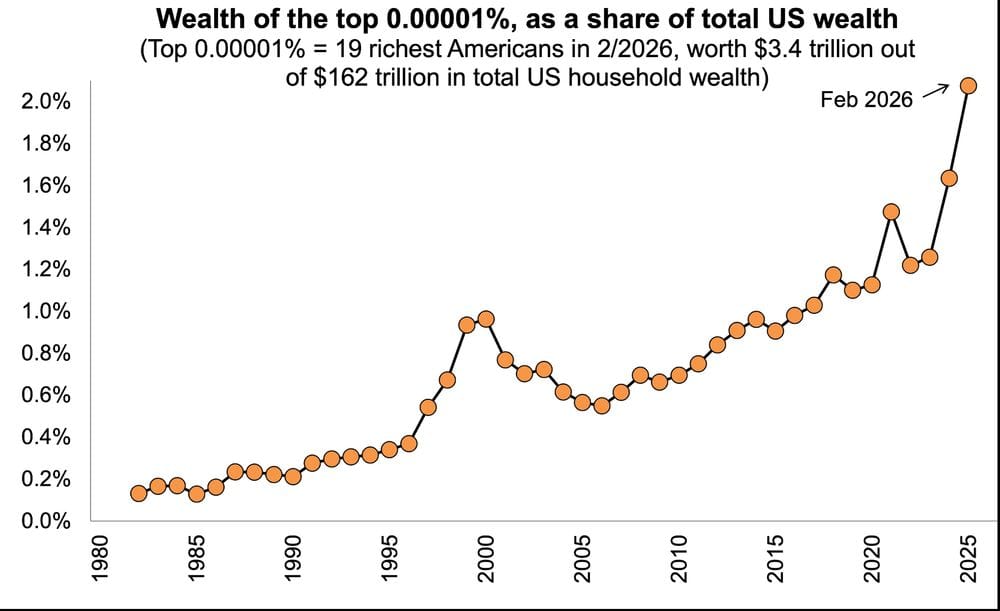
That jump from 2020 to 2025 is astonishing. 19 people in this country are hoarding $3,400,000,000,000. They did not "earn" this money. Being that rich is never a victimless crime. So they can pay for our goddamn childcare and bus fares.
If you agree, please send a letter on behalf of the Tax the Rich campaign. It only takes a second.
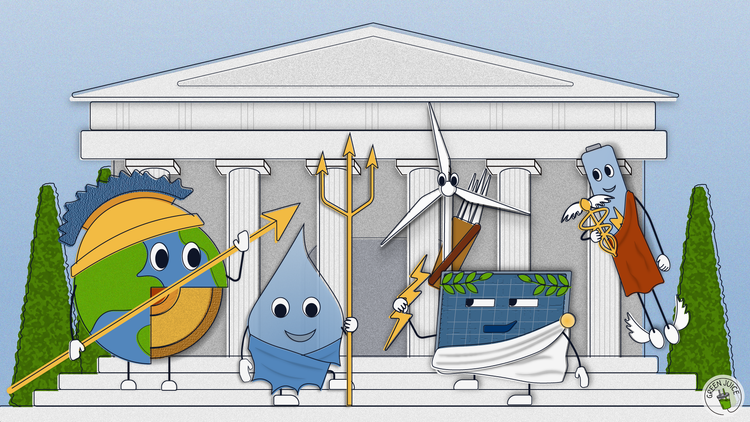
Welcome to the fourth and final installment of Mythology Month.
ICYMI:
Week 1: Climate Myths
Week 2: Wind Turbine Myths
Week 3: Minerals & Mining Myths
After three weeks in the wilderness, Green Juice sets sail for familiar shores, just as Odysseus came home to Ithaca after 20 years at sea. Let's hope we find fewer suitors plotting to murder our son and betroth our wife!
But we're not home yet. Miles of mythical treachery lie between us and a big can of beer from the bodega and a nice cute blogpost about NYC-DSA's many fun clubs and affinity groups or whatever I'll write about next week.
We're talking sirens. Sea monsters. Paedophiles.
So let's raise anchor, hoist the mainsail, consider the jib, so on and so forth... and away we go.
First stop: The Isle of Wright.
Myth 1: Clean energy is raising utility bills
U.S. Secretary of Energy, Chris Wright, recently blamed Biden-era legislation for causing all our utility bills to explode. The bill in question—Biden's Inflation Reduction Act—earmarked billions for clean energy investments. So maybe there's a whiff of truth here?
Let's just pop over to Chris Wright's Wikipedia page to see if he's an unbiased authority on clean energy...
Before leading the U.S. Department of Energy, Wright served as the CEO of Liberty Energy, North America's second largest hydraulic fracturing (fracking) company, and served on the boards of Oklo Inc., a nuclear technology company, and EMX Royalty Corp., a Canadian mineral rights and mining rights royalty payment company.[3]
My bias detector is picking up a scent!
(The fuck is a "mining rights royalty payment company", by the way? And did y'all see Chris Wright in Venezuela a couple weeks ago kissed a glass of oil? Is Chris Wright the actual Devil from Hell? I'm not sure, it's just something other people are saying!)
Wright is not alone. The President himself posted on his official social media account that wind and solar power are “THE SCAM OF THE CENTURY!” (caps lock his).
This is how conspiracy theories work. There's a legitimate problem—energy bills are rising fast and Americans increasingly cannot keep up—but neither the real explanation nor the best solution cohere with the goals of the rich racist guys running the world. So they blame something they don't like instead. And since these are powerful men with massive platforms, a nontrivial number of people will hear them and believe them.
So, what's the truth? Is clean energy responsible for raising our energy bills?
The truth: clean energy is slightly more expensive upfront but far cheaper in the long-run
I'll concede that clean energy projects sometimes have a higher upfront cost, or capital cost, than comparably sized fossil fuel technology. Here's a comparison of upfront costs per installed megawatt:
🌞 Utility-scale solar: $850k–$1.6M per MW
🌬️ Onshore wind: $1.3M–$2.2M per MW (typical range from industry reviews)
☠️ Gas combined cycle: $670k–$1.6M per MW
But once it's built, a solar panel requires only sunlight and occasional Windexing to operate. A wind turbine can churn out clean power for 30 straight years. A natural gas power plant, on the other hand, is completely useless without a worldwide system of pipes, drills, refining equipment, container ships, and lots of other crap just so it can operate at ~60% efficiency or worse.
Even the banks agree with me
Lazard, Inc. is a massive American investment bank operating out of 30 Rockefeller Place. Their CEO, Peter Orszag, recently lamented, "I'm sad to say the Democratic party is becoming increasingly anti-Capitalism."
So Lazard is not exactly DSA-aligned.
And yet Lazard's 2025 report on the Levelized Cost of Energy (LCOE), which "provides insights into the cost competitiveness of various energy generation technologies", found that utility-scale solar (i.e. 1 megawatt or bigger) and onshore wind remain the most cost-effective forms of new energy generation... even without subsidies.
As a refresher, LCOE measures the cost of an electricity generator over the course of its lifetime. That includes initial costs, any ongoing fuel costs, and operational and maintenance costs. I like using LCOE because it makes sense for society to measure infrastructure projects by how much they'll cost us in the long-run.
What LCOE ignores
But Levelized Cost of Energy leaves out one critical component: the environmental and health costs of air and climate pollution. These are not just abstract moral costs! There is a very real dollar amount associated with poisoning people. But for some reason, those particular costs don't get factored into the equation.
So I did a little back of the napkin math.
- Per the science journal Environment International, the average health damage cost from natural gas power plant pollution in the U.S. is $0.01–$0.02 per kilowatt-hour. Meaning, for every kilowatt-hour (a unit of energy) a gas plant produces, the associated pollution cost is one to two cents.
- That's actually the lowest health damage cost by far of the big three fossil fuels: coal costs an enormous $0.19–$0.45 per kWh, while oil costs $0.08–$0.19 per kWh
- Let's say we build a 500 megawatt gas-powered power plant. Let's say it runs 55% of the time. And let's say it runs for 30 years. These figures are all near the industry averages.
- Our 500 MW power plant will produce about 72 billion kilowatt-hours over the course of its lifetime. (Leave a comment if you want to see my maths.)
- At a price of one cent per kilowatt-hour, our power plant will incur $720 million in additional public health damage.
- At a price of two cents an hour, that cost balloons to $1.4 billion.
- If we add an extra billion dollars to the LCOE of gas plants, the cost jumps another 15–20%, making renewables even more competitive.
The reason LCOE doesn't factor in health damage costs is because the people building energy projects don't have to pay for that. Healthcare costs get passed onto you and me, buddy.
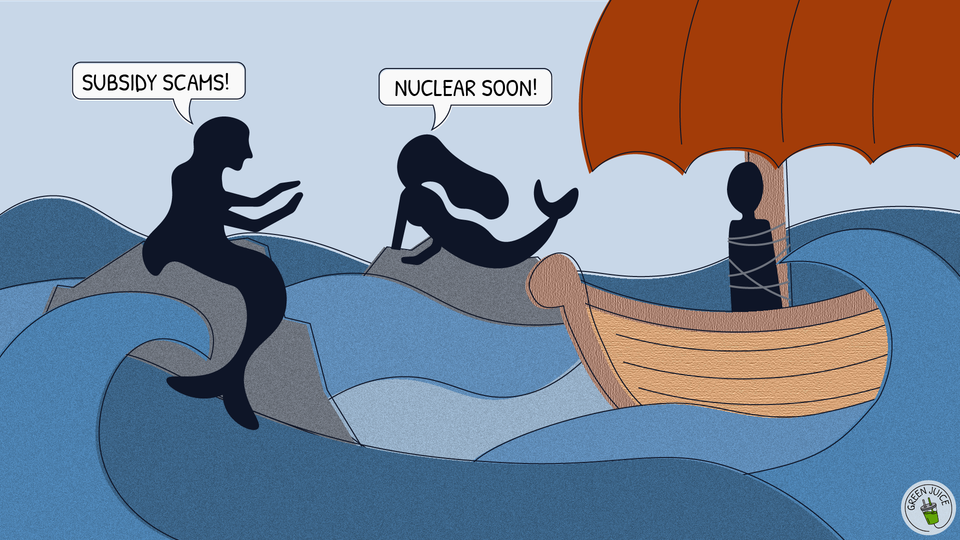
Speaking of which, let's change tack and depart for our next destination: the Sirens of Subsidy.
Myth 2: Clean energy is heavily subsidized
God, I wish!
Biden's IRA bill included around $369 billion for clean energy, which was to be spent over a 10-year period. Some of that was for tax rebates for rooftop solar and e-cars, some was for utility-scale solar and wind projects, some incentivized American renewables manufacturing.
Trump's tried (and continues to try) to rollback and cancel as much IRA money as possible. While much of it was already handed out or obligated, the Financial Times estimates Trump has put $70 billion of the IRA money under threat (and already killed 20,000 good green jobs as a direct result).
Let's assume there's still up to $300 billion in U.S. money allocated in some way to renewables.
Sounds like a lot!
But there's another side to this coin.
We've been subsidizing the fossil fuel industry for over 100 years
Indeed, the federal government has been propping up the fossil fuel industry since it's very inception.
And we're giving them more today than ever before.
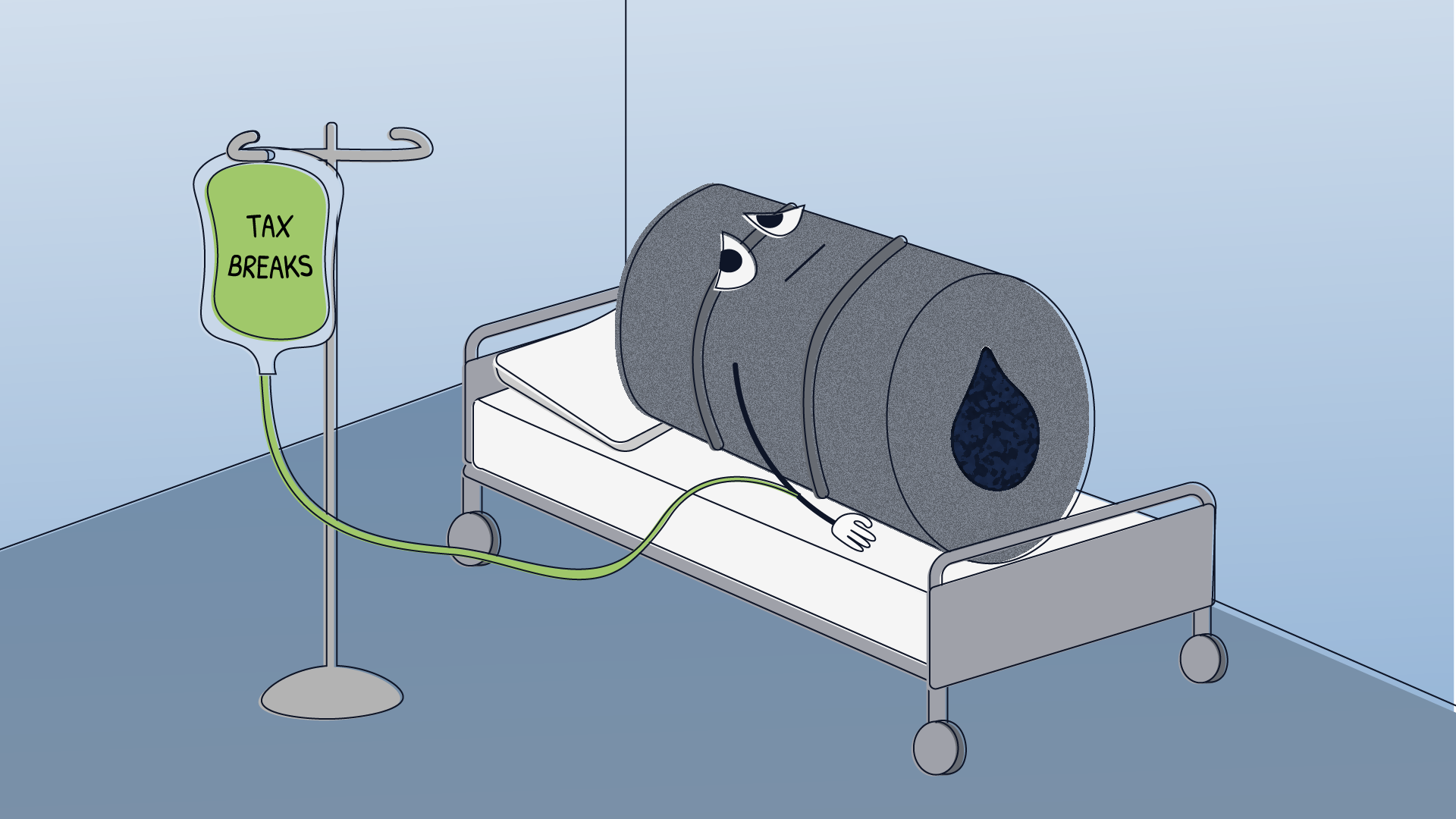
One conservative estimate puts taxpayer payout at $35 billion a year in 2025. America has been doling out at least $20 billion a year to our oil and gas companies since at least the early 2000s. Since taking office, Trump has increased that subsidy by another $4 billion.
...but once again, these numbers ignore the very real health costs associated with burning oil, coal, and gas, which fossil fuel industries do not pay for!
The International Monetary Fund divides subsidies into two categories: explicit and implicit. Per their 2023 report, they estimated the U.S. government paid only $3 billion in explicit subsidies in 2022, but spent a stunning $757 billion in implicit subsidies, which they define as "undercharging for environmental costs and forgone consumption tax revenues," i.e. poisoning the air we breathe and tax breaks for modern day oil barons.
It's tough to accurately measure just how much money our government has paid to or undercharged the corporations that've been knowingly destroying the planet since the 1970s. But it's probably in the tens of trillions of dollars.
So shut da fuck up about renewables, Chris Wright!!
Let's sail on. Our next opponent: the Myopic Cyclops.
Myth 3: Bills are rising, but it's not the utilities' fault!
Con Ed released their 2025 earnings, by the way. Congrats on another $2 billion in pure profits, fellas! Keep up the great work!
Okay, so if it's not clean energy's fault, then what is causing utility bills to rise?
Four things:
- Natural gas prices. In the first half of 2025, natural gas cost 67% more than it did the year before. That's because America's new energy strategy is to force the rest of the world to buy American-fracked Liquified Natural Gas (LNG)... which they don't really want. But we're sending it to them anyway, which leaves less for us. Over 40% of U.S. electricity is still generated by burning deadly natural gas.
- Demand for electricity is growing. This is largely due to energy-eating data centers, but it's also from good clean energy tech: e-cars, heat pumps, induction ovens, and electric water heaters. Electricity demand outpacing our ability to supply it = higher costs.
- Climate change. Climate change is raising energy bills two ways: it's causing more severe weather more frequently, which can and does damage grid infrastructure. (For more on this, read my piece on the wildfires in California.) Climate change is also making the planet hotter, duh, so people are using more A/C than ever before (see #2).
- Aging and insufficient grid infrastructure. Another two-parter: our energy grid (power lines, transformers, substations, etc) is getting old. Like, going to die soon, old. But even if it were brand new, we'd still need to build more of it to meet what's coming: the full-fledged electrification of our society.
For-profit distribution utilities, like Con Ed and PG&E, are responsible for maintaining the physical infrastructure of our energy grid. That's *all* they do. They're literally forbidden from owning electricity generation (though there are big loopholes to this).
"Ugh, we gotta build all this new grid infrastructure and it's gonna be sooooo expensive, we have no choice but to raise rates again!" the distribution utilities love to claim.
The thing is, the utilities have known about rising electricity demand for a very long time. Since the 1970s, probably, but they've known for sure since at least the early 2000s when the U.S. Dept. of Energy published a report called “Grid 2030, a National Vision for Electricity's Second 100 Years!" back in 2003.
It begins like this, by the way:
On February 6, 2003 President Bush highlighted the need to “...modernize our electric delivery system...for economic security...and for national security.”
Not sure the Republican line on that still holds, tbh.
Anyways. Con Ed and others were hip to this at least 20 years ago. Which means they should have gotten started early! They should have invested in growing and upgrading the energy grid at a reasonable pace while electricity demand was still flat, which it was for a long time. They should have, y'know, acted in the long-term interest of the people.
But when you've got a state-sanctioned monopoly, a guaranteed return-on-investment of nearly 10%, and your biggest investors are all massive investment firms, you don't necessarily give a shit about public interest.
Instead, you spend decades making record profits while deferring major grid transformation work till... somday, knowing you can just pass it on to your ratepayers to finance later.
And by later, I mean... now.
This excellent piece by Nick Bowlin in Harper's gets into the lurid details of this supposed public good—and the deeply suspect regulators who rubber stamp them.
 Nick Bowlin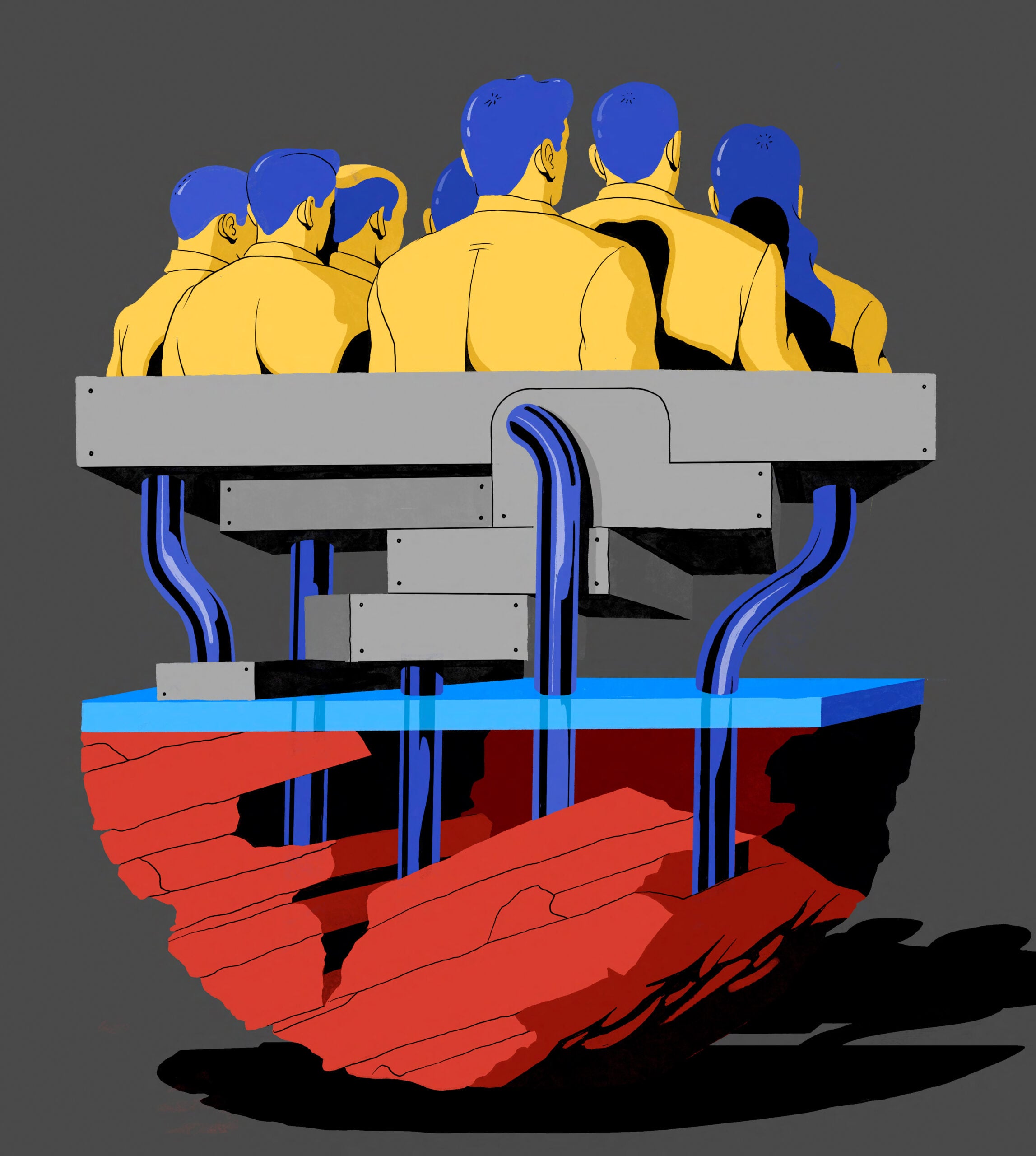
Well, I've already busted my word-count. But Mythology Month is nearly over and there are myths we've yet to bust.
Commence rapid-fire mythbusting, starting with... a trip to the Green Hydrogen Isthmus.
Myth 4: Hydrogen will be an important part of a renewable future
The world has been heavily investing in green hydrogen—$75 billion of investment in the past four years alone—with precious little to show for it. Making green hydrogen is expensive. And it looks like it's going to stay that way. Perhaps that's why one of the leading investors in the largely unserious hydrogen industry is... fossil fuel companies! Are fossil fuel companies sinking money into an industry they know will never work because it maintains the illusion they care about the environment? Again, I don't personally know, I'm just repeating what many, many people are saying!
If you want to learn more:
 SHARE
SHARE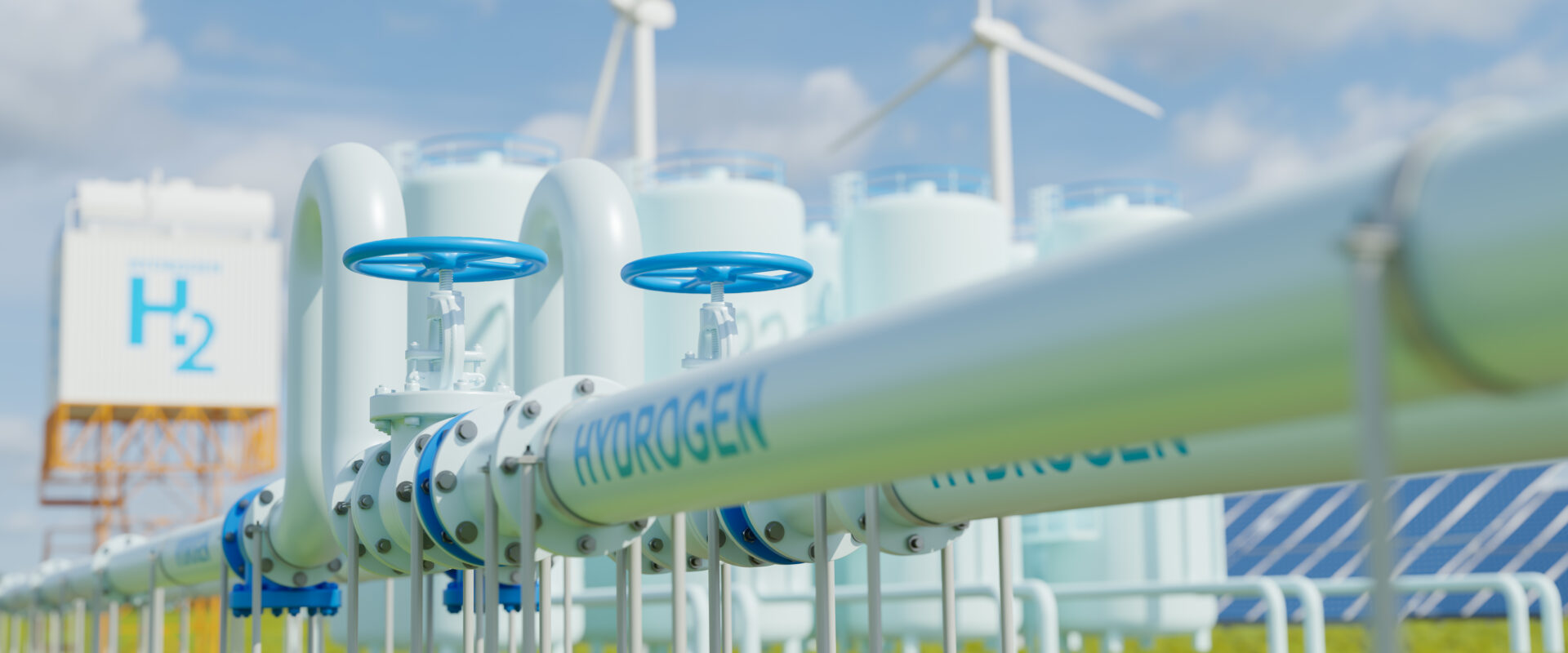
And finally, we make landfall at the last stop on our odyssey: The Mythical Land of Nuclear Fusion.
Myth 5: Nuclear fusion will be here soon, so none of this really matters
Ah, yes, nuclear fusion: the smashing together of atoms at insanely high temperatures to create miniature suns that can produce ginormous amounts of energy with zero emissions.
Sounds pretty good!
Unfortunately, despite there always being some supposed new breakthrough in the form of a press release from a fusion startup, the experts still don't think nuke fusion will be a reality on any meaningful scale until the 2050s at the earliest.
 Meris Lutz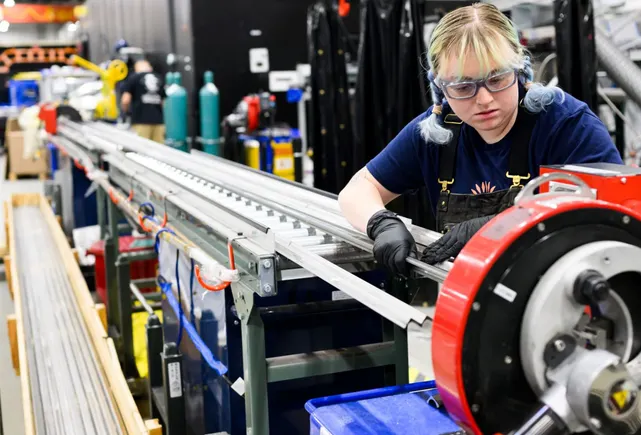
But that won't stop utilities from investing our money in it! Better to hope for a miracle (that you'll be able to profit from) than pursuing the one real solution we have to the problem of runaway utility bills. And that is... Publicly owned renewable energy!
A publicly controlled energy system cuts out the investment firms pushing to ignore the obvious cheap wins. It cuts out the for-profit utilities who have ignored reality for decades just to print more money. It cuts out the influence of Big Dystopia lobbyists putting money in our politicians pockets to pretend this isn't an option.
Instead, we invest in building an absolute fuck-ton of the cheapest form of energy humankind has ever produced: wind, solar, and batteries.
Public renewables is the only way out of this mess. I hope you see that, too.
Myth = BUSTED
Whew. And that does it, folks! If you've followed along for the whole ride, I commend you, I knight you, I hoist you upon my shoulders (if you're comfortable with that.
Next week's post will be more chill.
And in two weeks, Green Juice hits a very special milestone... our one-year anniversary!
Till next time, busters.
Member discussion