
Tilting at wind turbines
Welcome back to Mythology Month. If you missed last week's utter annihilation of 5 climate change myths, check it out here.
Today we strike down 5 more myths swirling around Donald Trump's least favorite form of clean energy: wind.
I haven't written about wind before! When we started Green Juice last March (we're approaching one year 👀), the U.S. wind industry was in dire straits. Trump had issued an executive directive on his first day back in office halting federal approvals for all wind energy projects. He later issued a stop-work order on five major East Coast wind projects already under construction, citing unspecified "national security risks".
But wind energy is picking back up. Like the blade of a wind turbine located outside of Justice, West Virginia during a gusty summer breeze, the moral arc of the universe bends towards justice. I'm happy to report all five halted wind projects have recently been given the green light to resume construction.
So, at the risk of being a little long-winded...
*dry cough*
Let's begin with some wind energy basics.
Wind energy 101
Wind turbines—that's the official name, but you can still call them windmills, I don't mind—are an amazing technology: cheap, efficient, long-lasting, and over 90% recyclable.
Around the globe, wind turbines generate more energy than solar panels. Over 10% of the world's energy last year came from wind. Denmark, the world's windy winner, generates over 50% of its energy from wind turbines.
What's old is new again
The first electricity-generating wind turbine was invented by an Austrian named Josef Friedländer way back in 1883.

Remarkably, Friedländer's invention wasn't too far off from the way wind turbines work today: the wind pushes the blades, the blades turn a hidden rotor shaft, and the rotor shaft spins a generator. Inside the generator are magnets and copper wire. When the generator spins, the magnets rotate around the wire and, for reasons I will never fully comprehend, this act produces Alternating Current (A/C) electricity out of thin air.
Fun fact: spinning a generator to make electricity is the end goal of basically every form of electricity generation there is, with the notable exception of photovoltaic (PV) solar panels. Gas and coal power plants, nuclear reactors, geothermal wells... all they're really doing is producing steam, which we use to... spin generators!
How does the wind move those big blades?
You don't need to be a conspiracy theorist to wonder how anything short of a hurricane-force gale can make those huge blades rotate.
Three reasons why:
- The blades are shaped like airplane wings; wind accelerates over them but hits resistance under them, which creates lift
- Modern turbines rotate to face the ideal direction; built-in sensors tell them where the wind is coming from
- Turbine blades don't need to spin very fast to make electricity; there's a second, high-speed gear inside the turbine's gear box that spins much faster
This short video illustrates all this and more:
Turbines are getting bigger. Much bigger.
Though the core mechanics remain the same, we've come a long way from Friedländer's original turbine. We've designed more efficient blades and generators, figured out how to construct turbines on land (onshore wind) and at sea (offshore wind), and we learned how to engineer absolutely freaking huge turbines—because the bigger and taller the turbine, the more energy it can produce.
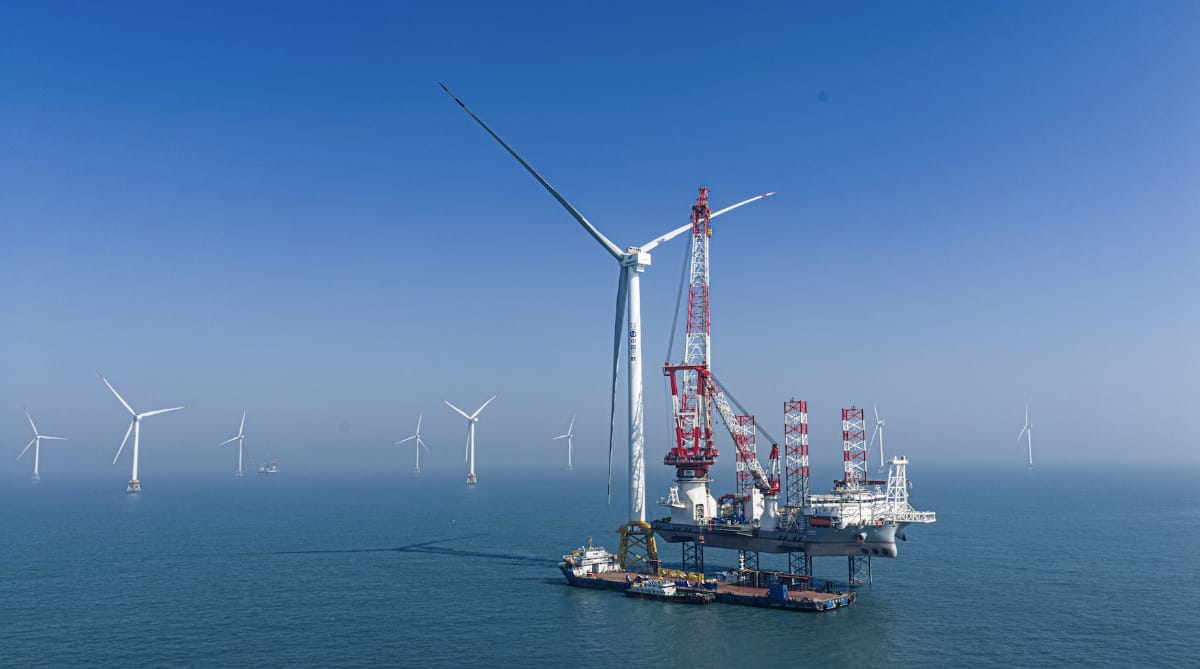
How huge we talkin'? In January, China turned on the beefiest wind turbine ever, a 20-megawatt behemoth now floating—yes, floating—30 kilometers off the coast of Fujian. Capable of powering 44,000 homes a year by itself, the turbine is the height of a 58-story building; it's 147-meter-long blades sweep an area the size of 10 football fields.
Turbines are getting cheaper. Much cheaper.
Like solar panels and batteries, wind turbines take advantage of manufacturing learning curves. As a result, turbines have gotten drastically cheaper to produce and install over the last 20 years. In 2024, onshore wind had the lowest LCOE (Levelized Cost of Energy) of any form of electricity generation on the planet at just $0.034 per kilowatt-hour.
 Jon
Jon
No clue what a kilowatt-hour is? Check out this post.
Why so much ill-will towards wind?
Wind is cheap, efficient, and clean. And yet wind turbines are subjected to some of the wildest mythologizing in all of clean energy.
So what is it about wind that makes people go nuts? Is it the cultural legacy of Don Quixote tilting at windmills? Is it their sleek, vaguely alien appearance? Or is it the fact that cheap wind is a direct threat to the future of the fossil fuel industry?
Probably that last one, yeah.
But whatever the reason, myths about wind abound. And the worst offenders have routinely been muttered in semi-coherent soundbites by the most powerful man in the world.
The President of the United States has said the following things about wind energy
- Wind turbines "cause cancer"
- "You want to see a bird cemetery? Walk under a windmill sometime"
- Wind turbines are "driving the whales crazy"
- "If you have a windmill anywhere near your house, congratulations, your house just went down 75 percent in value”
- Wind energy isn't truly "green"
What a guy, haha. He should probably [50 lines of redacted text]
Folks, it's finally time to lower your lances. We're busting up every lie (about wind, anyway) that Trump has told.
Myth 1: Wind turbines cause cancer
Trump's beef with wind turbines seems to have begun in 2006, when he was unable to prevent a wind farm from being built off the coastline of one of his golf courses in Aberdeen, Scotland.
I mean... maybe the guy had a point? Just look how hideous this is:
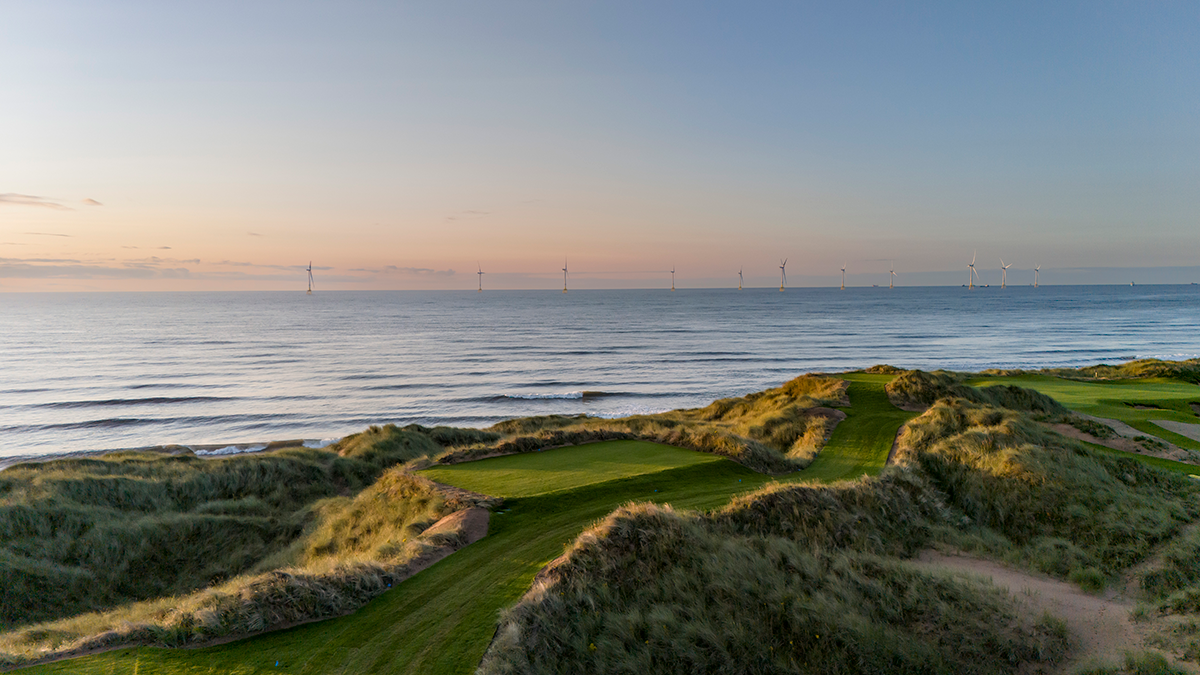
Hm? Wassup? You can barely see the wind turbines in the distance? They're not even close to the shore? To claim they're somehow spoiling the natural beauty of a golf course is patently absurd?
Interesting.
There is zero evidence wind turbines cause cancer. Even the failing New York Times agrees.
What about Trump's other claims?
Myth 2: Wind turbines kill birds
The sad fact is that birds are dying in record numbers.
Since 1970, North American bird populations are down by more than 3 billion birds. The skies were once full of sweet singing songbirds. No more. Their sudden disappearance is one of the clearest examples of species destruction that climate change has wrought on this continent.
But it's not because of wind turbines.
The #1 cause of bird population loss is habitat destruction. Every year, millions of acres of bird habitat are destroyed or degraded due to land development, agriculture, and forestry practices, per the U.S. Fish & Wildlife Service.
The #2 cause of bird death is wittle kitty cats.
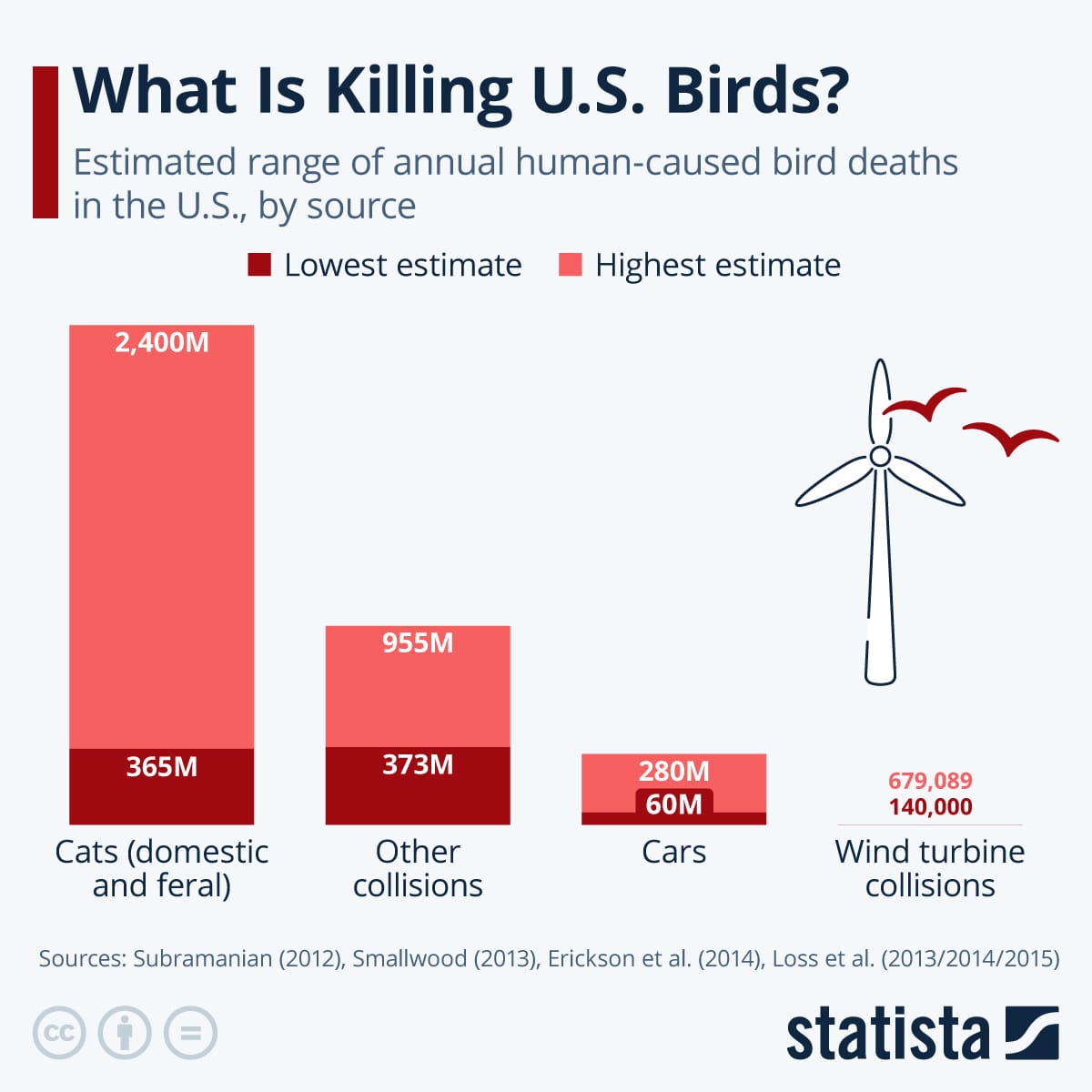
Outdoor cats are bird-killing machines.
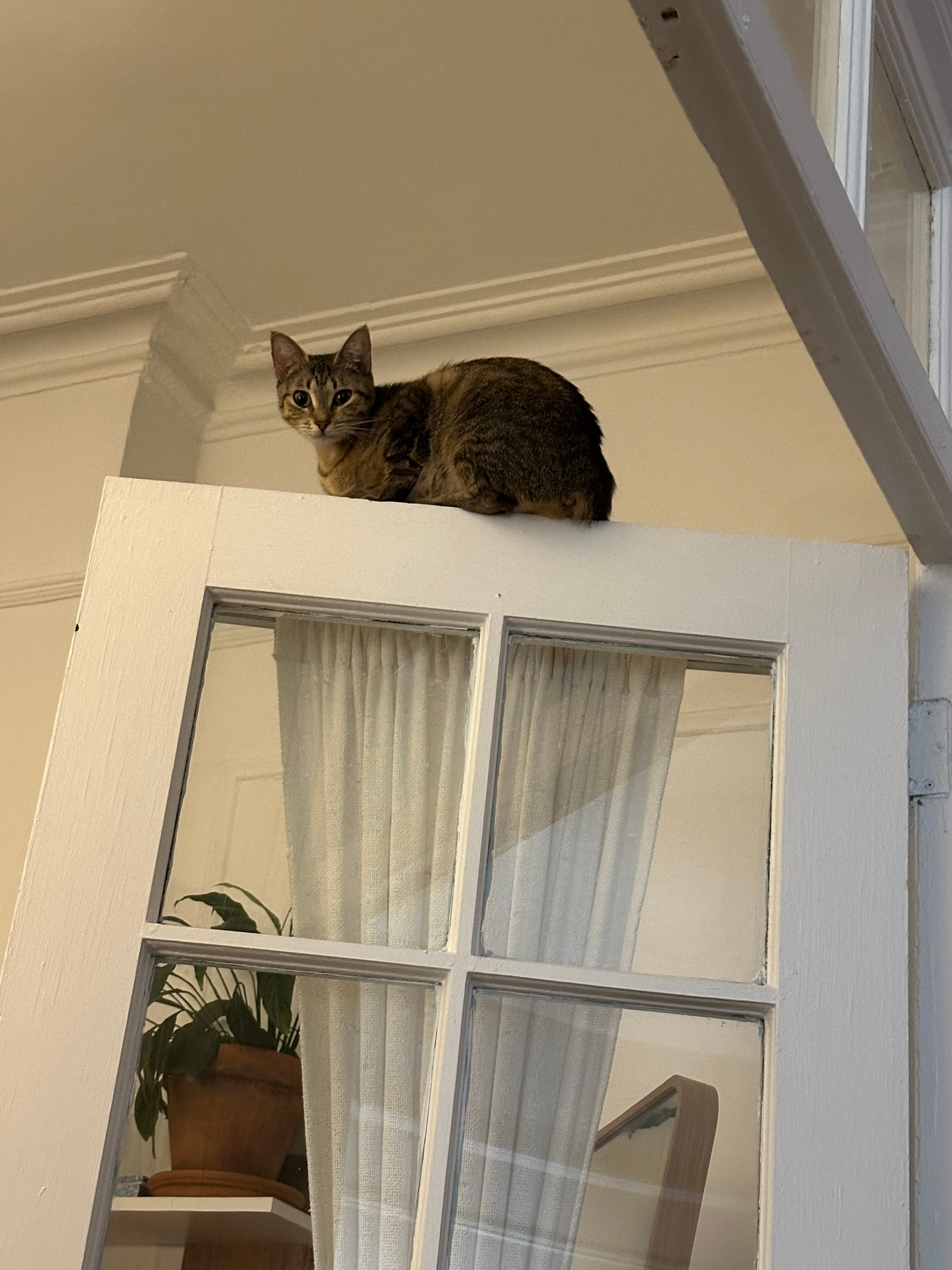
Because I try to practice what I preach, I scheduled a meeting with Abby the Intern. The Green Juice HR department was in the room (I serve as interim HR director). We asked her straight up how many birds she murdered when she was living on the mean streets of NYC.
Rather than engage with my question in good faith, Abby scampered up a curtain and plopped down atop a doorframe, refusing to come down even for snack. I'm no body language expert, but I don't love what I'm seeing here.
Anyway, wind turbine collisions do kill some birds, it's true. That's why scientists are working on solutions to reduce bird strikes. One idea is to paint stripes on the blades to make them more visible, which I think would look nice.
But we should keep the big picture in mind. Building more wind farms could potentially save up to 70 million birds a year, because wind energy doesn't pollute the air or require vast tracts of habitable land to be destroyed. Fancy that.
Myth 3: Wind turbines make whales crazy
It kinda sounds like Trump just freestyled this one. But this is actually a disinformation narrative that’s been deliberately spread by a network of fossil fuel interests and astroturf groups who have been cultivating ties with MAGA politicians over the last ~3 years.
And yet per our own government, "There are no known links between large whale deaths and ongoing offshore wind activities."
There is, however, a known issue with offshore wind and marine life. It relates to installing the turbines. Nearly all offshore wind farms today aren't floaters—they're anchored to the seafloor. (Floating wind turbines account for less than 5% of offshore wind projects, though the practice is growing.)
Anchoring a turbine is done by pile-driving, i.e. hammering, big steel tubes down into the seafloor. It's a noisy endeavor, as you can imagine. That's why NOAA recommends avoiding installations when migratory whales are likely to be in the area.
Doesn't hammering a big old steel tube into the seafloor mess with fish habitats, you may be wondering?
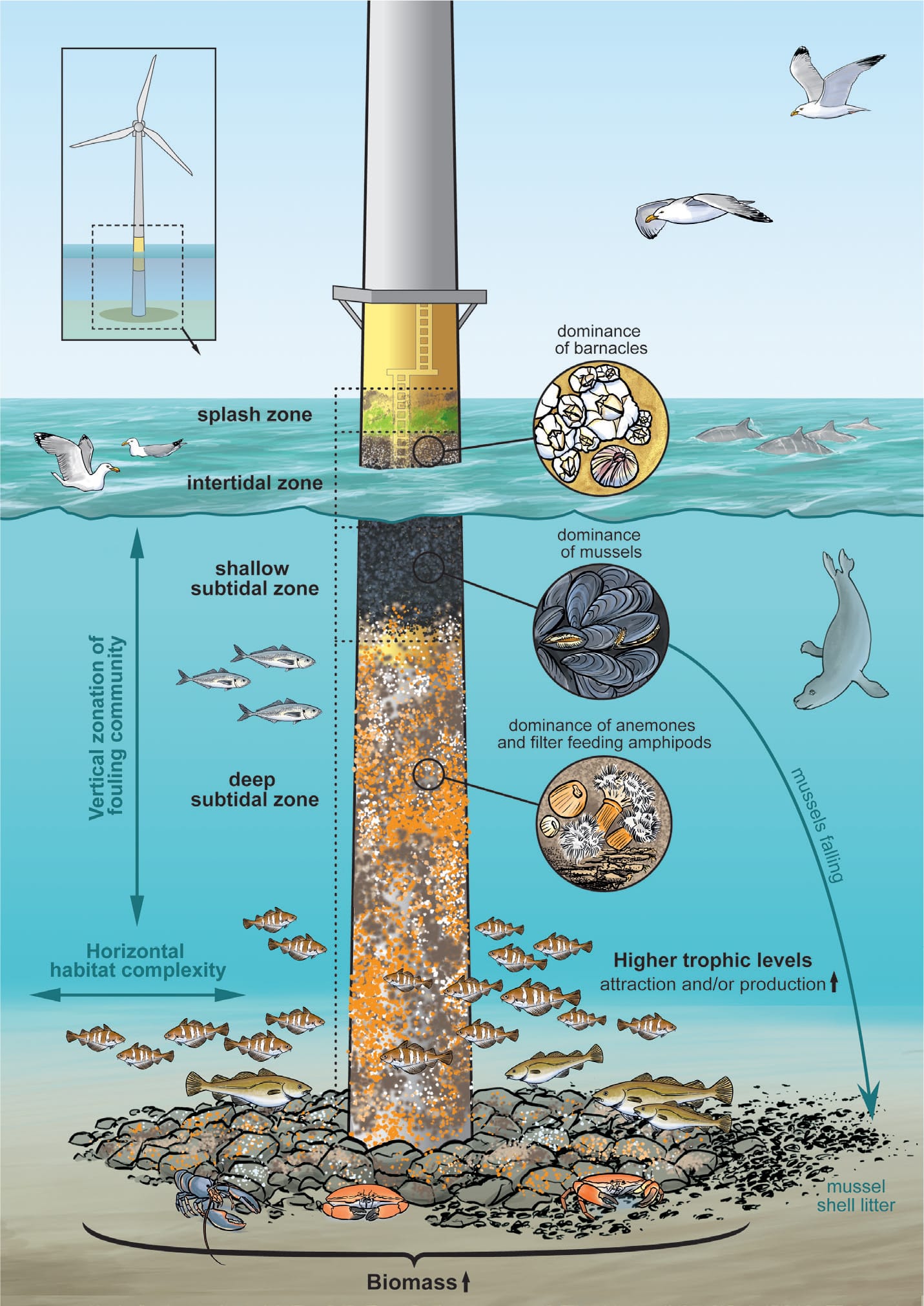
Temporarily, yes. But soon enough, the opposite becomes true. The tubes transform into artificial reefs that provide new habitats for marine life.
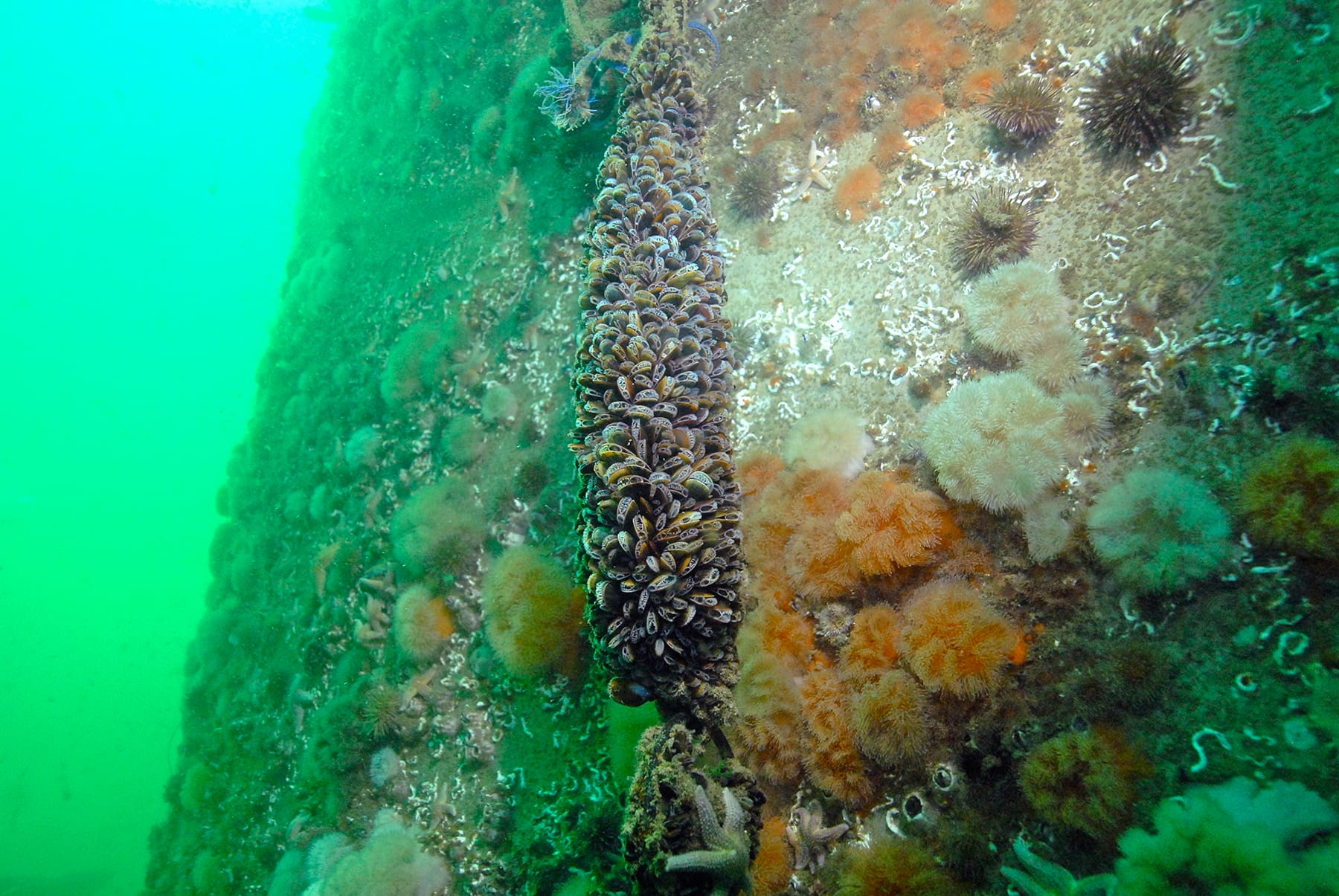
An illustrative quote from The Oceanography Society:
The response begins with dominant suspension feeders that filter organic matter from the water column. Their fecal deposits alter the surrounding seafloor communities by locally increasing food availability, and higher trophic levels (fish, birds, marine mammals) also profit from locally increased food availability and/or shelter. The structural and functional effects extend in space and time, impacting species differently throughout their life cycles.
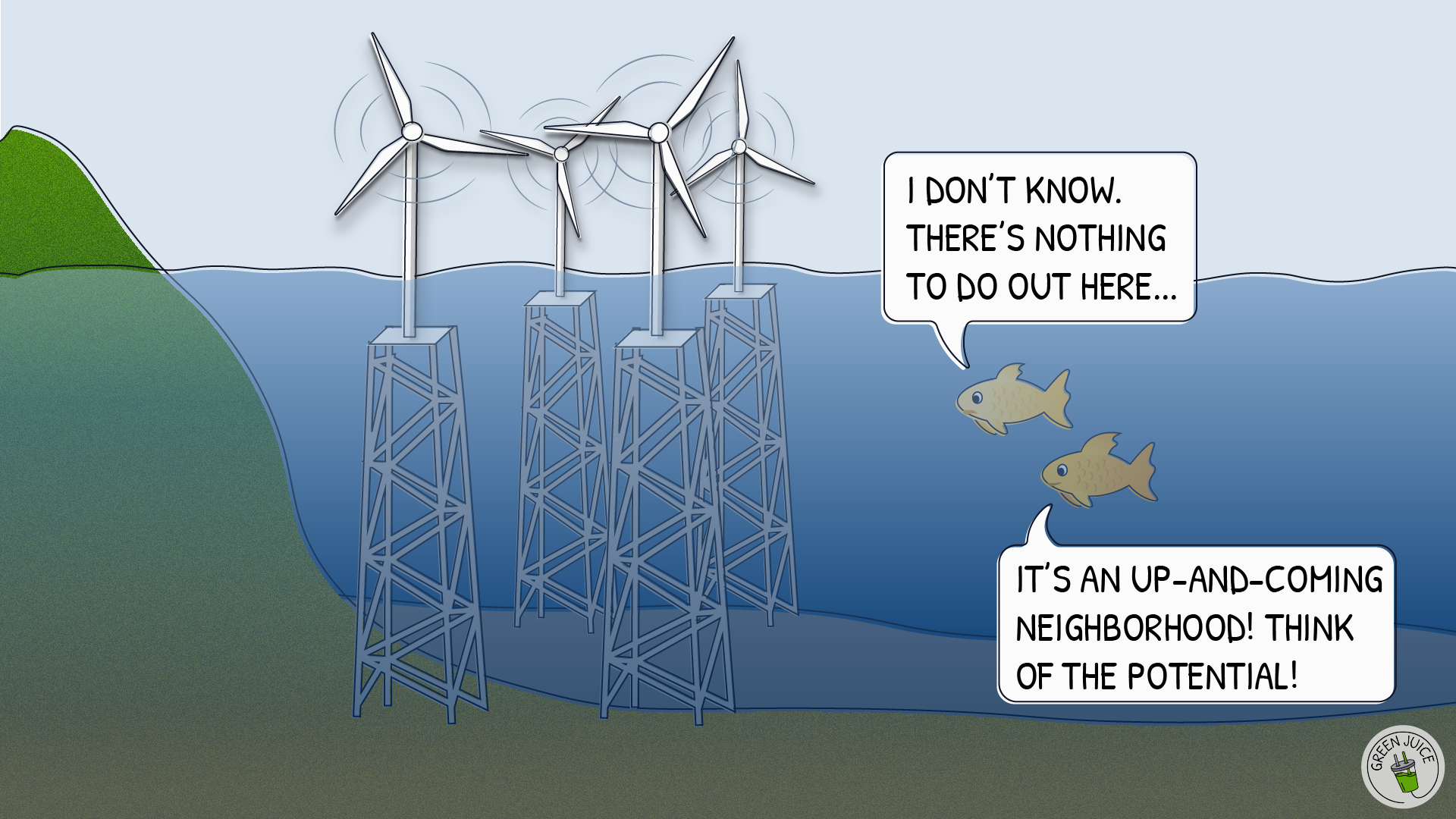
One more graphic, just 'cause I think this is really neat:
Myth 4: Living near wind turbines lowers property values
Once again, our own government has put this myth to bed.
A major study by the Lawrence Berkeley National Laboratory looked at nearly 7,500 home sales near wind farms and found no consistent, measurable long-term impact on home prices from proximity to turbines.
Some recent research did find a temporary drop in value for homes located within one mile of a proposed wind project right after the project is announced—but prices rebound within a few years after construction and operation.
Y'know, once it becomes clear that insane whales won't start washing up on your front yard.
Myth 5: Wind turbines aren't truly green
Here's Trump's full quote: "When they start to rust and rot in eight years you can’t really turn them off, you can’t burn them. They won’t let you bury the propellers, the props, because there’s a certain type of fibre that doesn’t go well with the land.”
Not one word of this is true. Per The Guardian:
Wind turbines have a typical lifespan of 20-25 years, and the industry is getting better at recycling old parts; according to the National Grid, 96% of a wind turbine is made from recyclable materials. Their outer shell, shafts, gearing and electrical components are typically made from steel, copper, aluminium, other precious metals and recyclable plastics. The blades are made from fibreglass, which is not biodegradable and is indeed typically sent to landfill. However, scientists have found a way to repurpose them into cement, and the blades have been used to create pedestrian footbridges in Ireland and noise barriers for highways in the US.
I hope that settles it.
For more information about how scientists and engineers are solving the problem of clean energy infrastructure and minerals recycling... well, you're gonna have to wait till next week.
May the wind be at your back!
Read part 3 in this series!
 Jon
Jon
Member discussion