
Electrify Everything
Hey, check out this chart:
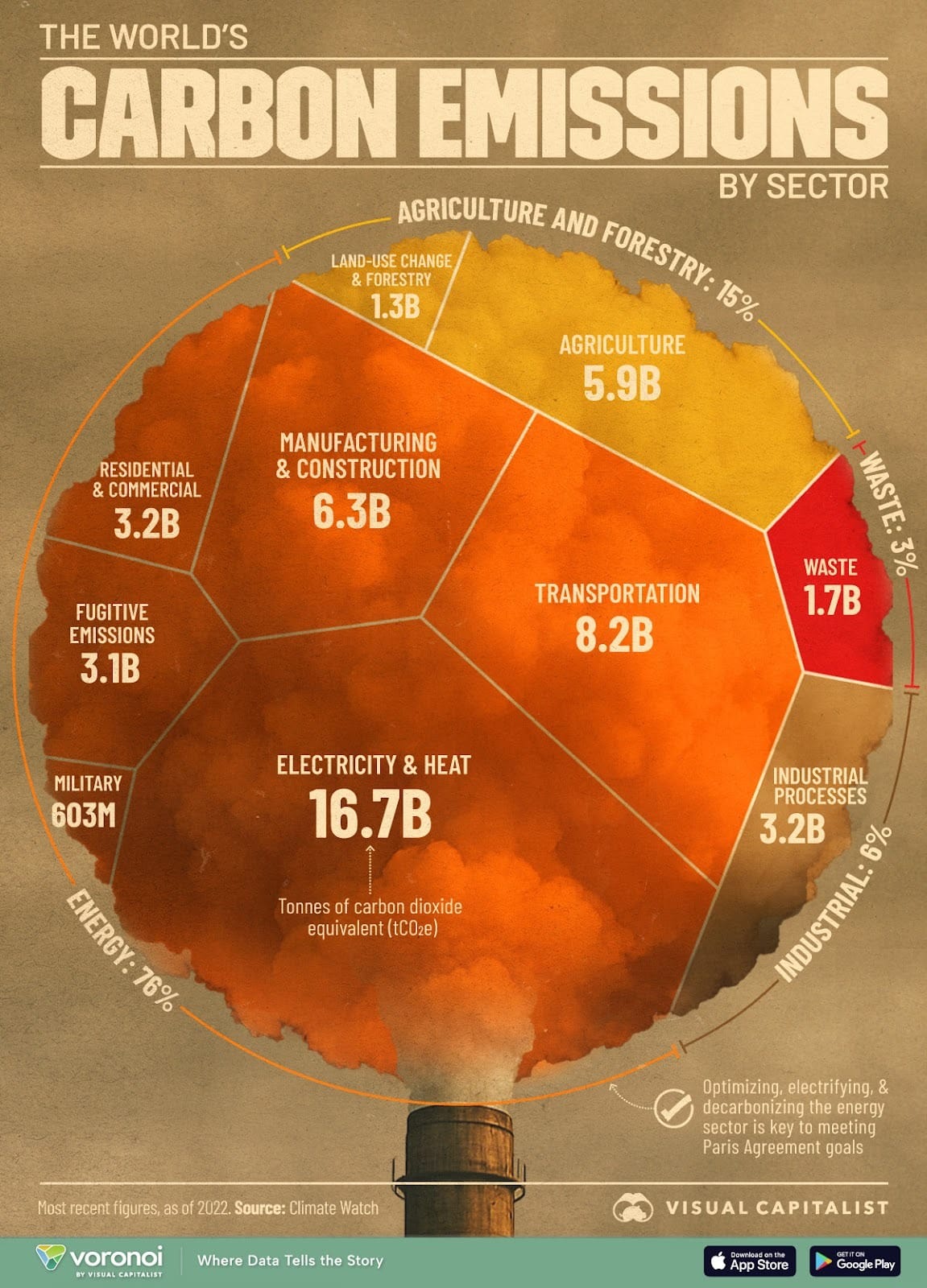
Lots of orange!
What that means is the biggest piece of our pollution pie isn't cow burps, landfills, or industry, though each is a key contributor to climate change and must be dealt with.
But no, the biggest category of pollution is Energy: burning fossil fuels like coal, oil, and "natural" gas to heat our homes, fuel our transportation, and generate dirty electricity.
Therefore! The single most impactful thing we can do to slow down climate change is to stop burning the goddamn fossil fuels.
That's the crux of the clean energy transition. If we quit pumping up, refining, shipping, and burning fossil fuels, we can reduce our greenhouse gas emissions by nearly 80%. That's most of them, folks!
How do we do that? Simple. We must Electrify Everything.
The Plan: Electrify Everything
In practice, this means two things:
- Replace everything currently powered by fossil fuels with a fully electric alternative. Gas car? Get an EV. Gas boiler? Switch to a heat pump. Gas oven? You'll love your new induction oven! Many of these technologies have advanced by leaps and bounds in recent years. They're no longer just greener; they provide a superior user-experience.
- Change how we generate our electricity from fossil fuel powered generation to renewable sources. Today, we make most of our electricity by burning methane gas (and some coal, still) to create heat, which we use to spin a magnetic generator. That's how the sausage gets made, folks! Spinning a big old magnet. But we can make electricity other ways: with solar panels, wind turbines, geothermal power, hydropower, batteries, and more.
There's some good news on this front. The energy transition is already well underway. If you, like me, live in America, you maybe haven't heard that last year nearly 50% of the world's electricity generating capacity came from renewable sources. 50%! That's huge!
In the U.S., we now generate about 25% of our electricity from renewables. That's not terrible, though, especially with the Trump administration doing everything they can to stop it.
The thing is, Trump can't stop it. He can slow it down, but he cannot stop the energy transition. That's for one simple reason: solar panels, wind turbines, and batteries are now the cheapest form of electricity generation humankind has ever produced. This was not the case even just a few years ago. But these incredible technologies continue to get cheaper and more efficient with every passing year and show no signs of slowing down.
Solar and batteries are the very best electricity option for nearly everyone on the planet. That much is now indisputable.
Right. So, we get off fossil fuels and use electric stuff. Sounds simple, right?
There are just a few problems.
The Problems
1. Our energy grid is totally fucked
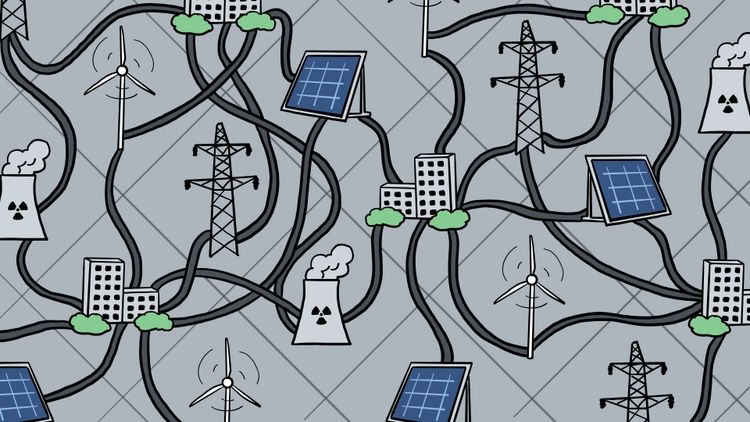
Our energy grid—often referred to as just the grid—is a vast constellation of incredibly complicated infrastructure: high-voltage transmission lines, substations, transformers, and lower-voltage distribution lines that move electricity around, change its voltage and current, and generally get it from wherever it’s made to wherever it's demanded.
How the grid does all that is interesting (to me, anyway...), but not important right now. There are, however, a few things you should know:
2. The grid has a finite capacity
Electricity isn't like WiFi. We can't just beam it from a solar farm in Upstate New York down to my apartment in Brooklyn. Electricity must be physically moved from place to place. The way we do that is with power lines.
Power lines, unfortunately, have a maximum amount of electricity they can move at a given time. Imagine a garden hose: it would take a long-ass time to fill up a swimming pool with a garden hose because the hose can only move so much water per second. You could add more hoses to mix, or use wider hoses. But you can't force more water into a standard garden hose that it can fit or it'll explode and floor your house.
Same thing is true with power lines, except when they get too overwhelmed with electricity the whole system shuts down (as a way to prevent it from literally exploding). That's how blackouts happen.
All that to say, our energy grid has capacity issues. It's got them right now, in fact. And if our plan is to electrify every single part of our world? Well, our capacity issues are only going to get worse unless we add hella more hoses.
Here's another problem:
3. The grid cannot store electricity
This one is tricky to understand, because electricity in America is so readily available. We flip a switch and the light turns on. But what's going on behind the scenes is actually kind of insane. That's because the grid cannot store electricity.
The electricity that powers the light bulb when you flip the switch is not coming to your home from a giant reservoir, like tap water. It would be super helpful if it did! But it doesn't. What actually happens millions of times a day all around the world is far stranger: every single watt of electricity we use is generated the instant we flip that switch, in real-time, and comes to our homes via power lines at the speed of light.
Not only that, but our energy grid is incredibly finicky. It must stay perfectly balanced at all times: demand for electricity (i.e. flipping on a light switch) must always match the amount of energy being generated (i.e. a gas plant firing up to spin the generator). If there's ever too much electricity on the grid, or too little, we get big problems.
The grid, they say, is the most complex machine ever made.
So what do we do about this?
Well, if demand for electricity is going to keep growing—and trust me, it is—we should probably add more power-generating renewables to the mix, so that when you want to turn on the lights there's enough electricity to go around.
This brings us to our next problem:
4. The queue to get connected to the grid is years long
For many reasons, building renewables in this country is hard. But the biggest challenge of all is that even if you manage to build the project, you're not done yet: you need to plug it into the grid. That's a process called interconnection, and in America it takes absolutely fucking forever.
New energy project proposals can wait up to seven years (!) to get approved for an interconnection to the grid. There are over 2 terawatts of energy projects—the equivalent of ~2,000 nuclear reactors—waiting to get approved by their local grid operator or utility (it depends on where you are) to plug your project in.
98% of those 2 terawatts stuck in line are solar and wind projects.
To put that terawatt number into perspective, there are only 1.25 terawatts of energy total on our grid today. That means there are more proposed energy projects waiting for approval than there are currently in operation.
Who approves these interconnections, and what’s the hold up?
That’s a subject for another post—have you subscribed to Green Juice yet??—but suffice it to say, we need to make it much easier to get clean energy projects approved.
But let's say we fix that issue and make it much easier to get renewables onto the grid.
We encounter yet another problem.
5. Wind and solar production is "variable"
Annoyingly, solar panels only work when the sun is shining and wind turbines only spin when the wind's a-blowin'. So even if we built a shit-ton of wind and solar farms and they all got approved for grid interconnections, we still wouldn’t be able to meet our electricity demand. At least not at night.
Guess what else is highly variable?
6. The grid is also highly variable
People use different amounts of electricity at different times of day, depending on the season. A Texas summer evening at 7pm, when everybody gets home from work and starts watching football and cooking chili and blasting their A/C all at the same time, is an example of intense electricity demand, or what’s known as a peak.
But electricity demand rises and falls throughout the day, every day. Generally speaking, we use a little when we’re sleeping, more when we wake up, less again during the middle of the day, and the most in the evenings.
So, knowing that power lines can only carry so much electricity at any given time, how do we deal with these peaks?
The answer may disgust you!
7. We meet peak demand today by firing up very dirty, very expensive gas power plants
Whenever demand on the grid peaks, utility companies fire up special gas power plants called peaker plants to make sure we can all watch The White Lotus Season 7 on Sunday nights in our air-conditioned, palatial American homes.
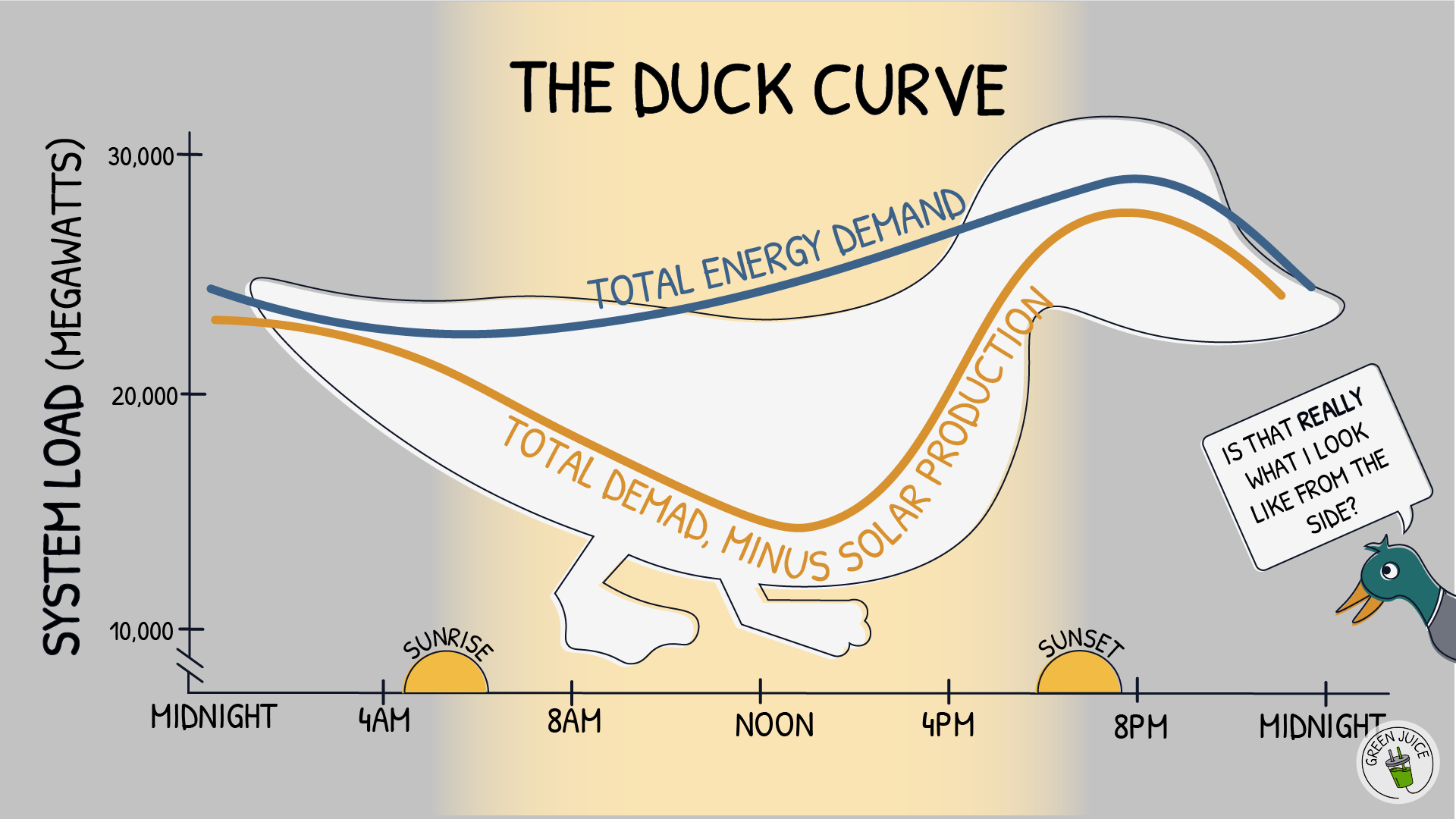
Perhaps you see the conundrum: the times of day that solar panels produce the most energy—aka "daytime"—does not line up with our intense nightly electricity demand. There's actually a name for this phenomenon: the Duck Curve. So-called, because when you compare our total energy demand with and without the addition of solar power, the two lines on a graph look (sort of) like a duck. Solar can supply most of the power we need during the day, but it needs to be offset after dark. Wind turbines can help here, but it depends on where you live.
So what do we do? Can we, say, build a bunch of batteries to store the electricity we make during the day for use later on? Are there other ways besides batteries to store energy? What about less variable ways to produce clean energy? Can we build out more grid infrastructure, or improve the existing grid so it works better? And, hey, don’t electric vehicles have giant batteries in them? Can't we send energy from our EVs and home batteries back into the grid to help meet peak demand?
Yes, yes, yes, yes, yes, and yes!
There are thousands of viable solutions to these thorny problems. Allow me to sketch out a few of them for you now.
The Solutions: An Incomplete List
A: Expand, enhance, and reconductor
Building out new grid infrastructure, like high-voltage transmission lines, is really hard and expensive. That sucks, because if it were easier, we could build transmission lines all the way out to Arizona and power our whole country with desert sunshine—an idea I wrote about here. Other countries are doing their own version of this *cough* China *cough*. But in America, a tiny town in Iowa can hold up a multi-billion dollar transmission project because they don't like how it looks.
The good news is that there are ways to improve our existing grid infrastructure. We can make the grid smarter and easier to control using what are called grid-enhancing technologies. Some estimates say we can get 30–50% more capacity out of our existing grid with these relatively low-cost upgrades.
Another option is to replace America's ancient power lines with technologically superior lines that can carry more electricity; this is called reconductoring. Remember the garden hose analogy? We can replace the old hose in the backyard with brand new ones that are thicker and more powerful. It's easier to replace what's already built than it is to build new lines from scratch.
B: Build utility-scale batteries
The Energizer Bunny would lose his furry little mind if he could see the batteries we’re making today. Scientists and engineers have figured out all kinds of ways to make batteries more energy dense—meaning we can make smaller batteries that store more energy—as well as much, much cheaper to produce. And, just like other 'learning curve' renewables, these improvements are compounding: batteries get 5-8% more dense every year, which means they double in density every ~10 years.
We could build utility-scale battery parks to store the extra electricity created by solar and wind during the day (renewables often generate more power than we can use), and then tap into it when there’s high demand on the grid at night.
C: Build a huge network of DERs
DERs stands for Distributed Energy Resources. I’ll explain. On the one hand, we’ve got centralized, utility company-owned means of power production like gas and nuclear plants, large-scale renewable projects, etc. But on the other hand, we’ve got an increasingly large number of normal folks with their own small means of energy production and storage in the form of solar rooftop panels, electric vehicles, and home batteries.
All those rooftop solar panels and home batteries collectively generate and store a surprisingly huge amount of power, and the technology exists to send that power into the grid in order to help out during peak demand times. You don't need to wait in a grid interconnection queue: your house is already interconnected! Folks can actually get paid to do this, though the utilities are fighting to pay us as little as possible for our energy contributions.
Imagine a world where there’s tons of rooftop solar—not just on homes, but on schools and warehouses and malls and community centers—all of it serving to balance the overall grid and keep our local communities energy resilient.
There’s massive potential in leveraging DERs. One popular idea is to aggregate or combine a large swath of individual DERs into what's being called a Virtual Power Plant (VPP). Imagine if everyone in Chicago with rooftop solar signed up for a service that allowed a VPP company to leverage all their solar panels at once. The company could divert very small amounts of power from a bunch of homes during key times to areas of need, so the grid doesn't crap out—and they'd pay the suppliers for their borrowed energy.
D: Build more 'clean firm' energy
Clean firm in green energy parlance refers to sources of renewable energy that are not variable. Sun and wind, recall, are variable because they do not produce energy around the clock. But geothermal and hydro do. Here's a brief explanation of how those work.
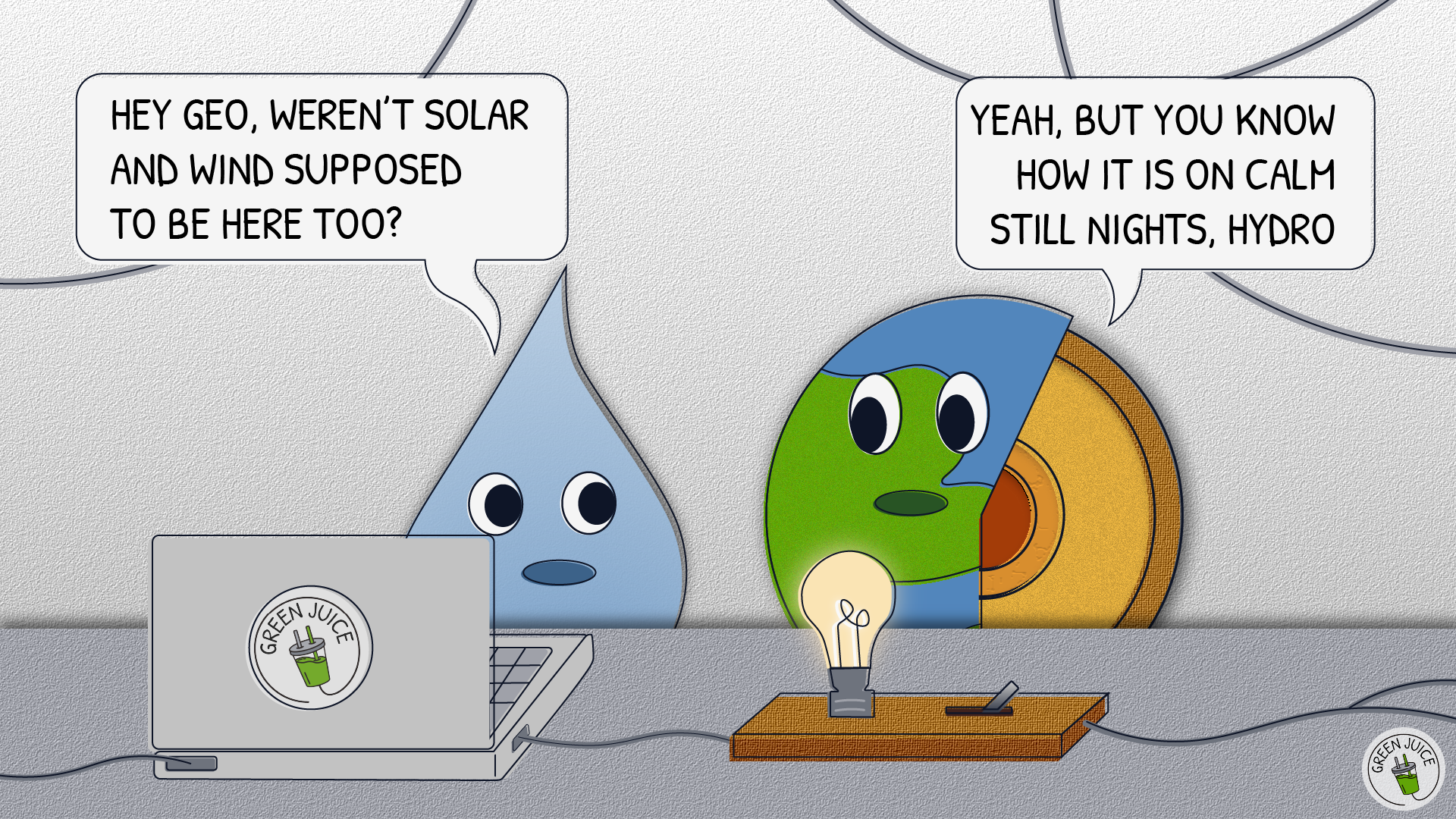
Geothermal: Fun fact! The earth’s molten inner core is roughly the same temperature as the surface of the sun. This heat radiates outwards, towards the surface—so much so that we only have to dig a couple thousand feet down into the mantle for things to start heating up. This naturally occurring heat is constant. Geothermal taps into it by capturing the heat energy in the form of steam. Steam has the power to spin the electromagnetic turbines that generate electricity.
(FYI, the above paragraph is a pretty oversimplified explanation of geothermal. I’ll be doing a deeper dive in, you guessed it, a later post.)
Hydro: Dams create electricity by using the force of rushing water to spin turbines. Since rivers are (generally) always flowing, it’s considered a source of clean firm energy. Man-made hydro is a very promising new technology that can both generate and store energy. Speaking of which…
E: Build non-battery storage
There are a number of ways to store energy besides chemical batteries. One is called closed-loop hydro: you build a huge swimming pool at the top of a hill and fill it with water, then build a second pool at the bottom of the hill. Connect your two pools with a tube. During peak-demand hours, you can send the water from the top of the hill to the bottom. Inside your tube is a generator that gets spun by water pressure, just like a hydro dam. Later that night, when clean energy gets cheap again, you pump the same water back up to the top pool. Rinse and repeat this process as often as you need to, every day for approximately 100 years.
There’s also thermal storage, i.e. energy stored as heat. Several startups are working on what climate folks refer to as the bricks in a box model of thermal storage. Literally heating up a bunch of bricks stacked in a very well-insulated box using a toaster-like heating mechanism to get them super-duper hot. If the bricks are made of the right material, like carbon, they can retain their heat for a very long time. A similar principle to hydro applies here: you heat the bricks up when energy is cheap and convert it back to electricity (or turn it into steam, or just use the pure heat) whenever you need it.
Geothermal, too, allows for a form of energy storage. If you cap the well where the steam comes out of the ground, it builds up pressure. Open the tap and release the built-up steam as needed.
F: Repurpose retired coal plants
The big advantage to building solar and wind farms on the site of retired coal plants is that those plants already have an interconnection to the grid, so you can skip the years-long queue.
That was a lot of information, dude!
I know... and that was just a taste! We haven't even talked about the systemic forces who are fighting to the death—literally, the death of everyone on Earth—to keep their polluting, inefficient, and inferior fossil fuel system in place. These include Big Oil and Big Gas, of course, but also the for-profit utility companies like ConEd here in New York and the many corrupt politicians, Republicans and Democrats alike, whom they own.
The task ahead of us is clear: we must build a working-class movement powerful enough to fight for a fair energy system. We must put public goods into public hands. I'm proud to be organizing for exactly that with the NYC-DSA Ecosocialists Working Group. We'd love to have you join us!
If you have questions about any of this, don't hesitate to send an email to jon@greenjuice.wtf
We've also got 50 more posts for you to check out that dive deeper on these topics and more. Thanks for reading.
–Jon, Dr. Aarati the Artist, and Abby the Intern

Member discussion