
A failing grade for public schools

Long ago, when I was an angsty high school student, I had my fair share of complaints about my school. They kept making me take math classes, for one. Everybody "sucked", for two. I never got cast in the musicals... just because I can't sing??
Still, I never worried about whether drinking from the water fountain would give me lead poisoning. I wasn't afraid of passing out in the middle of Spanish class because the school's ancient gas boiler made our classroom unbearably hot. In June, I counted down the minutes till summer break... but not because my classroom didn't have air conditioning.
I was lucky, even if I didn't know it then.
Less lucky are the hundreds of thousands of students enrolled in New York City public schools trying to learn algebra in what are too often inhumane and unsafe conditions.
"It can't be that bad, can it?" you ask, hopeful I'm exaggerating for effect.
It is that bad. I know, because the group I organize with—the NYC-DSA Ecosocialists—has been surveying students and teachers from pubic schools all over the city about the conditions they experience every day. They've reported visible mold, pest infestations, leaks that never get fixed, crumbling ceilings, polluted air without proper ventilation, broken bathrooms, and no potable drinking water.
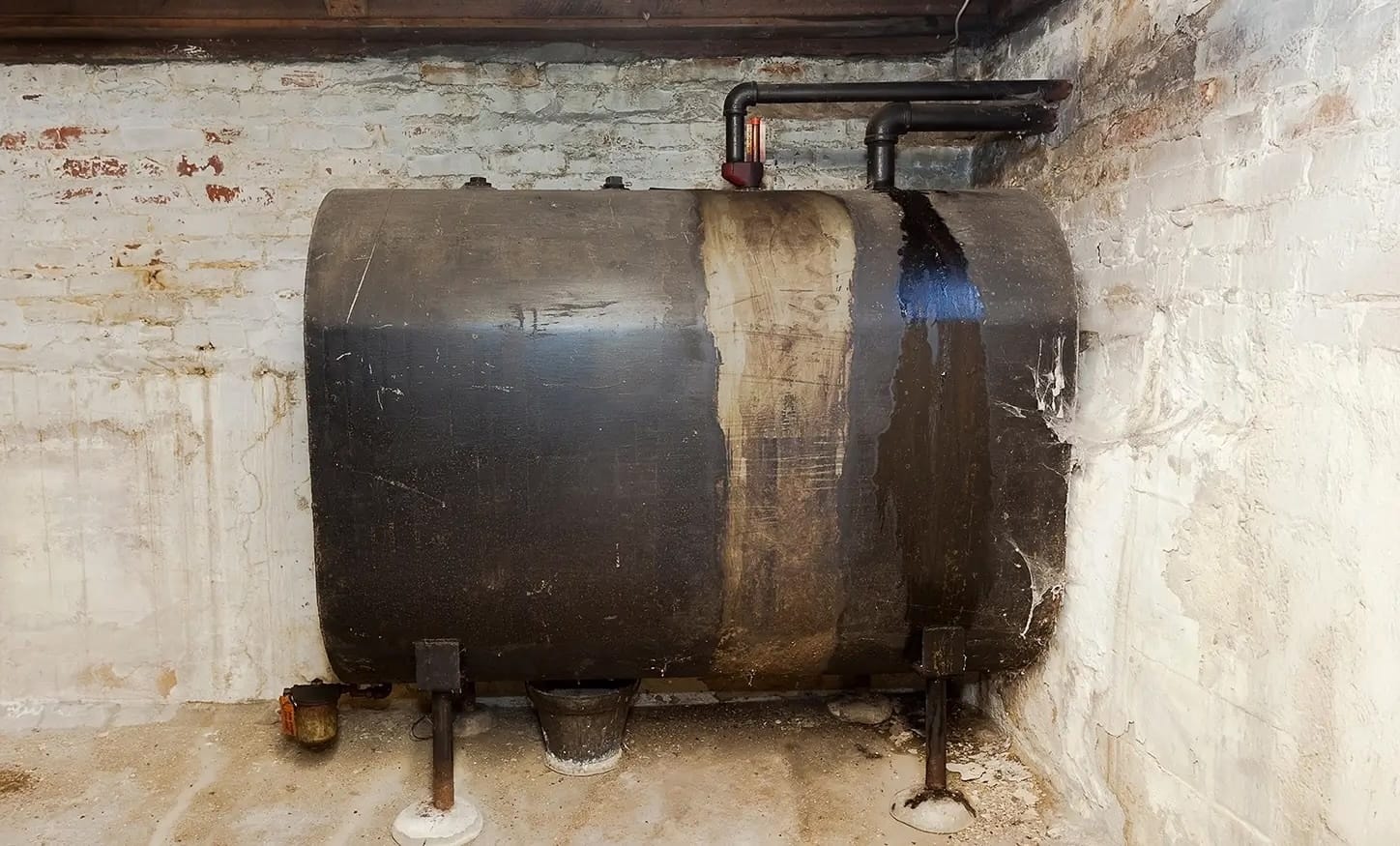
One student told us there's an active oil leak in the basement of his school, which the sanitation department comes by drain every few weeks! I didn't quite believe the story until I looked into it and found out that, indeed, this is a very real thing that happens, a relic from when schools used to burn nasty fuel oils for warmth. The surplus oil was stored in massive, thousand-gallon tanks in the basement, or sometimes buried underground. When schools eventually switched over to burning natural gas (still very bad!), some decided to just leave the tanks down in the basement indefinitely because decommissioning and removing them would have been too expensive. These tanks, rusting away over decades, developed leaks. Oil pools in the basement or spills into the soil. Here we are, years later, stuck with a self-inflicted biohazard.
At least NYC's public schools eventually switched over to burning natural gas, which, while bad, doesn't off-gas volatile organic compounds (VOCs) such as Benzene, a known carcinogen. Right?
Wrong on both counts! Burning "natural" gas absolutely emits VOCs and particulate matter and hundreds of NYC public schools still burn toxic fuel oils for heat in the year 2026. From the linked article:
Pollutants released in the burning of heating fuels can contribute to health conditions including asthma, which disproportionately affect Black and Latino children in New York City.
Did you know 1 in 5 kids in the South Bronx will be diagnosed with childhood asthma?
Look, I'm not saying every public school has an active biohazard in the basement. There are some very nice NYC public schools: your LaGuardias, your Stuyvesants. But there are more than 1,400 public school buildings across the five boroughs. Hundreds of them were built before World War II. Some date back to the 1890s. And for a number of reasons, which I'll touch on later, too many of these schools have been allowed to just... fall apart. To decompose, like dead things. When in fact our public schools are so full of life.
How you can help
The NYC-DSA Ecosocialists—Ecosoc, for short (rhymes with "gauche")—has made funding green schools a priority campaign.
Help us put an end to this injustice and do two things right now:
- Sign our petition telling the City Council to fund our green schools plan. Anyone can sign the petition. It only takes a second. Sign, then share it widely. Here's the link: bit.ly/SafeSchoolsNYC
- Are you an NYC public school teacher, staffer, student, or parent? Know one? Ask them to take our short survey about the conditions of their school: bit.ly/SchoolSurveyNYC
...but I've gotten ahead of myself.
Let's go back to where this all started: with a request to Ecosoc from the Zohran Mamdani campaign in the fall of 2024.
How Ecosoc got involved with public schools
In the before times, when he could still leave the house without a security detail, Zohran Mamdani's campaign approached the NYC-DSA Ecosocialist Working Group with an exciting opportunity: help the campaign envision, design, and write Zohran's climate platform.
The platform, they said, must be Ambitious, Impactful, and Widely Felt by the people of New York City.
Ecosoc got to work.*
*For the record, this happened right before I joined Eco. Sad for me.
The group dreamed up a radical vision for greening public schools. Buildings, after all, are the single biggest source of emissions in the city. They produce 71% of all greenhouse gasses, more than transportation or waste. The bulk of this pollution results from burning fossil fuels for heat.
Public schools, in particular, punch far above their weight, producing a full third of all the pollution that comes from city-owned buildings. Students, teachers, and school staffers get first dibs on sucking down all that polluted air.
Following months of diligent research, a policy memo was born: Green Schools for a Healthier New York City. Not quite as catchy as Fast & Free Buses, but hey, it got the point across.
Read the full memo here. There's a ton of detail inside. At a high level, the original platform called for three big things:
1. Renovate 500 public schools
Beginning with schools in environmentally disadvantaged communities (DACs), we need to rip out those ancient gas boilers and disgusting fuel oil furnaces and replace them with energy-efficient electric heat pumps, which can both heat and cool spaces. One in five NYC classrooms has no A/C today.
Install solar panels on the roofs, add batteries for energy storage, and we're in business.
I'll note that over 100 schools around the city have gotten rooftop solar installed in recent years. The average generating capacity for a school roof is over 2 megawatts. Another 500 school roofs could provide a full gigawatt of city-owned power—enough to power 250,000 homes. That number increases when you add battery storage.
If the city learns how to procure and install rooftop solar panels efficiently and affordably, they can ladder up the program to all city-owned buildings: libraries, colleges, administrative buildings, and so on. From there it's a short hop to operating a city-owned Virtual Power Plant (VPP), a huge step towards energy resiliency.
2. Build 500 green schoolyards
The asphalt "playgrounds" that dot the New York cityscape like so many blackheads aren't just an eyesore, they actively raise the air temperature and cause our streets to flood faster. That's because asphalt absorbs heat from the sun, but it cannot absorb water.
The plan: rip out the asphalt, put down a natural or porous play surface that will divert up to a million gallons of stormwater yearly per schoolyard. 500 green schoolyards would therefore divert up to *doing math...* 500 million gallons of stormwater that would otherwise overwhelm our sewer system and spew untreated sewage into our waterways.
Plant shade trees, build vegetable gardens, and turn those asphalt deserts into urban oases.
3. Transform 50 school gyms into resilience hubs
A resilience hub is a place where people can take shelter during extreme weather events to stay safe, charge their phone, refrigerate medication, and find assistance.
School gymnasia are an obvious choice for resilience hubs—so long as they're air conditioned. Add solar panels, a battery, a fridge, and hire a community liaison.
Who wouldn't get behind all that?
What happened next
Ecosoc delivered the final memo to the Zohran campaign on Earth Day, 2025... and the campaign signed off on it! Everybody felt real good about themselves. Then we waited for something to happen.
And waited.
And watched Zohran's poll numbers soar as he spoke again and again on his biggest campaign promises: Freeze the Rent, Fast & Free Buses, and Universal Childcare.
Green Schools for a Healthier New York City, it seemed, wasn't going to crack the top three.
And honestly? I can't blame the guy. Climate change is not a political winner. Climate ranked 19th out of 28 issues among all registered voters in 2024, per a Yale survey. Zohran stayed true to the affordability tip and won the election. Fair play.
Since Zohran took office, we've received a smidgen of climate related announcements. $38.4 million for heat pumps for a building in the Rockaways, $50 million to reconstruct 10 parks in underserved neighborhoods, a goody bag of energy efficiency upgrades at NYCHA properties around the city.
But zip about Green Schools.
Tired of waiting, Ecosoc decided to take matters into our own hands. We're going to get the damn policy implemented ourselves.
Here's how.
1. We're doing their homework for them
The same group of Ecosocialists who figured out what to do is now researching how to get it done. That means power mapping the city's byzantine bureaucracy, contacting organizations that have done similar work elsewhere (Paris, LA, Boston, Chicago, and beyond), modeling financial mechanisms, writing legislation, and building a one-of-a-kind Geographic Information System (GIS) map of every school in the city with dozens of filters for things like ventilation, air conditioning, flood risk, proximity to gas "peaker" plants, heat exposure index, and many more.
I'm very excited to share our map publicly for the first time right now.
(Questions about our data or methodology? Email climate@socialists.nyc)
Try playing around with the filters in the left-hand menu. As an example, you can see below how I filtered for showing only public schools (vs. all schools or just charter schools) and for schools located in a DAC (environmentally disadvantaged community). Applying these filters reveals a whopping 963 qualified schools.**
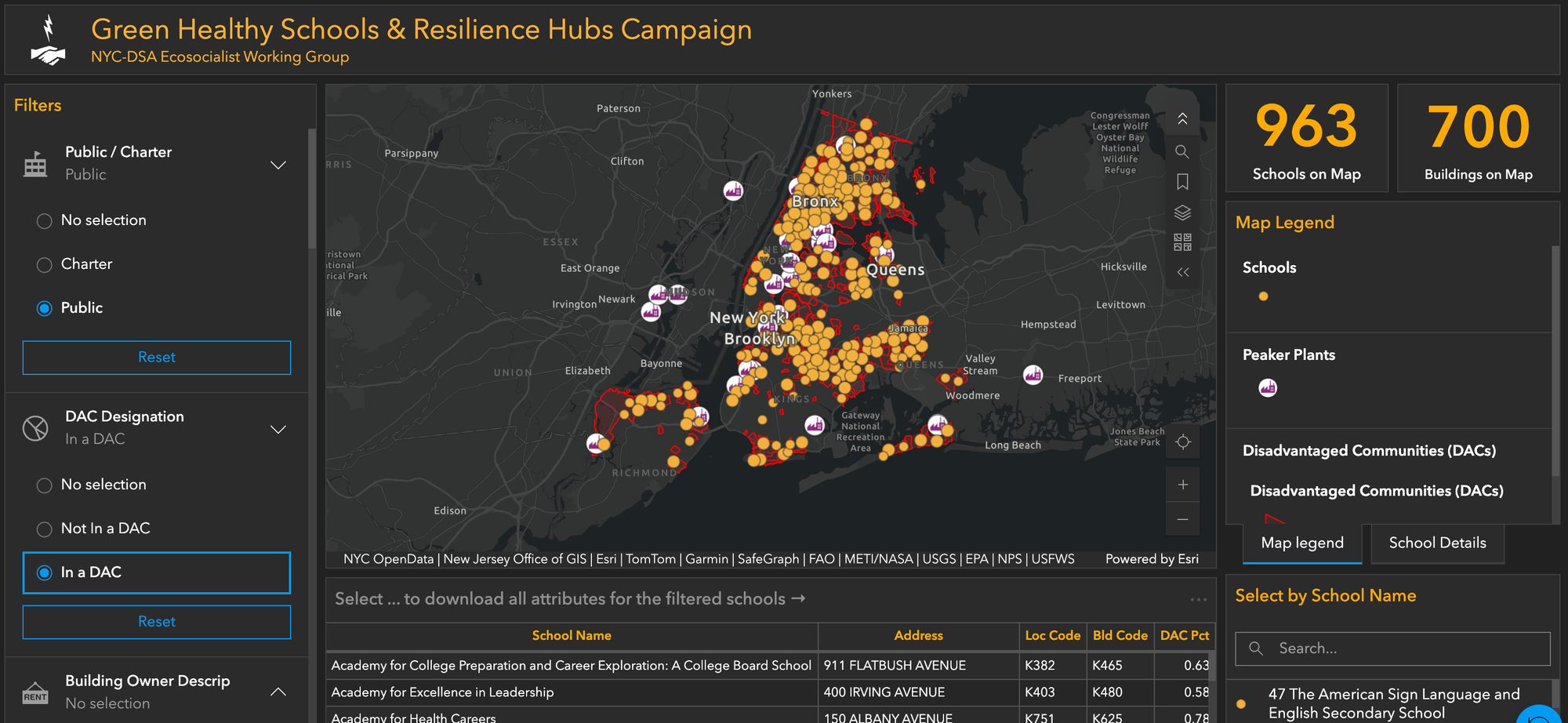
**One peculiarity of the NYC public school system: single buildings often house multiple schools. This practice exploded under Mayor Bloomberg, the richest man in New York, primarily as a way to expand charter schools in the city.
Ecosoc has been hard at work on all this for months, meeting every Monday night to put our heads together, pore over the data, and push on. Still, there's so much more to be done. If you're in the city and want to get involved in this work, join Ecosoc!
2. We're building a grassroots movement
Even an extremely motivated group of Ecosocialists can't do this alone. That's why we're building a genuine grassroots movement. Our Field campaign launched last week in Bed-Stuy's Herbert Von King Park to solicit signatures for our petition. We'll be out there all summer long, getting parents, students, and school staffers informed and involved. Soon enough, we'll expand to other parts of the city.
Building the movement we need to move the needle.
3. We're helping teachers tell their stories
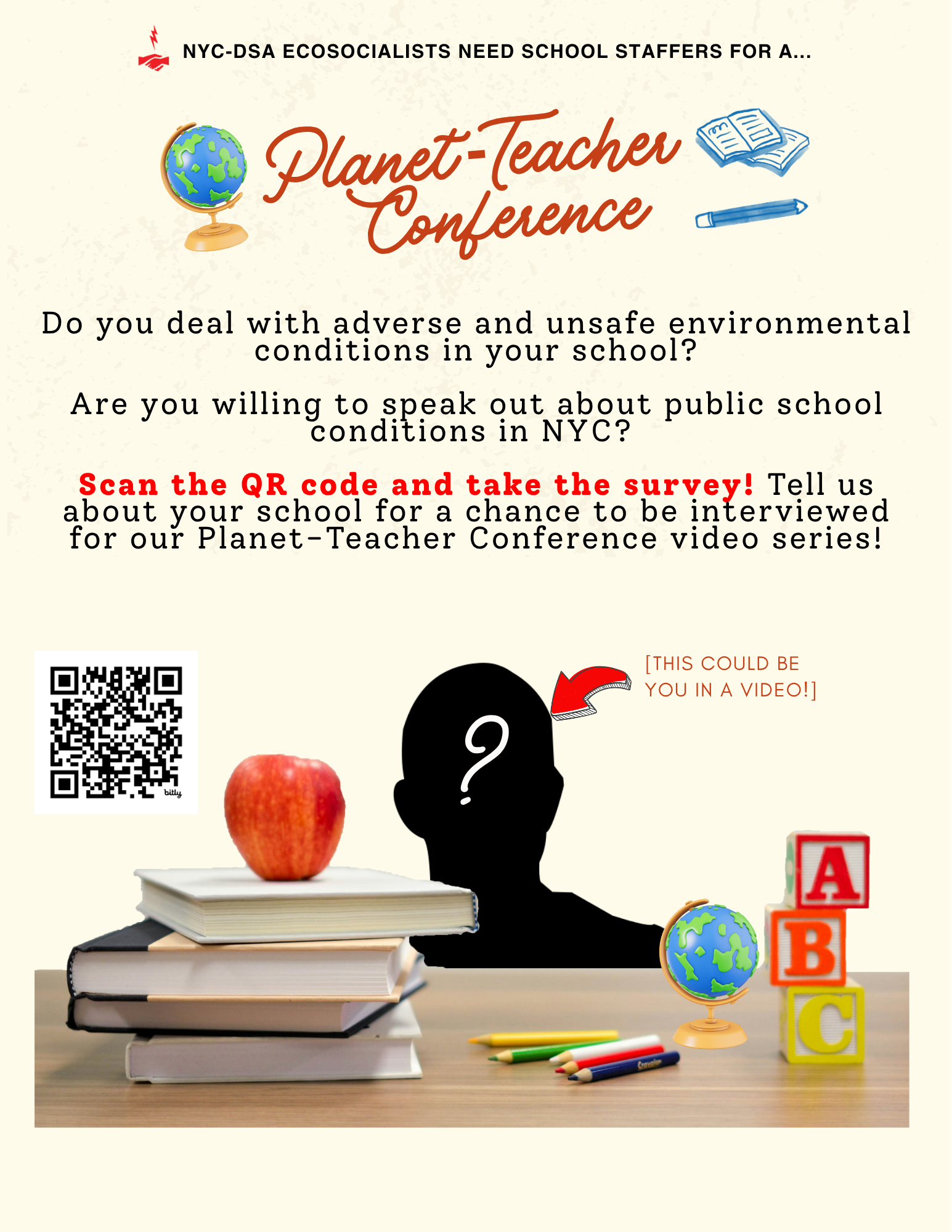
Nothing gets politicians off the couch faster than a scandal. That's why we're looking for NYC public school teachers and staffers willing to tell their stories on video—anonymously, if they prefer. We're calling it a Planet-Teacher Conference. Go ahead and scan the QR code below if you can help—or pass along our flyer to the teachers in your life.
Talking to parents, students, and teachers, we've learned our campaign must go beyond just decarbonizing schools. It must center environmental justice. It's about school safety. It's about who we're willing to fight for.
We know it won't be easy. Making repairs to century-old buildings is inherently expensive and complicated. Old buildings often contain lead paint and asbestos, the removal of which is federally mandated and competes with other repair needs. Everything is more expensive in New York, including construction and remediation.
Compounding the problem, the city is staring down a budget crisis of historic magnitude because Governor Kathy Hochul refuses to tax the rich.
But how can we go on as usual, knowing so many New York City kids are suffering?
How will we ever stop something as big as climate change if we can't even provide our students with a safe place to learn?
As with climate change, we know the work won't come cheap or easy.
Yet we also know delaying climate action today will cost us $178 trillion by 2070, to say nothing of the billions of lives that will be needlessly lost.
Building a movement of students, parents, and teachers aligned on systemic climate action that materially impacts daily life, reduces emissions, and adapts to more frequent severe weather—this is where we need to go.
We get there together.

Member discussion