
Transmission: Impossible
Catch up with our last two posts before reading this one!
There's no easy way to say this.
You are not the President of the United States. You are not AOC. The year is 2026, not 2028.
What happened is I hypnotized you with my spellbinding blogging prowess for the past five weeks :/
But! BUT! All those things we talked about? Building cross-country transmission lines alongside train tracks to unlock infinite renewables in the Southeast and Midwest? Electrifying trains around the country that will run faster, smoother, and cheaper than what we've got today? Unifying the three isolated American energy grids with a high-voltage mesh network to make blackouts obsolete?
Those things are still possible. The future is yet unwritten. AOC—the real AOC—could very well be our next President. NYC-DSA is behind her all the way, and that's not nothing.
The present, however, is a different story.
Today we're gonna take a look at the state of American transmission in the few places where exciting things are happening right now.
Merchant transmission lines
Before we dive in, a quick note on how these projects work: the majority of transmission lines in the U.S. are merchant lines, meaning they're privately owned and run for profit. Think of a merchant line as a toll road for electricity. Wind and solar farms need somewhere to sell the power they generate, especially if they're built on cheap, rural land. The transmission toll road lets them do just that; it brings rural electricity to dense populations... for a small fee. Collect enough small fees over the project's 50-year-lifespan and you're making beaucoup bucks. That's the idea anyway.
Right, let's start the list!
1. The SOO Green
The SOO Green is a 350-mile High-Voltage Direct Current (HVDC) transmission line project that will bring 2.1 gigawatts of wind and solar power from rural Iowa to urban Chicago. The whole line will be buried underground (remember The Mole from last time?) and 90% of the line will follow existing railroad Rights-of-Way! Exactly like what we've been talking about!
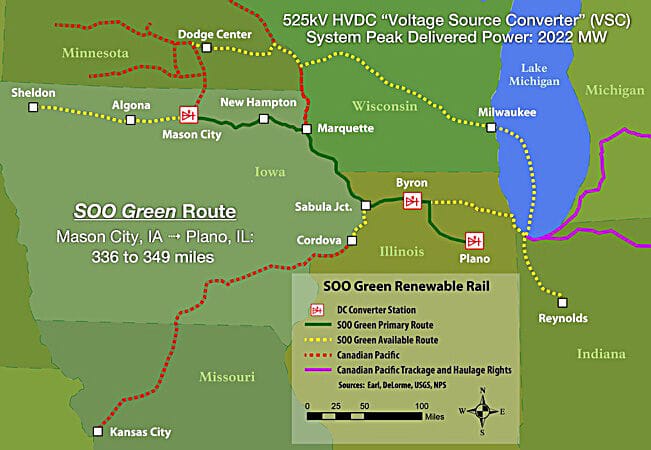
Getting to this point hasn't been easy. And we're not over the finish line yet. First proposed back in 2010 under a different name, construction on the SOO Green line still hasn't broken ground and won't be operational until at least the early 2030s.
Here's a rough timeline of where we're at:
SOO Green timeline
2010: Initially conceived as the Rock Island Clean Line, an overhead 3.5 GW transmission line from Iowa to Chicago
2010–2017: Local landowners freak out, form a lobbying group called the Preservation of Rural Iowa Alliance (lol), tie the project up in regulatory battles for years
2017: Iowa Governor Terry Branstad signs Senate File 516, a bill that targets the SOO Line directly by baring the use of eminent domain for high-voltage transmission lines carrying wind energy across Iowa into Illinois. Great governance, Terry!
2018: The project pivots from aboveground wires to a buried underground line, even though the buried line is more expensive. This is a theme we'll return to: some people really, really don't like the idea of poles and wires running through their idyllic ethanol cornfields. The project's owners reach a deal with the Canadian Pacific railroad company to build alongside their railroad tracks (and utilize their Right-of-Way), effectively engineering around Iowa's new law
2019: The SOO Green HVDC Line is officially announced
2025: Despite the railroad agreement, the SOO Green still needs to secure franchise agreements from each of the 24 separate Iowa municipalities through which it will run. In September, 2025, the final town on the list—Bellevue, Iowa, population 2,256—grants final approval.
2026: All that needs to happen next is for the project to 1) secure an environmental permit from the U.S. Army Corps of Engineers (6–9 month process), 2) line up buyers for the electricity the line will produce (a prerequisite for securing financing for the line's construction), and 3) receive grid interconnection service agreements from MISO (the private Iowa grid operator) and PJM (the private Illinois grid operator). That last piece was supposed to happen in late 2025 but evidently has not yet.
Talk about easy, peasy, lemon squeezy! Should all that go according to plan, Chicago will start receiving up to 2.1 GW of wind and solar by 2031, a scant 21 years after the plan was originally conceived.
Let's move on.
2. The SunZia Wind and Transmission project
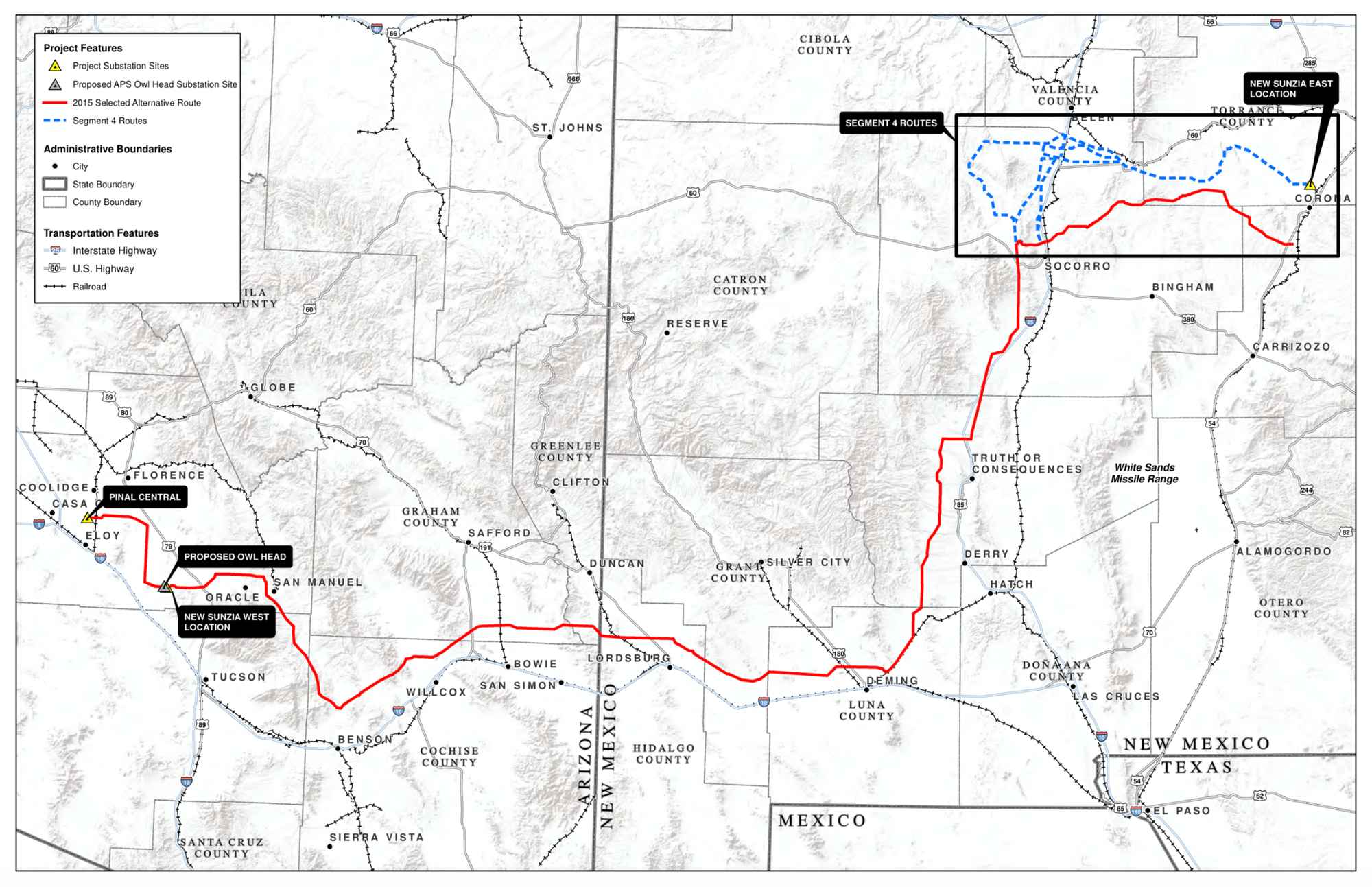
The largest transmission line project in the country just started delivering power this week! What timing! With a price tag of $11 billion, the SunZia Wind and Transmission project is a 550-mile HVDC line now delivering blustery wind energy from New Mexico to Arizona and California.
Obviously you heard the big announcement about SunZia going live, right?
I mean, it's the largest transmission line in the country! 916 wind turbines! 3.5 GW! It's already breaking California records for wind generation!
Hm? No, you didn't heard about it?
Oh... Well, yeah, that's because neither the people behind the project nor California's private grid operator bothered to announce it's operational. That's because they're too scared of drawing the ire of our own federal government to celebrate the achievement. What a world.
I'll spare you the timeline for this one, but know that SunZia took 20 years to get built due to permitting delays and local opposition, including from the U.S. Army who thought it was too close to the White Sands Missile Range (where they practice blowing stuff up). SunZia's owners remain embroiled in a messy legal battle with the Tohono O'odham Nation and the San Carlos Apache Tribe; the tribes tried to stop the line due to the cultural significance of the San Pedro Valley, through which the SunZia now runs.
Moving along.
3. Champlain Hudson Power Express (CHPE)
Better known as "Chippy", the Champlain Hudson Power Express is a 339-mile underground (and underwater!) HVDC line set to bring 1.25 GW of renewable, hydro-powered electricity down from Québec to New York City.
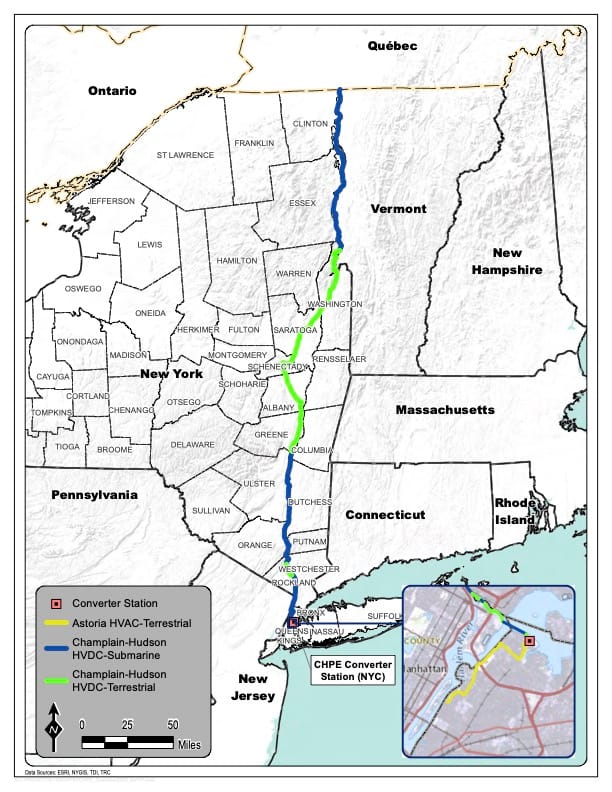
First conceived as an overhead line called the New York Regional Interconnect (NYRI) back in 2006, that idea got shelved due to, you guessed it, staunch local opposition to having to look at power lines. So the company pivoted to building an underground line, which has since finished construction and is almost fully approved to start transmitting power to the Big Apple.
The final project cost is about $6 billion. The overhead line design would have been cheaper, but hey, I'll take it.
Especially because...
4. Clean Path NY
...a second New York transmission line, Clean Path NY, was canceled last year. Clean Path NY would have brought a massive 5 GW of renewable energy from upstate wind and solar farms to where it's desperately needed downstate. Clean Path would have taken advantage of existing Rights-of-Way for the majority of its 178 miles, making the approval process far easier. Maybe that's why they named it that?
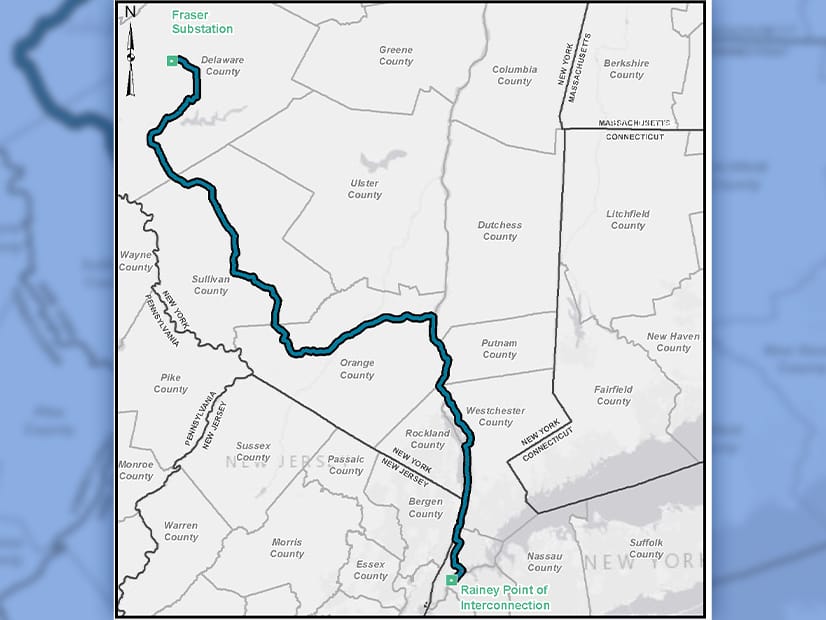
This one is particularly galling to me. That's because when the project's private developers bailed due to rising costs (something that's happening more and more of late), the New York Power Authority (NYPA), did the right thing and pitched taking over the project. But the Public Service Commission (PSC)—that malign, utterly corrupted, Kathy Hochul-appointed institution—rejected the bid and let the project die on the vine.
Why did the PSC reject NYPA's bid?
According to the PSC (the state body charged with regulating New York's utilities), Clean Path NY isn't "needed expeditiously". As in, not urgent enough to justify the $5.2 billion price tag.
How they can justify that claim when New York City still gets 85% of our energy from fossil fuel-generated sources, when there are still two dozen dirty power plants operating within NYC limits, and when the clean energy transition is the single most effective solution to stop global warming... well, that's beyond me.
The crux of the PSC's argument is that, based on the number of projects in the interconnection queue today, Clean Path NY might only reach 50% utilization by 2042—meaning, there might only be 2.5 GW worth of clean energy projects upstate plugged into it by then.
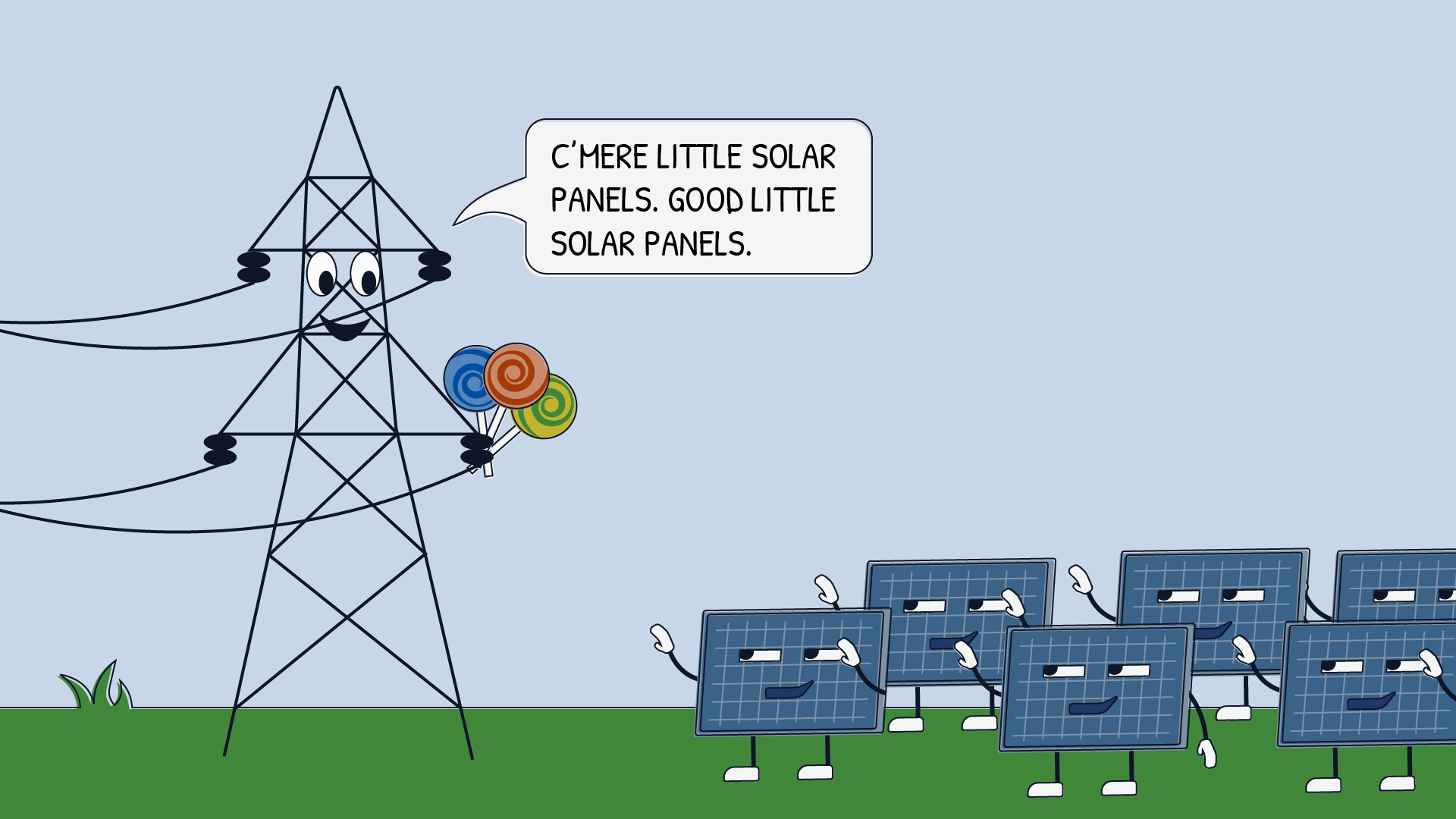
That, my friends, is horseshit. Nobody plans to build a solar farm upstate unless there's a transmission line nearby! Otherwise the solar farm would be useless! But the moment that transmission line exists, suddenly everybody wants to build a solar farm upstate.
It's like saying, "There aren't any ants on the sidewalk, so I'm not going to drop my lollipop here." Bro, the lollipop is what attracts the ants.
We see a similar phenomenon with Electric Vehicles here in the U.S., where we sell fewer EVs than any other developed country in the world: just 10% of all new car sales are electric. Compare that with China, where 50% of all new car sales are EVs. There are many reasons for this, including Trump killing the EV tax credit, but the biggest is that America simply lacks sufficient EV charging infrastructure to give car buyers confidence that their e-whip won't perish on the highway for lack of a nearby charger.
But just like building transmission lines, private investment for EV charging infrastructure is an enormous risk: what if they build a huge network of EV chargers, but nobody uses them? Or it takes a long time for EV adoption rates to increase, so they sit there idle for a few years? Private capital demands a quick return on investment.
So what's the solution?
The solution is public investment
Speaking of China...
China has a similar geographic challenge to the U.S.: their big population centers are located along their eastern seaboard. Meanwhile, the massive Gobi Desert, which is where you'd want to build your solar power, is way to the west, while windy Inner Mongalia is way up north.
The challenge is similar; the approach is completely different.
Rather than leaving things in the hands of risk-averse, profit-driven private developers, China has chosen to entrust important matters of state infrastructure to the State Grid Corporation of China, the country's largest public power utility firm. In China, the State Grid Corp can't be blocked by the aesthetic concerns of townsfolk. They don't have to worry about earning a 15% ROI the second the line is operational. They don't need to spend years begging for permits, or bury their lines underground as a compromise, or co-locate along railroad tracks to make it easier.
As a result, the State Grid Corporation of China is going absolutely fuckin' nuts with it.
Sorry to curse... it's just hard to accurately convey just how vast the gulf between our two countries is in this regard. Allow me to toss a few numbers at you:
- By the end of 2025, China had completed 45 Ultra-High-Voltage (UHV) transmission lines. Ultra-High-Voltage, compared to regular old High-Voltage, means, well... a lot more volts. More volts means less electricity losses as electrons travels thousands of kilometers from the desert to Shanghai.
- Those 45 UVH lines add up to...
- ~32,500 total miles
- ~300 GW of transmission capacity
And they're not done.
- China plans to build another 15 UHV lines by 2030
- That will increase their capacity to transmit power by another 35%
- Included in the next 15 is the Gansu-Zhejiang UHVDC line, the world's first Ultra-High-Voltage flexible direct current line. Flexible here means electricity can be moved around the system far more easily, in any direction—which is a great thing if you've got tons of intermittent renewables on your energy grid. If the wind stops blowing in the East, you can send them electricity. When the sun goes down in the West and the wind picks back up, you can switch directions. Our grid cannot do this.
- Also included in the 15: the Jinsha River-to-Hubei line, which will be the world's highest-altitude UHVDC project at 3 miles above sea level. The line will deliver ~40 billion kilowatt-hours of clean energy annually and cut 34 million tons of CO2.
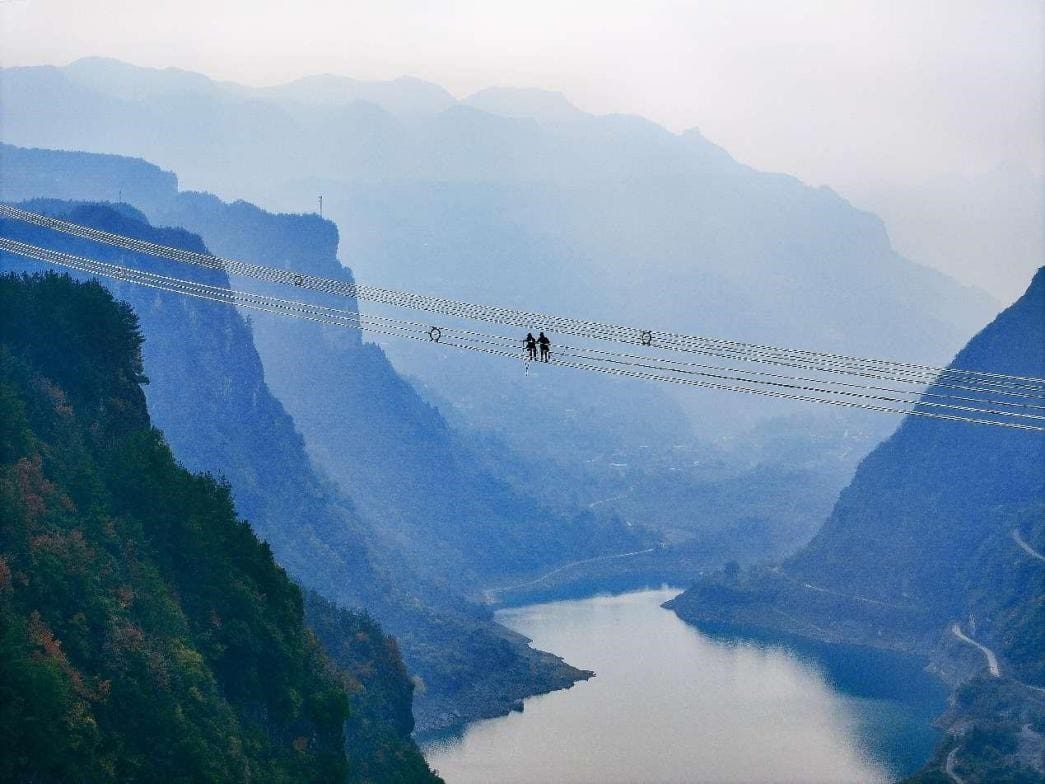
So, to recap: China built 32,500 miles of Ultra-High-Voltage transmission lines in less than 20 years.
This network of transmission lines forms the skeleton upon which renewable energy projects are added. And they've done just that: by the end of 2025, China's total renewable energy capacity was approximately 2,340 GW.
By comparison, in 2024, the United States built 322 miles of new High-Voltage transmission. Our total installed renewable capacity will (hopefully) reach 525 GW by the end of this year, per EIA estimates.
I don't want to frame this as a contest. First off, because it's no contest—we are getting our asses kicked all the way in. But secondly, because China going HAM on renewables is a good thing for the entire planet. They're showing us all a way forward, even if we here in the U.S. aren't very quick on the uptake.
So, how do we make ours look more like theirs?
That's a question for another day. November 7th, 2028, specifically.
Member discussion