
Mexico's head start on state capacity

Attention New Yorkers! The battle for the soul of Con Edison is begun. Join the Utility Customers Association and me Tuesday evening for a short webinar on the FAIR Act, our opening gambit to prime investor-owned utilities for a public takeover. RSVP here!
When a tsunami makes landfall, the first wave rarely hits hardest.
I sure hope that's true of political tsunamis, as well. Last week's Bluenami was a triumph. It was also insufficient.
In 2028, I foresee a breaker towering 10,000 feet tall. Squint into the sun and there, cresting the wave, is AOC. Surfing into the Presidency.
If you, too, are Ready for AOC, sign the pledge! Let her know she's got our support.

Let's say it goes down just like that. A second, even bigger Bluenami razes the GOP country clubs and the billionaire bunkers. When the floodwaters recede, they'll reveal a fresh mess of a country. Ripe for renewal.
What do we do next? How do we do it?
"The State must build everything! Ban private development!" cries the Learnèd Leftist.
Just one problem: after a half-century of neglect, the American government's state capacity muscles have severely atrophied. To wit:
- Federal investment plummeted from 6.2% of GDP in 1968 to 2.4% in 2018
- The federal government funded 67% of all US R&D in 1964. By 2022, it funded 18%
- Public housing has shrunk from 1.3 million units in the mid-90s to 860,000 today
- In 2013, we built nearly 4,000 miles of high-voltage transmission. In 2024, we built 322.
America can't build high-speed rail, high-voltage transmission lines, or high-density housing.
What we do manage to build costs more and takes longer than almost anywhere else on Earth. Phase 2 of the Second Avenue Subway is projected to cost close to $4 billion per mile, more than 11x the global average. Georgia's Vogtle nuclear plant came in seven years late at more than double its original cost estimate.
Turns out that offshoring our manufacturing capacity, allowing public agencies to fire their engineers and hire armies of consultants, and building big things so rarely that we have to relearn how to do it from scratch every time has ultimately not served the public interest.
So... what's a President AOC to do?
The conundrum: developing state capacity vs. delivering results
In a perfect world, we Americans would concede it's darned hard to revitalize our state capacity in one four-year term. We would acknowledge China's industrial domination is the result of 40-odd years of patient state investment in manufacturing and R&D.
That ain't the world we live in.
Prez AOC will be tasked with restoring our state capacity while simultaneously delivering meaningful results right off the bat. Lest she incur the wrath of the capricious American public.
We're seeing a city-sized version of this play out right now in NYC, with Mayor Mamdani running headfirst into the contradictions of governing as a socialist without sufficient state capacity to lean on. For Zohran, that's meant compromise: his city-owned grocery stores will be privately run, most new affordable housing will be privately financed and developed, his universal childcare plan will depend on a patchwork of nonprofits, private centers, and home-based providers.
Mamdani's latest maneuver? Signing a licensing deal with the streetwear brand Supreme. I don't hate it!

Again, Zohran isn't willfully ignoring a seasoned civic workforce. Despite what some of the far-left would have you think, he's not a secret capitalist masquerading in communist wool. Zohran's leaning on private developers because the city's in-house building muscle is mostly gone.
It's a real shame. New York once built our own subway lines and the Catskill aqueducts. But the 1975 fiscal crisis—driven by deindustrialization, suburban flight, and years of budget gimmicks—cost tens of thousands of city workers their jobs and froze capital spending. While the headcount eventually came back, the engineering capacity mostly didn't. That's why the MTA now pays consultants to manage consultants.
How to go beastmode once again? Not just in NYC, but from sea to shining sea?
Take a roadtrip down Mexico way, AOC. Bring your journal, and leave space in your suitcase for souvenirs.
Mexico is a hotbed of state capacity experimentation
South of the blue Texas border, Mexico finds itself in a similar predicament: the lefties have the reins, but not the horses.
What they do have is an eight-year head-start. Six years under AMLO (aka President Andrés Manuel López Obrador), and two to date under President Claudia Sheinbaum, a trained energy scientist. Sheinbaum in particular has shown a willingness to throw spaghetti (fresh tortillas?) at the wall and see what sticks. It hasn't all stuck. But some has, and there are useful lessons for American upstarts.
Here are some strategies Mexico is undertaking:
1. Amend the constitution
F*ck it, we ball! Mere weeks after Sheinbaum took office in 2024, Mexico amended its constitution to put its state-owned utility, the Comisión Federal de Electricidad (CFE), back in charge. The amendment says the goal of planning and running the national grid is...
"…preservar la seguridad y autosuficiencia energética de la Nación y proveer al pueblo de la electricidad al menor precio posible, evitando el lucro…"
Translation: "…to preserve the nation's energy security and self-sufficiency and to provide the people with electricity at the lowest possible price, avoiding profit…"
Avoiding profit? Enshrined in the constitution?! Let's gooooooooo!!
The following year, laws were passed that require CFE to supply at least 54% of the power on the electricity grid. Private companies can still compete for the rest either as minority partners in CFE projects or with fully private projects that fit with the government's plan.
Mexico has a proud tradition of public energy. Quick history: on March 18, 1938, President Lázaro Cárdenas kicked out the foreign oil companies and created CFE and PEMEX, the state-owned oil company that still exists today. (CFE was founded the year before.) March 18th remains a national day of commemoration. Mexican pride in energy sovereignty—and PEMEX propping up the federal budget—are big reasons why Mexico has been slow to move off fossil fuels. Mexico is roughly 26% renewably powered today, though Sheinbaum is aiming for 38% clean energy by 2030.
The US has no comparable tradition, and no recent appetite for amending our constitution. The last amendment to go through the full process, the 26th (which lowered the voting age to 18), happened in 1971.
But, hey, there's no time like the present. And we've since invented word processors, so it should be way easier now.
2. Bring in China
A new grid rule requires every new Mexican solar and wind farm to include battery storage equal to 30% of the project's generating capacity. That's huge. But also hard: Mexico's chemicals industry is too immature to manufacture its own battery cells.
In this situation, there's only one country to call.
Chinese battery juggernaut CATL recently signed on to supply a 1.6 gigawatt-hour battery storage system to the La Alegría Solar project on the Yucatán peninsula. CATL says it will be Mexico's first battery system over 1 GWh.
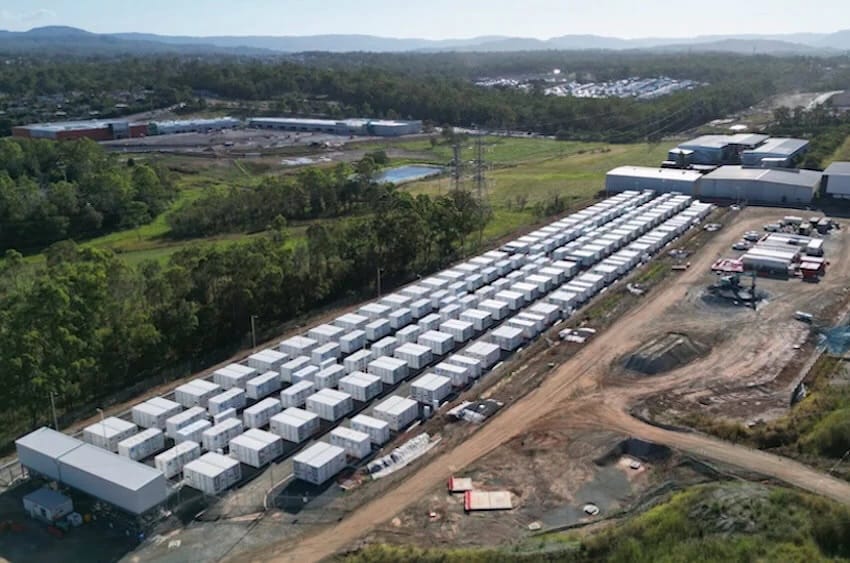
The deal isn't with the Mexican government itself, but with a Danish investment firm called Copenhagen Infrastructure Partners. That makes it one of the first fully private renewable projects to move forward under Sheinbaum’s 2025 energy laws, after years in which AMLO’s government all but froze new private renewables projects. There's a lesson here: AMLO's intention to do everything using state capacity didn't pan out. Critics say it raised prices and emissions. Mexico just wasn't ready.
Under Sheinbaum, CFE's role in the CATL project is planner and customer: the project satisfies the government's grid plan, and a CFE subsidiary signed contracts to buy its power.
CATL says it supplied more than 80% of the battery storage capacity awarded in Mexico this year.
3. Make the army do it
Wanna build a giant public works project in a hurry, but you harbor a severe distrust of your country's corrupt private developers? Make the army do it!
Army engineers are building new passenger railroad lines from Mexico City to Pachuca and Querétaro, part of a push that also includes Irapuato and Saltillo to Nuevo Laredo near the US border.
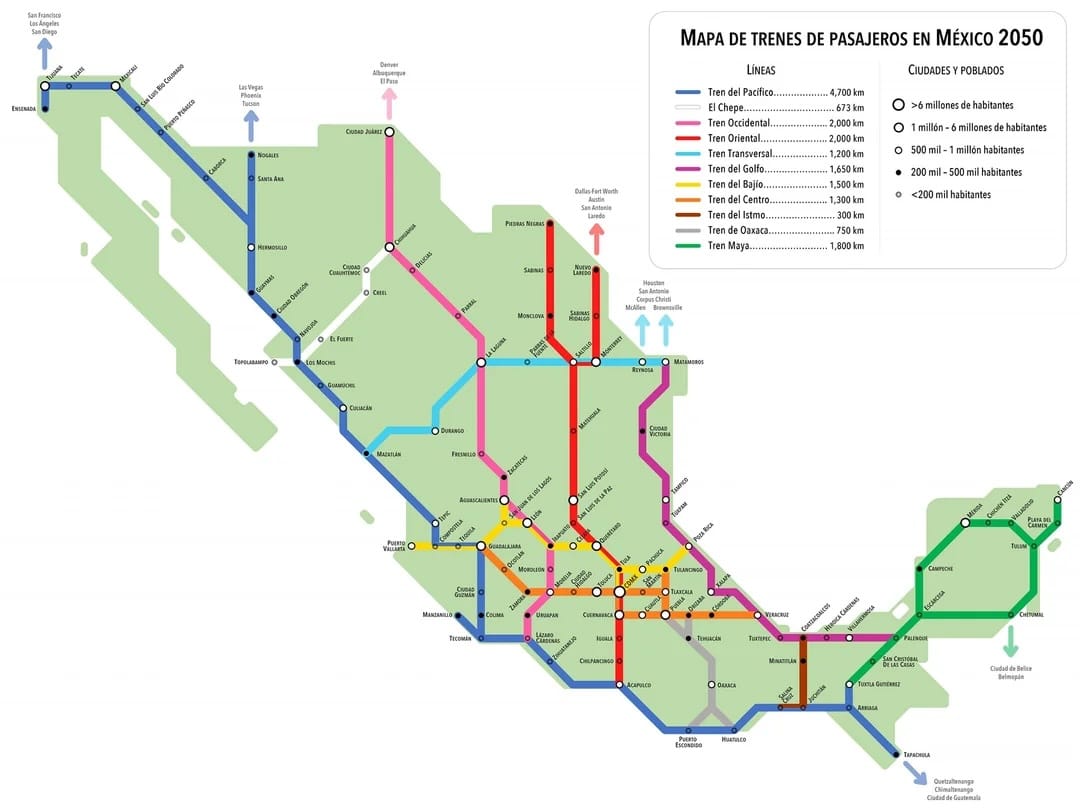
It's not high-speed rail, to be clear. These trains will top out around 100 mph. The super-fast trains require dead-straight track, which would mean blasting tunnels and building viaducts, and that gets crazy expensive. Also, nearly every country with true high-speed rail started off building ample pretty-high-speed rail. So HSR could still happen for Mexico.
🚨🇲🇽 BREAKING — New images show Mexico's RELENTLESS TRAIN EXPANSION.
— Samuel 🇲🇽 (@resisres) November 3, 2026
Around 60,000 workers on at least 22 active fronts, racing to connect every major city in the country, with the Army leading the charge. pic.twitter.com/l9uYUMzFSI
I couldn't fact check this Tweet, fyi!
The history here is that Mexico largely abandoned passenger rail in the '90s after their neoliberal government privatized and handed over the railways to freight companies. New rail construction started under AMLO, who reasonably distrusted private construction firms after decades of graft. So he enlisted army engineers to build the Pachuca and Querétaro lines, which the army will run. The army also built parts of the Tren Maya line around the Yucatán and runs that, too, while the Navy built and runs the Interoceanic train across the Isthmus of Tehuantepec. Other rail sections will be built and run by private contractors.
The primary advantage to using your army to build is speed. AMLO declared his rail projects matters of national security and fast-tracked all the permitting.
But faster isn't always cheaper, or better. The Tren Maya line was estimated to cost ~139 billion pesos in 2020. It's now up to around 550 billion. That's roughly $23 billion USD over budget, and auditors keep finding... irregularities. Overpayments, unnecessary work, missing pieces, and quality concerns.
The Tren Maya line was controversial from the start. Environmental groups and Indigenous rights activists criticized it for cutting through jungle and building over fragile cave and cenote systems. And it's underperforming. Ridership averages about 3,300 riders a day, well under the official target of 8,200 and a far cry from early planning estimates as high as 80,000.
The Interoceanic line, which the Navy built, tragically derailed last year in Oaxaca, killing 13 people.
So... be careful using the armed forces to build infrastructure. It's a "break in case of emergency" option.
Although the closest American equivalent, the Army Corps of Engineers, might be a better model: it's mostly civilian engineers who plan projects and manage contractors. What you want to avoid is teaching the army how to build, but not the state.
4. Do it mostly yourself, but start small
When you hit the gym for the first time in a decade, the key is not to overdo it. Even if you think you'll look silly curling five-pound weights. You'll probably look cute!
Related: the first state-backed Mexican electric car is a certifiable cutie. Meet Olinia Uno, which Sheinbaum debuted by driving onstage in June.
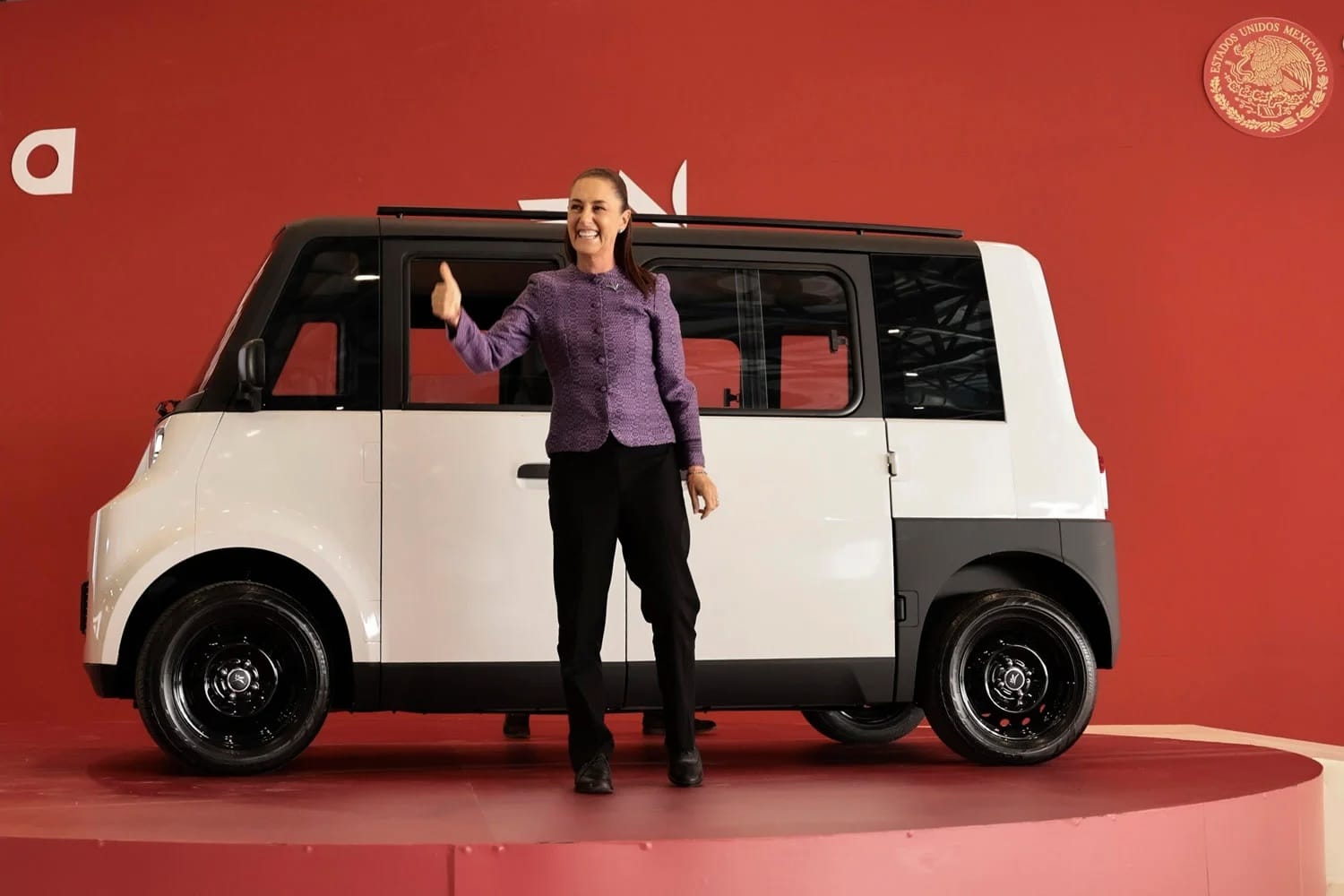
The prototype seats six, tops out at a cool 30 mph, scoots 78 miles on a single charge, and will cost about $8,600 USD when sales start next summer. Smaller, cheaper models are in the works. Olinia Uno was designed by engineers at public universities and research centers and will be built in Puebla.
 Mexico Solidarity
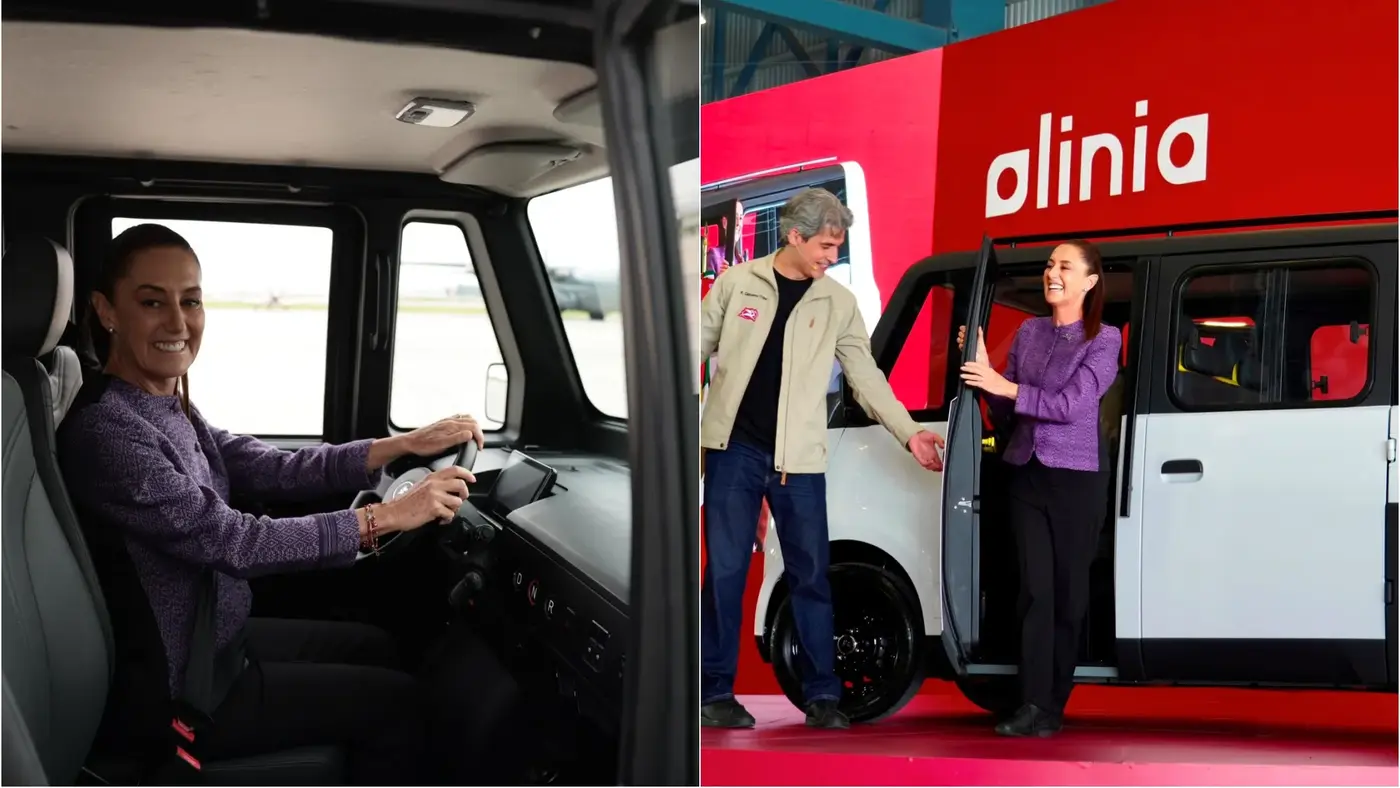
Nobody's pretending Olinia will beat out BYD. That's not the point. It's a training program with wheels: a way to build a new generation of Mexican engineers who know how to design and manufacture an EV.
Mexican batteries will follow the same logic. A $10 million plant to assemble imported cells into battery packs is also coming to Puebla, with Olinia as its guaranteed first customer. Baby steps!
5. Take a big swing... and maybe miss
Or you can swing for the freaking fences.
In 2022, Mexico nationalized its lithium deposits, created a state lithium company, and cancelled the concessions of the one company actually developing a mine. The catch: Mexico’s lithium is mostly locked up in clay, and the country doesn’t have the technology or money to extract it. The state lithium company has gone years without an investment budget. Mexico owns its lithium, but it can't get it out of the ground.
No shame in trying stuff, but do your due diligence.
BONUS: Mexico just announced universal healthcare
One way to buy yourself some public goodwill? Give everybody free healthcare. Mexico just announced the rollout of universal healthcare to 120 million citizens by 2027. Must be nice!
The things you can do when the left is in charge.
What to pack in your suitcase
To recap, here are some strategies I think President AOC ought to bring home:
- Keep the developer's seat. Contract out construction to private firms if we need to, but retain ownership and planning. Oh, and make the grid public.
- Make learning a precondition for every deal. If we need to bring in foreign companies to do stuff, the goal should include knowledge transfer. Write it into the contract.
- Rebuild civilian agencies. Probably don't hand big jobs to the military. Fund civic engineers instead.
- Start small. Not everything need be a blockbuster success right off the bat. Minimum Viable Products, people!
- Independent oversight matters. Sheinbaum's 2025 law abolished independent energy regulators, who were seen as protecting private interests. But public ownership, as Mexico well knows, is not immune from corruption. We need to bake in independent oversight, staggered board terms, and open data.
2028 can't come soon enough. But while we wait, we can plan. Who's up for a little research expedition?
Member discussion