
Do we have to do *everything* ourselves?
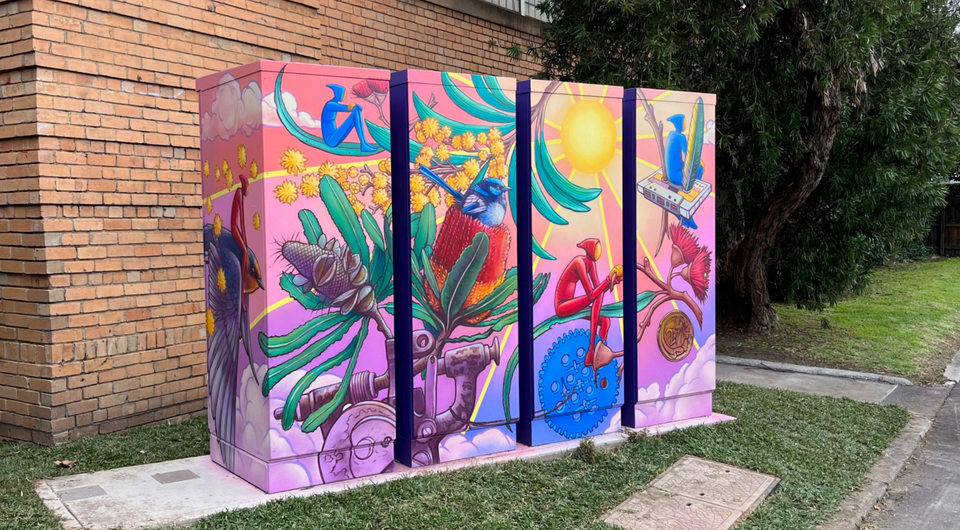
Picture a battery the size of four refrigerators sitting in a New York City parking lot, bedazzled by a local artist, quietly knocking money off your electric bill. Now picture hundreds of them, all owned by the public, collectively generating enough cash to fund more and more clean energy projects around town.
That’s the pitch behind PowerNYC, a tantalizing proposal mapped out in a new report from Jason Kowalski of the Public Renewables Project and Johanna Bozuwa of the Climate and Community Institute, with input from Public Power NY. The report is called PowerNYC Development Corporation: The Case for a Public Renewable Energy Developer in New York City. Read it here.
A quick-and-dirty summary of what the authors want to see happen:
- The city of New York creates a new entity—a local development corporation (LDC) or a city-run authority—called PowerNYC. This publicly owned nonprofit can build, own, and operate renewable energy projects in NYC on the cheap, taking advantage of access to city-owned sites, low-interest public financing, and bulk purchasing to keep costs down.
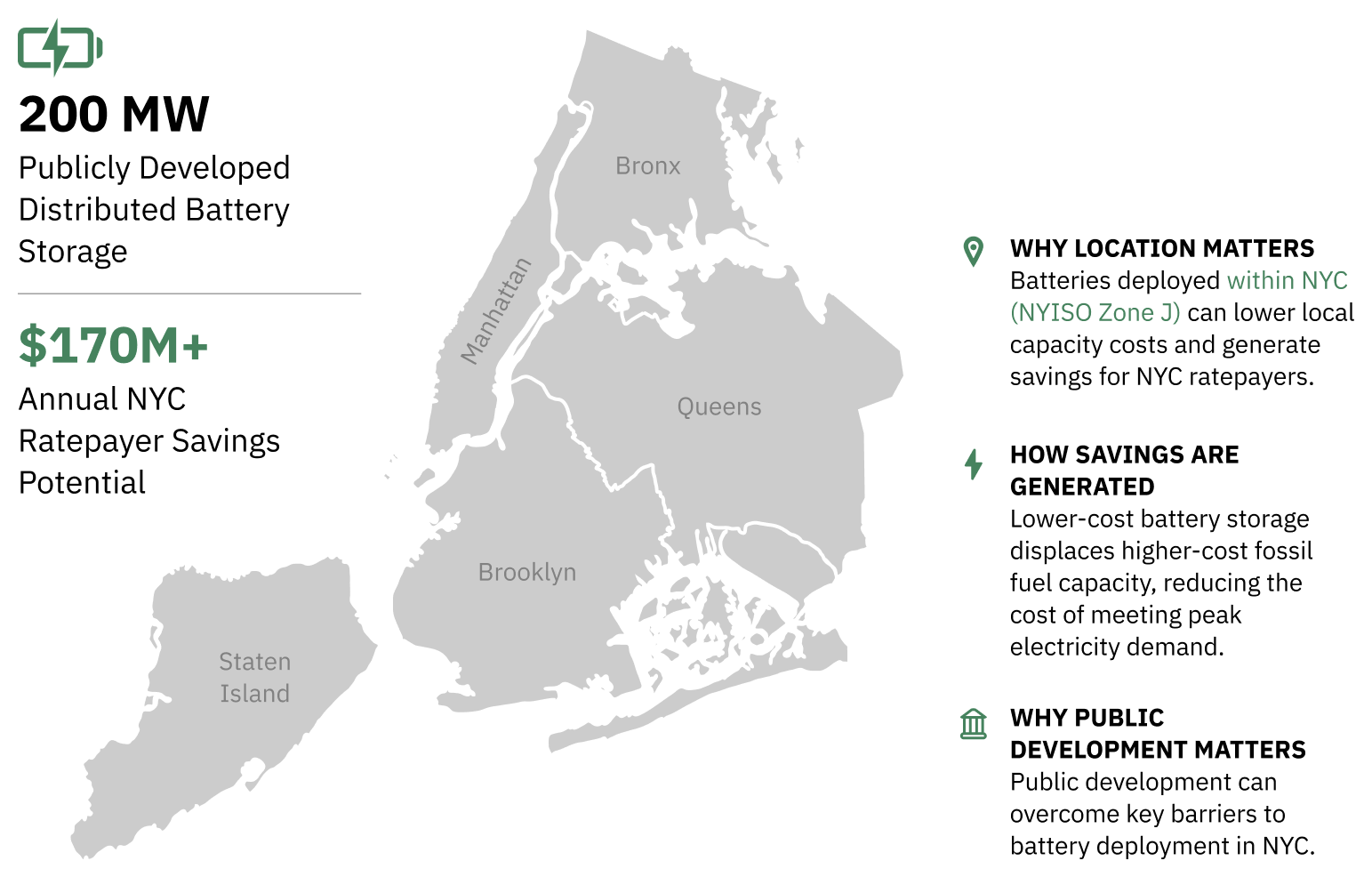
- PowerNYC's first order of business is to install a butt-ton of batteries. The report claims just 200 megawatts of smartly distributed batteries could save NYC ratepayers $170 million or more a year. PowerNYC should likewise get busy building out solar panels on public buildings (schools, hospitals, NYCHA housing, etc) and, eventually, developing Thermal Energy Networks (TENs), underground pipe systems that can heat and cool buildings gas-free.
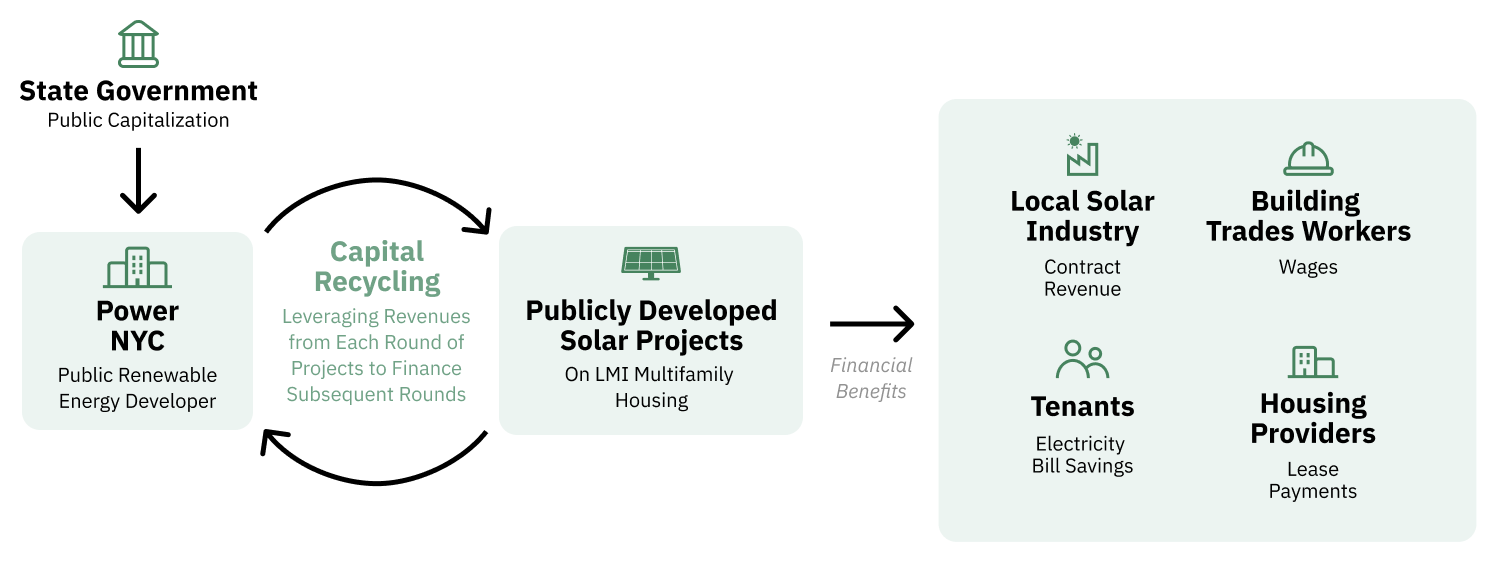
- To get PowerNYC up and running, the city requests $100 million from the state coffers. PowerNYC can also fundraise for itself, issuing bonds and taking loans. But once they get some batteries and solar panels installed, PowerNYC can sell power and energy savings, recycling the revenue to build more projects, which in turn will fund even more projects, ad infinitum, in a glorious loop of public power development.
There's a lot to discuss here! I imagine that you, reader, like me, think this all sounds pretty good, but you've got some questions.
Is it really that easy?
If so, why doesn't this already exist?
And what about the investor-owned elephant in the room... aka Con Edison?
Let's talk about it.
Is it really that easy?
Creating the corporation is pretty easy. Unlike, say, creating a new power authority, the city can set up a development corporation without Albany's permission (though it still depends on their money). But there are tradeoffs with this approach that we'll get into shortly.
Why doesn't this exist already?
Well, because of a certain shiny-headed, faux-vegan, Albanian passport holder. That's right: disgraced former mayor Eric Adams!

In 2022, then-NYC comptroller Brad Lander proposed creating a city-funded nonprofit called Public Solar NYC to finance, permit, install, own, and maintain thousands of rooftop solar arrays around town—600 MW over eight years.
But Lander and Adams were not besties. Brad was gunning for the mayoralty, and his comptroller's office was a constant thorn in Adams' unbelievably corrupt side.
So Brad's bodacious plan got watered down. Instead, Adams committed to a much smaller program financing rooftop solar for low-income homeowners living in environmental justice communities. But the plan leaned heavily on federal Solar for All money, which Trump's EPA detonated in 2025.
Zohran seems to have a much more cordial relationship with new comptroller Mark Levine. Let's hope it stays that way.
Plus, there is a success story we can turn to. It's just not in New York.
Introducing... the Connecticut Green Bank!!
Created back in 2011, the Connecticut Green Bank is the first green bank established in the US. Mostly what they do is finance outside clean energy projects, but there is a wing of the bank dedicated to development. It's called Solar MAP+, and since launching in 2020 they've completed 69 projects totaling 53.3 megawatts.
The PowerNYC report names the Connecticut Green Bank as proof of concept: a public renewable energy development program that's stuck around for nearly 15 years. PowerNYC can copy the Solar MAP+ business model: keeping costs low by doing the legwork of finding sites, permitting, and financing in-house, then bidding out bundles of eligible sites to private contractors.
One flag for PowerNYC: the Connecticut Green Bank, which is funded by ratepayers, has been raided several times by the state during budget crunches. The one-time upfront investment the PowerNYC report proposes seems like a safer bet, but still.
What about ConEd?
Green Juice readers know that the biggest obstacle to installing batteries in NYC today isn't a lack of interested developers: it's Con Edison, whose overly credulous regulators allow the utility to gatekeep access to the energy grid.
 Jon
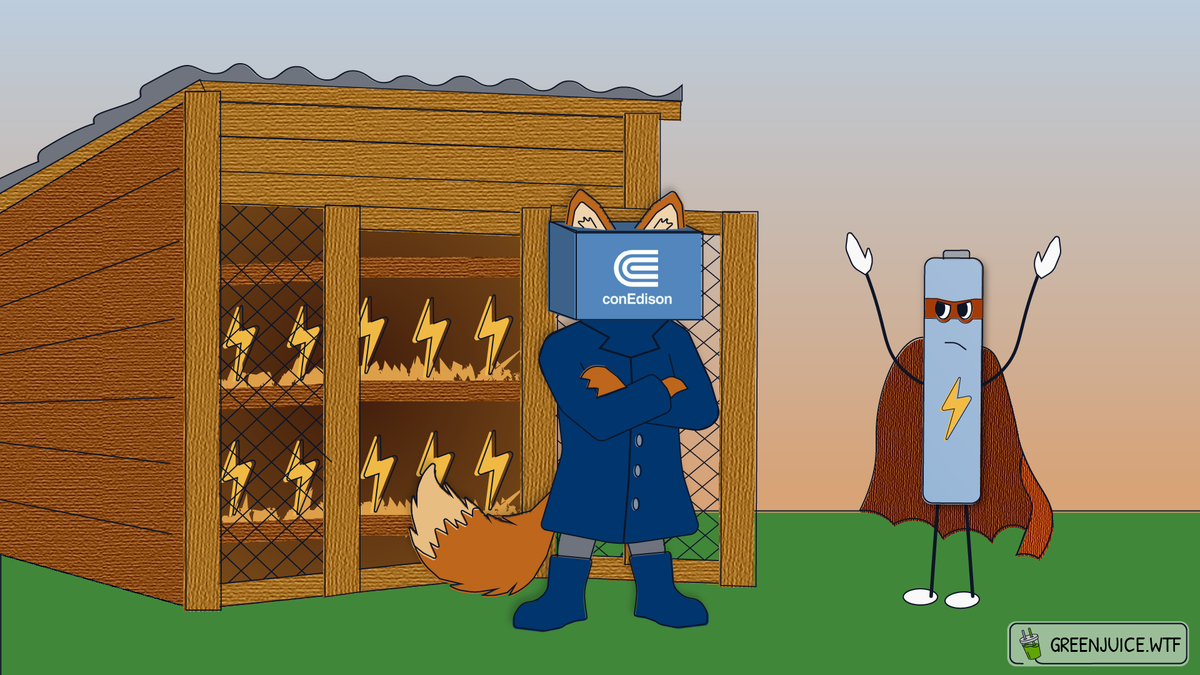
You wanna build a new battery project in NYC? Great, just fork over an extra $21 million on top of everything you've already spent and ConEd will plug you right in.
ConEd justifies their extortion racket interconnection fees by pointing to a pretty outrageous hypothetical scenario: someday, there could be so many batteries plugged into the grid that if they all charged at the exact same time the resulting spike might damage some grid equipment. ConEd says this means battery developers need to pay them millions of dollars today so that ConEd can go build a bunch of (highly profitable) new substations to prevent this scenario from taking place in the distant future. It's kind of like the plot of Terminator, but less believable.
Unfortunately, PowerNYC can't avoid dealing with ConEd.
But there may be some ways to make it work:
- Siting. PowerNYC would have access to all kinds of city-owned development sites that private developers do not. The City of New York owns 14% of all the land in NYC! Some of these sites are surely located in places where ConEd needs help maintaining grid reliability—exactly the thing batteries do best. PowerNYC could work with ConEd to prioritize these sites first.
- Flexible interconnection. Today, ConEd doesn't offer flexible interconnection as an option for third-party batteries. That's when a battery developer commits to charging and discharging only at certain times of day, even if that means making less money overall. PowerNYC could propose a flexible interconnection pilot program that gives ConEd control over when batteries charge during crunch times (without handing over ownership).
- Take the hit. By virtue of developing a large portfolio of projects, PowerNYC could absorb some of the big interconnection costs that smaller developers simply can't stomach.
- Push for rule changes. A city-owned developer that gets priced out of development by its local utility can and should get real loud about making some changes to how ConEd operates. PowerNYC could intervene in Public Service Commission (PSC) proceedings, publish studies that counter ConEd's assumptions with real data, and work with state agencies to advocate for treating distributed storage as the reliability resource it is.
If none of that works, well, then at least we've made a pretty good argument for why ConEd has got to go.
 Jon
Do we have to do everything ourselves?
Though there may be question marks, I like the PowerNYC proposal. I mean, we gotta do something. New York City ratepayers foot ~40% of the state's Clean Energy Standard through our utility bills, yet New York City still gets over 90% of our electricity from dirty fossil fuel power plants, many of them clustered in the city's poorest neighborhoods. Our utility bills this summer were as apocalyptic as our smoke-filled skies. Our Governor, her pockets stuffed with cash from fossil fuel and utility lobbyists, keeps pretending like she's gonna build a bunch of new nuclear plants?? Meanwhile, the city's best bet for a savior, the New York Power Authority, remains fully focused on upstate solar projects.
If there's one thing I've learned as an Elder Millennial, it's that nobody is coming to save us. We, the brainworm-resistant generations, are all we've got. And so we must do the difficult work of reversing 50 years of neoliberal decadence and decay. Installing a butt-ton of batteries is a fine place to start.


Member discussion