
VIDEO: Build or Burn
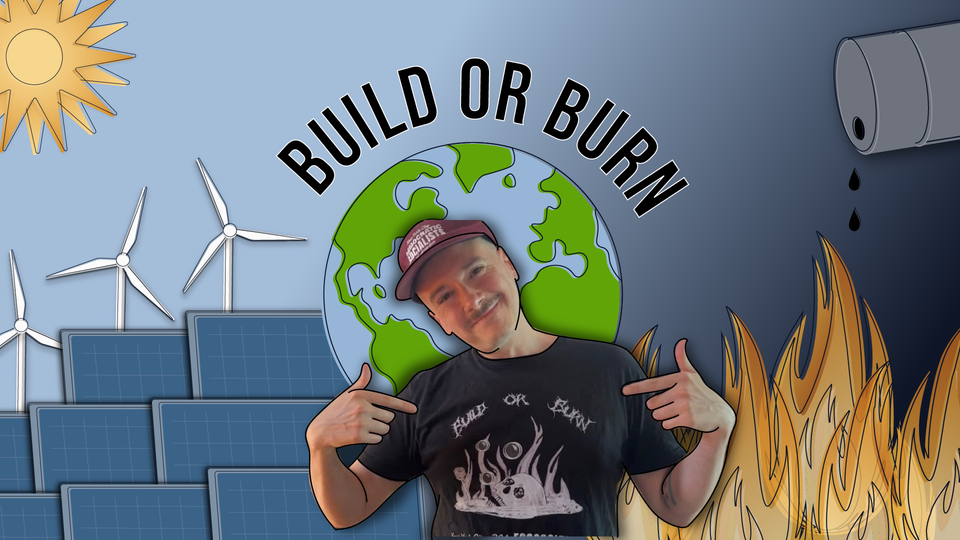
Does building solar farms harm the environment? A Sir David Attenborough fan account I argued with on Instagram thinks so.
Let's talk about it.
In this new video, I break down the real land use math behind solar energy — including the 30 million acres of American farmland currently growing inedible corn for ethanol fuel.
I also introduce exciting new alternatives to building solar on arable land, including floating solar that reduces water evaporation, agrivoltaics (solar + farming, working together), parking lot canopies, highway median strips, and a brand new experiment with train track solar in Switzerland.
The land is out there. The question is who gets to decide what we do with it.
Please thumbs up the video and subscribe to our channel!
And if you're curious, here's the full transcript:
Does building renewable energy projects like fields of solar panels do more harm than good? That's the big question we're gonna answer right now. Hey, by the way, I'm Jon I'm an eco-socialist and proud NYC-DSA member I write a newsletter about clean energy called Green Juice. Clean energy, green juice, you get it Check out what we're doing over at greenjuice.wtf The inspo for this video comes from an Instagram post I saw recently. Here it is. "We need to save the planet from those who say they want to save the planet." The caption reads, "Solar panels may produce clean electricity, but every energy source comes with trade-offs. The real challenge is finding solutions that protect both the planet and the landscapes we depend on." I'll be honest, I assumed this was posted by the real Sir David Attenborough. Turns out it's from a David Attenborough fan account. That's on me. Okay, but this argument is out there and it deserves a real answer, so let's give it one. First off, any conversation about the environmental footprint of solar energy has to begin with the fact that fossil fuels are responsible for ninety percent of all carbon dioxide emissions globally. Ninety percent. So transitioning to clean energy is not just like one useful strategy among many equally valid measures to address climate change. It is the central strategy, the single most important thing we can do to avert catastrophe. So when someone argues that building renewables is a net loss for the environment, they're missing the forest for the trees. Because every solar panel we build chips away at fossil fuel fascism, which is literally what's cooking the planet in a world of imperfect solutions, clean energy is a pretty damn good option. Build or burn, people. That is the truth That said, let's talk about land use because it is true that solar takes up space. But here's the number you need to know. Building out enough solar panels to power the entire United States would require less than one percent of our available land. Less than one percent. So let's talk about where that land should come from. Here's what I want you to picture when you imagine land being sacrificed for energy production. Not virgin forests, not meadows full of grazing buffalo. This. Thirty million acres of American farmland is dedicated to growing inedible corn to be used to make ethanol fuel. About forty percent of all corn harvested in the US does not feed anyone. It gets turned into a gasoline additive. Super quick aside. Most gasoline in the US is made up of ten percent corn ethanol that gets blended into the gas. In theory, this is supposed to be good for the climate. In reality, the corn ethanol program is widely considered one of the most expensive and least effective climate policies ever enacted. But farmers love it because you and me, buddy, are forking over billions of dollars in subsidies to corn farmers every single year. There's a lot more to say about corn ethanol. Maybe I'll make another video. Getting back on track, here's the kicker. A study out of Cornell found that solar panels generate the same amount of energy as corn ethanol, but need just 3.2% of the land. So we have this vast sacrifice zone of industrially farmed monoculture drenched in energy-intensive fertilizer and pesticide runoff, producing a fuel that recent research suggests is actually worse for the climate than regular gasoline So DavidAttenborough_Fandom is framing this as a false choice. We're not choosing between solar farms and forests. We're choosing between solar and inedible corn To be fair, there are many examples of private developers clearing forests to build solar, and this is because our energy system is privatized and profit-driven, and forested or underdeveloped land in rural areas is often dramatically cheaper than agricultural land, especially if that land has productive value that gets priced in. A forest that nobody's farming looks like a bargain on a spreadsheet, but that's only because the people making those decisions aren't the ones who will bear the ecological cost. What we really need is public ownership of our energy system, public goods in public hands So let's talk about some of the places I would put solar if I were the one in charge. First off, I would float as much solar as I can. This is China's Anhui Province. Home to one of the largest floating solar installations in the world. Panels built on top of a reservoir, no land displaced. And here's a bonus. Floating solar significantly reduces water evaporation, with early research showing a minimal disruption to fish and birds. In a world getting hotter and drier all the time, floating solar is a win-win. Over in France, they just passed a law mandating solar canopies be built over large parking lots. Think about how much asphalt exists in this country that's doing absolutely nothing except radiating heat into cities. That's free real estate, and the panels provide shade so you won't burn yourself on your seatbelt. South Korea is installing solar panels along the median strips of highways. Again, we can use land that's already been disrupted, that's already paved. It's just sitting there Switzerland has started to install solar panels between the rails on an active train line in the canton of Neuchâtel. Neuchâtel. The panels roll out like carpet between the tracks placed by a specialized train capable of laying up to 1,000 square meters per day. And then there's agrivoltaics, a terrible name, but that's what it's called when you integrate solar panels directly into working farmland. Research shows that shade-tolerant crops lettuce, spinach, broccoli, tomatoes, berries can actually thrive underneath solar panels with yields comparable or, in some cases, greater than open field growing. As for livestock, the shade from the panels reduces heat stress in animals, which matters more and more every summer. In a world that is getting hotter shade is increasingly a feature, and agrivoltaic systems reduce soil temperatures, slow evaporation, and protect crops from extreme heat and hail. We should rename agrivoltaics. Maybe we can call it sun farming or something cute. Let me know what you think So let's return to where we started. "Solar panels may produce clean electricity, but every energy source comes with trade-offs." Well, I would say that's technically true. Everything does have trade-offs But the fossil fuel industry has never once been asked to defend its trade-offs at this standard. Not the land sacrifice zones around extraction sites, not the pipeline corridors, not the cancer clusters downwind of refineries. Solar and wind, because they're new and clean, get asked to be perfect, whereas fossil fuels get to be the default. The future does not have to suck, but it requires an honest conversation about what we're actually comparing. For more videos like this, please subscribe to my channel, Green Juice, here on YouTube. I'm trying to put out new content every week. And check out my newsletter, greenjuice.wtf, where I go even deeper on topics just like this one. We've got a really exciting post coming out next week about the hidden ways private utility companies are screwing us over. You won't want to miss that one. Thanks for watching, and as always, solidarity forever. Thanks!


Member discussion