
ConEd's exploding manhole problem
Welcome back to #FuckConEd Summer! The high in New York City today is 99°. Check out our new video, 10 Facts About ConEd Every New Yorker Should Know!
Something exploded underground just a few blocks from my Brooklyn apartment last month. Fire rushed up from a grate like raw sewage during a rainstorm. Many of the nearby businesses lost power. Luckily, nobody got hurt, though that's not always the case.
While this particular explosion didn't make the news, the event registered on Reddit. None of the Redditors, however, could pinpoint the cause. "Fecal fire," "natural gas leaks," and "Ninja Turtle business" were the best guesses.
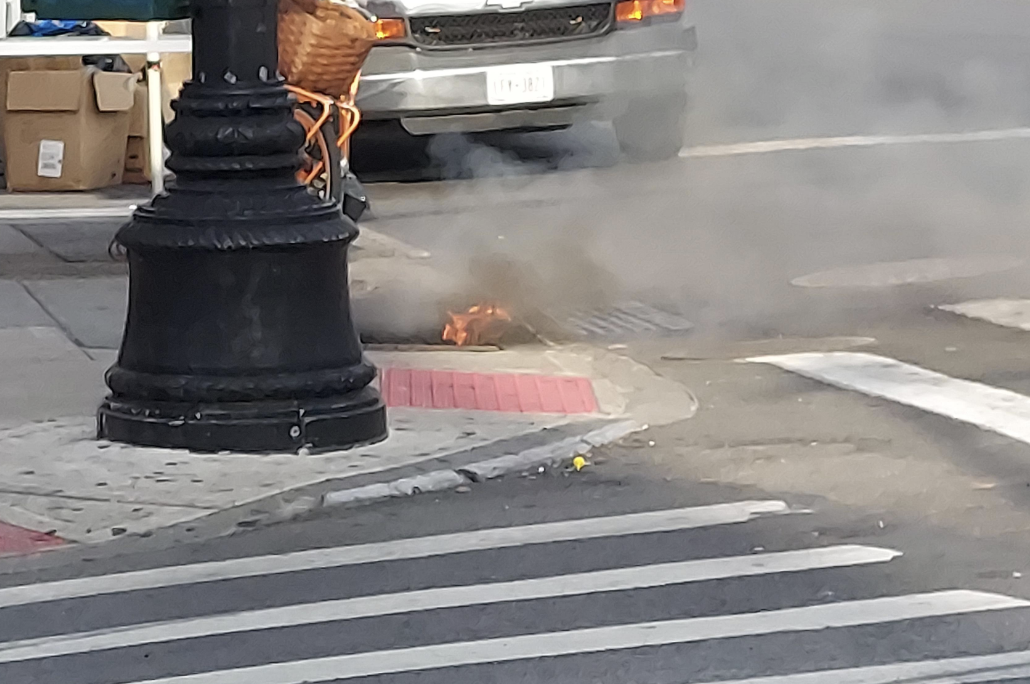
Allow me to name the real cause of this explosion and hundreds of others just like it that have rocked NYC's streets going on decades:
ConEd's ancient underground electrical infrastructure, never properly dealt with, has turned into a ticking time-bomb.
In this post we'll cover:
- What the hell is going on? (Old cables are exploding)
- How often is this happening? (ConEd won't say)
- What does ConEd do when a cable explodes? (Switches to a different old cable)
- Is ConEd replacing the cables? (Not really, but we don't know)
- What other data is ConEd keeping secret? (Lots)
- What would a publicly owned utility do differently? (Lots)
Let's get into it. Keep an eye out for flying manhole covers.
What the hell is going on?
There are thousands of miles of copper cables buried underneath New York City—95,000 miles, by ConEd's own estimation. These cables are responsible for shuttling the electricity we use around the city. It's not unusual to bury power lines, to be clear. Many densely populated cities do. Burying your lines keeps them out of the way and offers the electric grid protection from storms.
These cables form the connective tissue in NYC's local distribution grid, the electricity delivery infrastructure over which ConEd holds exclusive ownership and control.
Our problem is twofold:
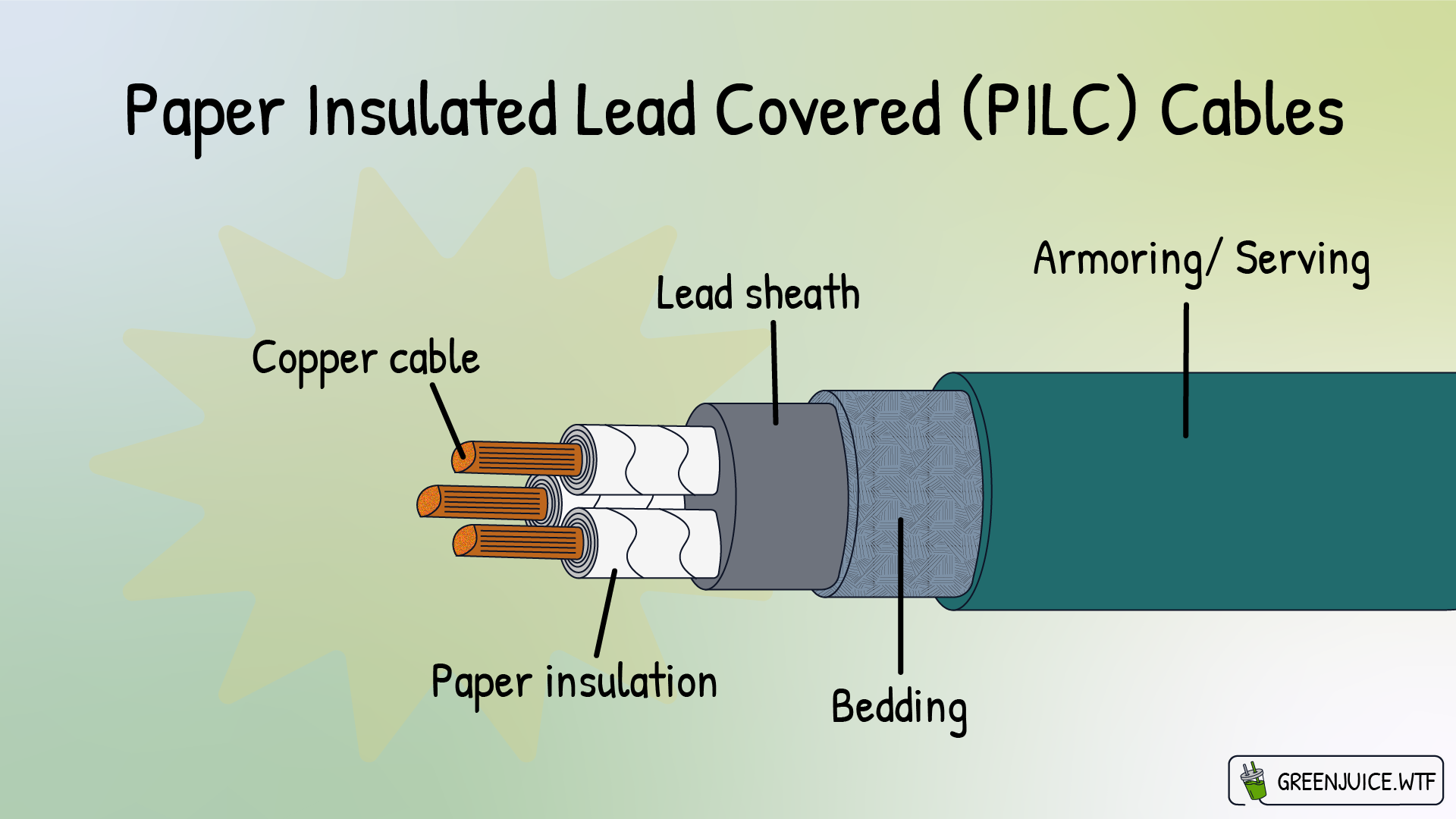
- When these cables were installed—beginning in the early 1900s all the way through the 50s and 60s—the leading technology for insulating and wrapping the copper cables was called PILC: Paper-Insulated, Lead-Covered.
How it works: you can't just bury copper cables underground without first insulating and covering them; otherwise, the electric current they carry would arc or leak out, causing lots of problems. So the solution they found was to wrap the cables in layers of paper that had been saturated in mineral oil before encasing the whole thing in a lead sheath, and then sometimes an additional layer or two of protective material. The mineral oil was found to be a surprisingly effective insulator... so long as it remains securely enclosed. - PILC cables are designed to work effectively for 40 to 50 years. Today, however, many of New York's PILC cables are 60, 70, or even 80 years old—and still very much in use. Some cables may be even older, but we don't know (see the section on ConEd's secret data).
These cables are now so old that they're literally decomposing, accelerated by corrosive salt used for clearing ice during the winter that gets into the pipes where these cables are buried, as well as the vaults—the underground chambers, covered by manholes, that allow workers to access the cable network.
What happens is that over time the outside layers degrade and the lead sheaths crack, exposing the layer of oil-soaked paper. Accelerated by a live electrical current, the cracked lead and the exposed insulation begin to produce a panoply of noxious, explosive gases: hydrogen, carbon monoxide, methane, acetylene, and ethylene.
As the insulation and lead casing further decompose, the copper cable becomes exposed and eventually short circuits: an arc of pure electricity jumps off the copper, connecting with one of other cables overcrowding the pipes and vaults, dumping an enormous amount of energy into a confined space, vaporizing the remaining insulation and producing a far greater volume of those gases which then ignite and generate an explosion capable of launching a car into the air.
Wait, what the fuck?
What the fuck, indeed.
How often are these explosions happening?
The best (and only) reporting I've found on this subject was done by THE CITY. I'll quote from two articles, one from 2020 and a follow-up piece from 2022:
The FDNY logged 45,000 "emergency manhole incidents" between 2009 and 2018, of which they classified 4,000 as "explosions". At least 57 people were injured during that period.
The number of “blown cover” events—meaning a manhole top dislodged by the force of an explosion—reached 281 in the fiscal year 2021 ... up from 134 in the previous year.
Manhole fires and explosions have caused significant property damage, building evacuations, power outages and traffic disruptions over the last decade. They have also led to dozens of injuries — and even death.
On Oct. 8, 2008, a ConEd cable splicer named George Dillman was working in a Brooklyn manhole when an electrical issue lit up the underground vault in flames. It took more than two hours to retrieve Dillman’s body from the manhole, which burned as crews struggled to shut off the power.
What does ConEd do when a cable explodes?
There's a lot of redundancy baked into NYC's underground grid network. That means when a cable fails, ConEd can usually just switch affected customers to other nearby cables.
Here's the problem with that: the adjacent cable that picked up the extra load is probably also old and already stressed—and ConEd just told it to run even hotter. In a few weeks or months, perhaps, you get another fault in the same area.
One failure begets the next.
Obviously, then, it makes a lot more sense to replace these old cables before they explode.
Is ConEd replacing old cables before they explode?
Yes, but we don't know how much PILC still remains.
In this 2020 state investigation into ConEd power outages, ConEd claims to have replaced the majority of the PILC cable in their primary feeder system. You can think of the primary feeder cables as electricity highways that run throughout the city—the major arteries.
Branching off from those highways is the far larger secondary network: thousands and thousands of miles of buries cables connecting individual buildings to the primary feeders.
We have no idea how much PILC still remains buried in the secondary network. ConEd doesn't make that information publicly available. But considering the sheer size of the network and the fact that shit is still exploding all the damn time, one suspects there's a substantial amount left untouched.
Why isn't ConEd moving faster?
If you've read Green Juice's previous posts on for-profit electric utilities, you know that ConEd only wants to do work that it can profit off of, which doesn't include repairs.
But ConEd can absolutely count replacing PILC cables as a Capital Expense (CapEx), which means they get ~10% of the total cost of the project returned to them as profit.
So... what's the hold up? Two reasons.
First, it's a huge pain in the ass to replace these cables. In order to dig up a New York City street, ConEd has to get a permit and coordinate with the DOT, the DEP, and the MTA. Just to replace a cable that might only be half a block long.
The second reason is more nefarious.
To get a new CapEx project funded, ConEd must first secure the approval of their regulator, New York State's Public Service Commission (PSC). Doing so requires ConEd to demonstrate to the PSC why the work is necessary. And, since any PSC rate case proceeding gets made public, that may well entail disclosing data that ConEd would prefer to keep under lock and key.
Y'know, data such as a detailed condition assessment of their vast network of underground cables, which could conceivably show a huge number of PILC cables at high risk of failure that ConEd's known about forever but hasn't done jack shit to remedy.
Such a revelation could theoretically expose ConEd to litigation. From, say, the family of the two-year-old and four-year-old who received burns on their faces from an exploding manhole cover in Tribeca earlier this year.
From ConEd's perspective, it makes much more sense to just wait until something explodes. That way, they can replace the cable without having to disclose any of that potentially damning data. In this case, ConEd won't make a profit—it gets categorized as an emergency operating expense, not a capital expense—but the cost of the work still gets passed onto the ratepayers, AKA you and me. A worthwhile sacrifice.
What other data is ConEd hiding?
ConEd, a monopolistic private utility controlling a public good, hoards a treasure trove of information about the electric grid that the public should absolutely be able to access.
I could write a whole separate blog post about this subject—and I will. Stay tuned.
How would a publicly owned utility address the problem?
If the City of New York took over ConEd tomorrow and ran it as a nonprofit public utility, what might they do differently?
Zohran would probably make a killer video about it, first of all.
But ripping up 70,000 miles of streets would remain difficult and expensive.
What you'd want to do, in one English major's opinion, is unfurl the map ConEd keeps hidden that shows where the oldest PILC cables still in operation are buried in the city.
Second, make a spreadsheet that scores every cable for its consequence of failure. Meaning, should the cable fail, would a hospital lose power? A school? A whole neighborhood?
Third—and this is my own stroke of genius—cross-reference a map of the city's buried natural gas pipes. Wherever possible, shut down those gas lines and use the already-built and buried pipes to store the new, modernized cables. Save some money, get off gas, win-win. I did a bit of digging on this and it does seem plausible. Not every pipe would be a great fit, but some could work.
Lastly, build a criticality-weighted capital plan for the systematic replacement of PILC cables, prioritized by risk score (cable condition × consequence of failure). Publish this information so that the public and the City Council have concrete data they can use to hold the public utility accountable.
And then we roll up our sleeves.
It's about time someone did.

Member discussion