
Geothermal Guesser
Hello, beloved Green Juice readers! We're back from our late summer hiatus with hot, wet, titillating news: according to a startup called Zanskar, there may be waaaaaay more naturally occurring geothermal hotspots in the United States than previously believed.
How much more? On a recent episode of the Volts podcast, Zanskar posited there are up to ten times more hot rocks with good water flow than the existing models suggest. Equally exciting, Zanskar boldly claims that each geothermal site—including those we've already found—can produce up to ten times more energy than anyone thought possible.
If Zanskar's right—a very big "if", to be clear—it's hard to overstate the impact. The amount of energy they're talking about could power the entire US with clean geothermal six times over, at a price that's potentially competitive with solar and wind.
A claim that bold begs the question: if all those hot rocks really exist, how in the world has nobody else noticed already? And what makes these guys so confident?
Let's discuss!
...except, hold up a second. OG Green Juice readers may remember our three-part series on geothermal energy from March, 2025. If you're already lost in this post's sauce, I recommend reading part one, Geothermal energy: the heat beneath our feet for additional context.
Parts two and three in our series focused on some of the exciting new advanced and enhanced geothermal technology companies trying to make geo energy possible anywhere on Earth by drilling so deep that the rocks get hot no matter where you're starting from.
That's not what Zanskar is all about. They have no interest in drilling 20 or 30 thousand feet down. Their hypothesis is there's way more conventional geothermal formations out there—naturally permeable hot rocks forged by tectonic plates shifting and stretching across millions of years. Think of Old Faithful spouting off in Yellowstone.
Now imagine if Old Faithful had never managed to breach the Earth's surface. All that hot water would still be roiling... but in a huge underground cavern, just a few thousand feet down. You could walk right over it and never know it was there.
That's what Zanskar's after. Because if you knew where to look, the relative cost of drilling a shallow well vs. a super-deep well is enormous. We're talking a few million vs. tens of millions. And the cavern, formed over millions of years of steady erosion, may well be enormous—and therefore far more permeable than the forced rock fracturing ESG companies like Fervo are capable of generating.
Maybe a $10 million cost differential doesn't make your spine tingle. I get it. But in the world of energy, cost is everything.
Great. Now that we're all on the same page, let's drill down.
What's Zanskar basing their claim off of?
I mean, how the hell can there be 10 times more piping hot geothermal out there than even our highly speculative government has previously speculated?
A couple things to consider:
- They're using AI. No, not to make striking images of new mythical beasts (hippo head + newt body??), but to produce a map of likely geothermal hotspots by synthesizing a variety of disparate data sets.
- Everybody stopped looking. The US government and various hot/wet rock enthusiasts tried looking at all the spots where it seemed like conventional geothermal should be. But it's not so easy. The world is big, and drilling even a thousand feet to test a site is pricey. So they threw in the towel and said, "Eh, guess there's just not that much of it."
- Zanskar isn't just dicking around in a spreadsheet. This story wouldn't be newsworthy if Zanskar had just made a sexy model that promised vast riches. Anybody can make a sexy model. Hell, I'll make you a sexy model right now. What do you want to model, a sexy new mythical beast? Just name the animal parts!
Point is, Zanskar didn't stop at modeling. They went out into the field and drilled. In the last five years, they claim to have tested over five million acres of land in the American West (another huge claim, for those counting at home). We know they've hit pay dirt at least three times, and likely even more. We don't know for sure, though, because Zanskar won't reveal the extent of their findings. We'll talk about why that is. But first...
A brief history of looking for geothermal au natural
There have been two major periods of geothermal exploration in US history. The first wave came in the 70s and 80s, spurred on by the oil crisis, led by oil companies and the US government. Despite spending billions in today's dollars, they didn't find much. A second wave launched in the late 2000s in response to federal and state policy changes that created new markets for renewable energy. That wave subsided with the explosion of cheap domestic fracked gas, and also because they didn't really find anything.
Today there are only ~36 geothermal fields operating in the US. They produce roughly 4 gigawatts in total. Half of those sites were discovered by accident: a farmer looking for water or a prospector digging for gold inadvertently unearthed a natural deposit of hot, wet rock and promptly pivoted careers.
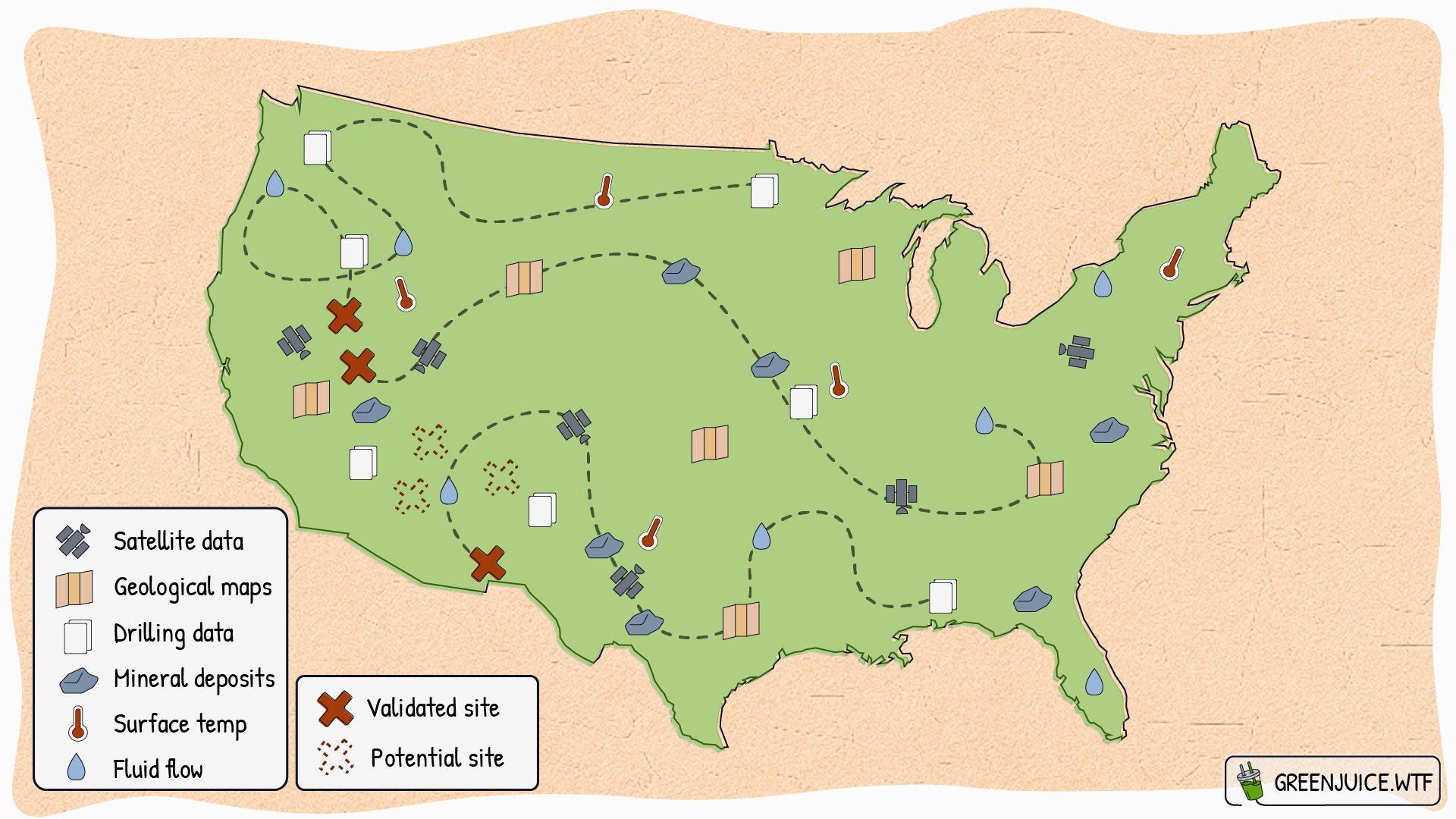
But all that exploring wasn't for nought. The resulting data sets are what's fueling Zanskar's AI models, along with geologic mapping data from universities and national labs and real-time data from satellites that can measure surface temperatures, tiny ground movements, and even identify mineral deposits.
All those data points are clues; none alone is sufficient. But when combined (and used to train AI), they evidently form a handy little treasure map.
A new meaning to "vertical integration"
As mentioned, Zanskar isn't just conversating with Claude Code. They are actively exploring the near depths of New Mexico and Nevada.
They're announced three sites:
- A formerly failing geothermal field called Lightning Dock in southwestern New Mexico where one of Zanskar's cofounders had previously worked. The company purchased the field, believing there was more hot rock on site than met the eye. They drilled a new, deeper well and got the operation humming. Zanskar estimates there's as much as 10 to 40 times more energy potential than the initial industry estimates, but they don't know for sure: Lightning Dock is currently constrained by the size of the pump they have on site.
- A site called Pumpernickel, named for Nevada's Pumpernickel Valley, where there are known hot springs. Yet none of the three previous attempts at exploration resulted in real drilling and development. The rocks can't just be hot, you see: they need sufficient water flow to run a power plant.
- Last but not least, Big Blind, the recently announced site in the remote western Nevada desert that's been turning heads. Unlike the previous sites, there was no telltale sign of geothermal activity. No existing wells to provide data. This was a genuinely blind discovery. They also claim that it's a big boy. Per Zanskar cofounder Joel Edwards:
The thing that’s really exciting about this system in particular is how big it is. This system, by the surface footprint of the heat flow anomaly, is much bigger than Pumpernickel and much bigger than Lightning Dock.
So, Zanskar's announced three sites, only one of which proves out the model. Is that enough to go on? To believe that there are terawatts of undiscovered geothermal out there waiting to be tapped?
Maaaaaybe? More information would be helpful. But there's a good reason for their secrecy.
90% of identified geothermal resources sit on federal land
As the federal government marched westward (thanks, Manifest Destiny!), they acquired whatever land the homesteaders and railroads didn't claim: huge tracts of dry, rugged terrain that has remained under federal control lo these many years. It amounts to roughly 245 million acres, a tenth or so of the entire US, managed by the aptly named Bureau of Land Management.
When a company like Zanskar wants to drill for geothermal on a parcel of BLM land, they can't just negotiate to buy or lease the land from the government directly. They have to go through a fairly complicated and severely antiquated process that entails nominating a specific parcel for lease, then winning a competitive auction run annually by the BLM and open to anyone with a dream.
So that's why Zanskar isn't bragging about all the sites they may (or may not) have discovered: doing so would drive up the price of those land auctions.
Should they win the lease, go on to discover hot, wet rock, and start producing power, they would then have to pay royalties: 1.75% of gross electricity sales for the first 10 years of production, then 3.5% after that. 50% of the royalties goes to the state, 25% to the county, and 25% to BLM for processing geothermal leases.
What about transmission?
Astute question, reader. What's the point of a cheap geothermal site if it's located in the middle of nowhere, with no way of moving those electrons to demand centers?
If you remember our series on building transmission lines, you know the biggest problem is dealing with tons of tiny NIMBY landowners, each of whom must be placated before anything can get built. Well, federal land doesn't have that problem. And yet it remains a huge pain in the ass to build transmission anywhere in this country. But it is happening.
NV Energy, a major private utility in Nevada, is currently building Greenlink, a set of big new high-voltage lines. Greenlink West runs about 350 miles from Las Vegas to Yerington and is expected online by May 2027. It follows the US-95 corridor, which just so happens to pass through the Tonopah area, where Big Blind is located. Convenient!
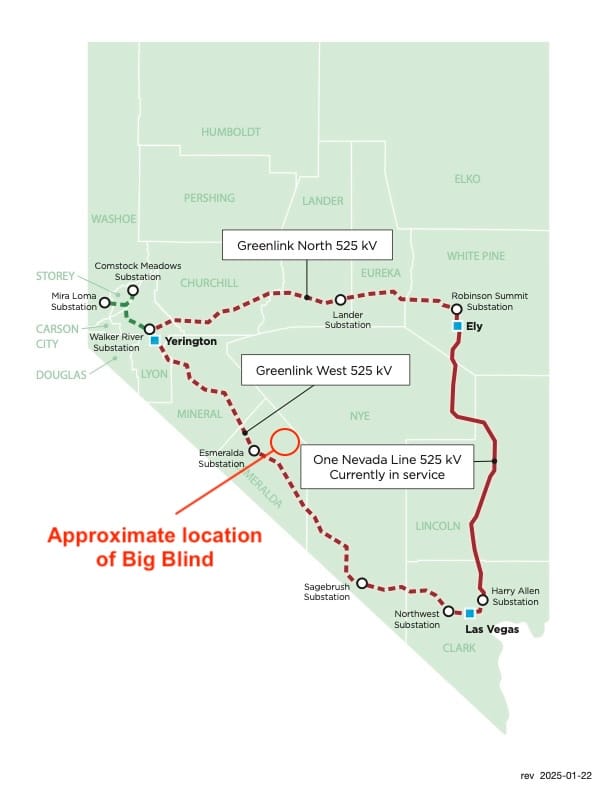
The price tag of the Greenlink line has climbed to $4.24 billion, up from an initial estimate of $2.5 billion. All paid for by NV Energy's wholesale transmission customers and ratepayers statewide, of course.
So, transmission remains a bottleneck. We already knew this.
What if they're right?
The US Geological Survey's 2008 assessment from that second wave of exploration estimated roughly 30 GW of geothermal resources still undiscovered. If we apply Zanskar's claim literally—that there are 10x more sites out there and every site has 10x the power—then we're looking at something like 3,000 GW of untapped clean energy resources, much of it sitting on federally owned land.
3,000 GW of geothermal power plants running 90% of the time would meet the US' current electricity demand five or six times over.
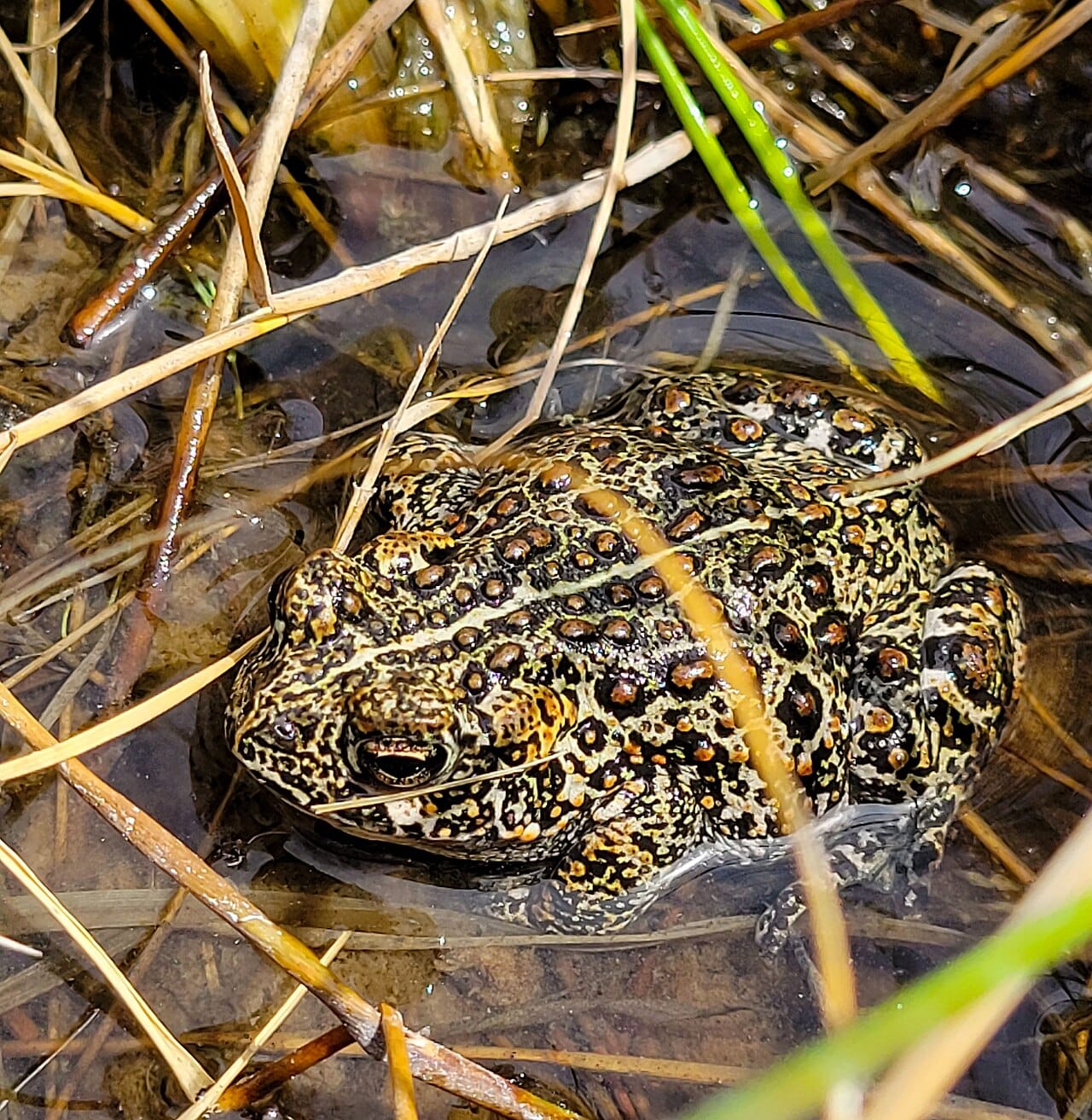
There are caveats, of course. Not all of those sites will be ideally situated, or shallow enough to make the drilling costs pencil, or easily reachable by transmission lines. There are important environmental and tribal justice concerns, as well. During the course of my research for this post, I learned about the saga of the Dixie Valley Toad, a tiny, endangered toad that only lives at one set of Nevada hot springs, a place the Fallon Paiute-Shoshone Tribe considers to be sacred. When a geothermal project moved in next door, the tribe joined the Center for Biological Diversity in suing to stop construction. They've been litigating for years.
Still, even if we threw out 50% of the theoretical sites, we'd still be very much in business.
What's the move?
A country that cares about stuff like climate change, providing its citizens with affordable electricity, and establishing energy independence, might consider taking the following steps:
- Fund the severely understaffed Bureau of Land Management so they can process permits faster
- Streamline the BLM permitting process. One example is the HEATS Act, a live bill in congress that would remove some of the permitting requirements for situations in which the federal government owns the rights to underground geothermal but up on the surface the land is owned by a farmer or homestead cosplayer.
- Consult tribes early. Get their buy-in. Don't site projects on sacred lands, duh.
- Build national high-voltage transmission lines so we can spread earthy geothermal power across the country. Legislate whatever reforms are needed to make this less expensive, annoying, and time-consuming.
- Invest in state exploration and public ownership. Yes, a third wave. Except now we've got a better blueprint to work off of. We can update our old data sets, build better models, and do exactly what Zanskar is doing... but at a scale befitting the richest nation on Earth.
- Increase the amount of money private developers have to pay out in royalties. A 100 MW plant on federal land might send the public a measly $1 million a year. That's silly. Zanskar built their models on data paid for by the public. It's only fair that we be compensated for those early, expensive periods of exploration.
It's way too early to know if Zanskar's right. But if they are, the decisions about who owns the hot, wet rocks, who profits from them, and whose land the power plants get built on are being made now, by default, through a leasing system designed in 1970 for a cottage industry.
Maybe, just maybe, we should spend some of that Iran War bomb money on maintaining a functional federal government?
A guy can dream.
Follow Zanskar on their journey by checking out their Substack.

Member discussion