
My secret solar panel

This post is #sponsored by Every Electric. Green Juice only partners with vetted allies in the fight against climate change and energy insecurity.
Like 1,000 other New York City households, I earned passive income over the summer by hosting a pair of Every Electric batteries in my apartment. These silent, unobtrusive boxes made me $200 over three months—my slice of the more than $160k Every Electric is on track to pay out to participating households this summer—all while helping to balance the energy grid. I would have made even more money, but one of my batteries had a software issue that took it offline for most of July (and I kept forgetting to bug them about it).
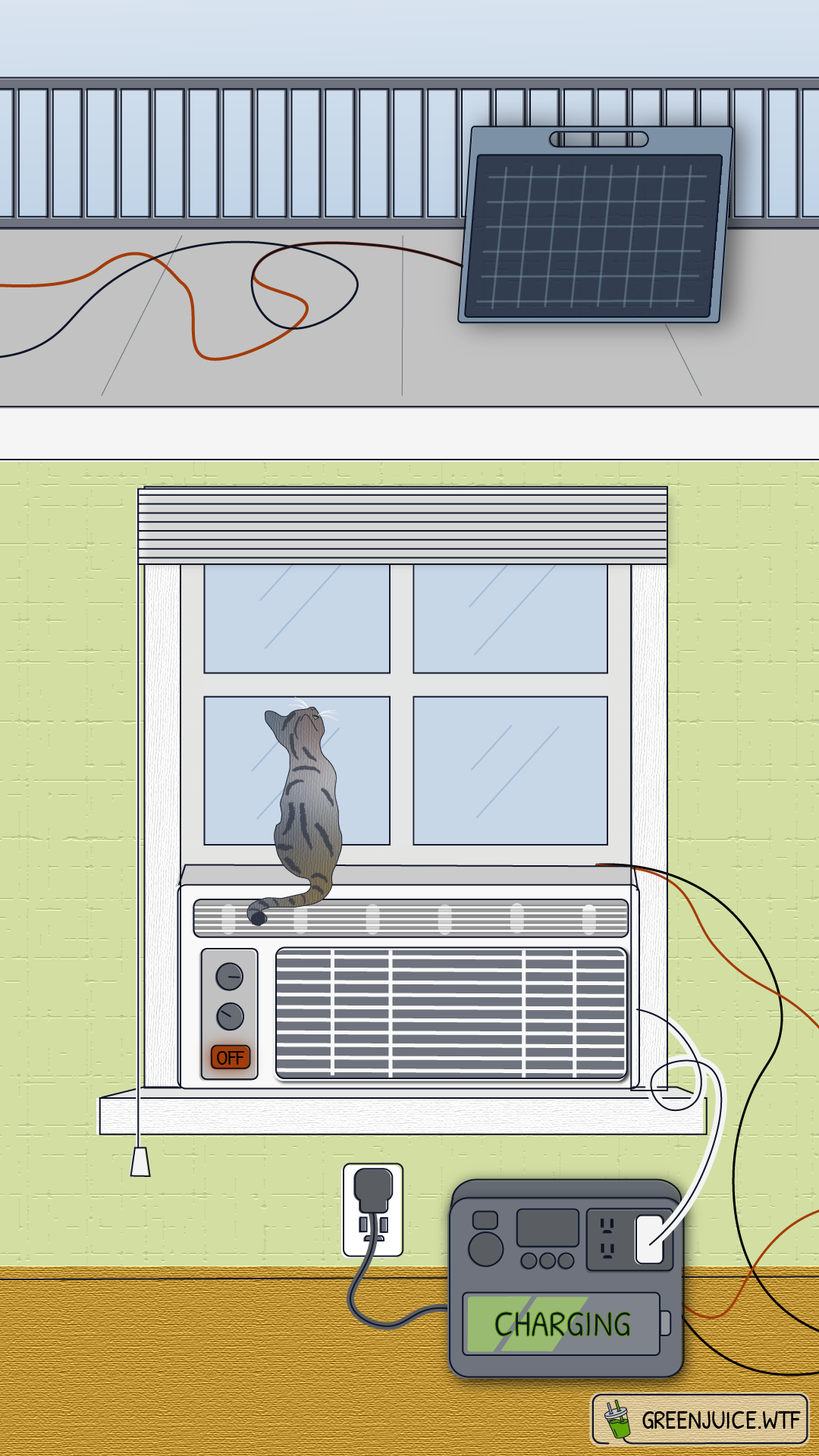
Still, all I had to do was plug the batteries into the wall and plug my window A/C units into the batteries. Easiest money I ever made.
Every Electric's program is done for the year, but they're already taking signups for the summer of '27—so sign up right now to lock in your spot.
But I had something special that probably none of the other 999 households participating in the battery bonanza had: a secret solar panel.
Yes, that's right. A secret solar panel up on my roof has been beaming clean energy down into my battery, keeping the tank full and lowering my ConEd bill.
"Wha?" I can hear my readership exclaim, incredulous with envy. "A secret solar panel?! How's that freaking possible? Plug-in solar is still illegal in New York because Governor Hochul refuses to sign the SUNNY Act!!"
Indeed, plugging a solar panel into your wall outlet is illegal. But plugging a solar panel into a battery is perfectly legit. And you might just want to pick up a panel for yourself.
I'll tell you all about it.
My solar saga
My solar saga began in May with an email from Andrew Wang, co-founder and CEO of Every Electric. Andrew and I had become friendly after Green Juice covered their program. Knowing I'm a clean energy freak, Andrew asked if I had any interest in helping EE collect some data around how solar interacts with their batteries.
I responded normally, of course:

A few days later, a lovely new Bluetti 100 watt solar panel arrived at my door.
Now, 100 watts is about the smallest wattage panel you can get your hands on. The SUNNY Act, which I believe I mentioned Governor Hochul refuses to sign, would legalize up to 1,200 watts of panels. Twelve times as much! The average rooftop solar installation ranges from 6 to 10 kilowatts.
So, 100 watts isn't huge. But this panel was mine.
I only had one question: where do I put it?
Our apartment doesn't have a balcony, so partaking in traditional German balkonkraftwerk wasn't in the cards. We have a fire escape, but the panel needs to be kinda close to the A/C unit, and you can't put an A/C unit in a fire escape window because, well, what if there's a fire?
What we do have is questionably legal access to our building's unfinished rooftop. The kind of New York City rooftop that's been generously coated in an off-white substance that squishes under your feet like marshmallow.
So I did what any enterprising clean energy accelerationist would do: I hauled the solar panel up to the roof, laid it flat on a random section of 'mallow, and lashed that sucker to a railing with a jumprope. I then snaked the cords down through the airshaft and plugged it in. Note that I needed an extension cable to reach our apartment.
I did all this under the assumption that my negligent landlord would never notice. So far, I've been right.
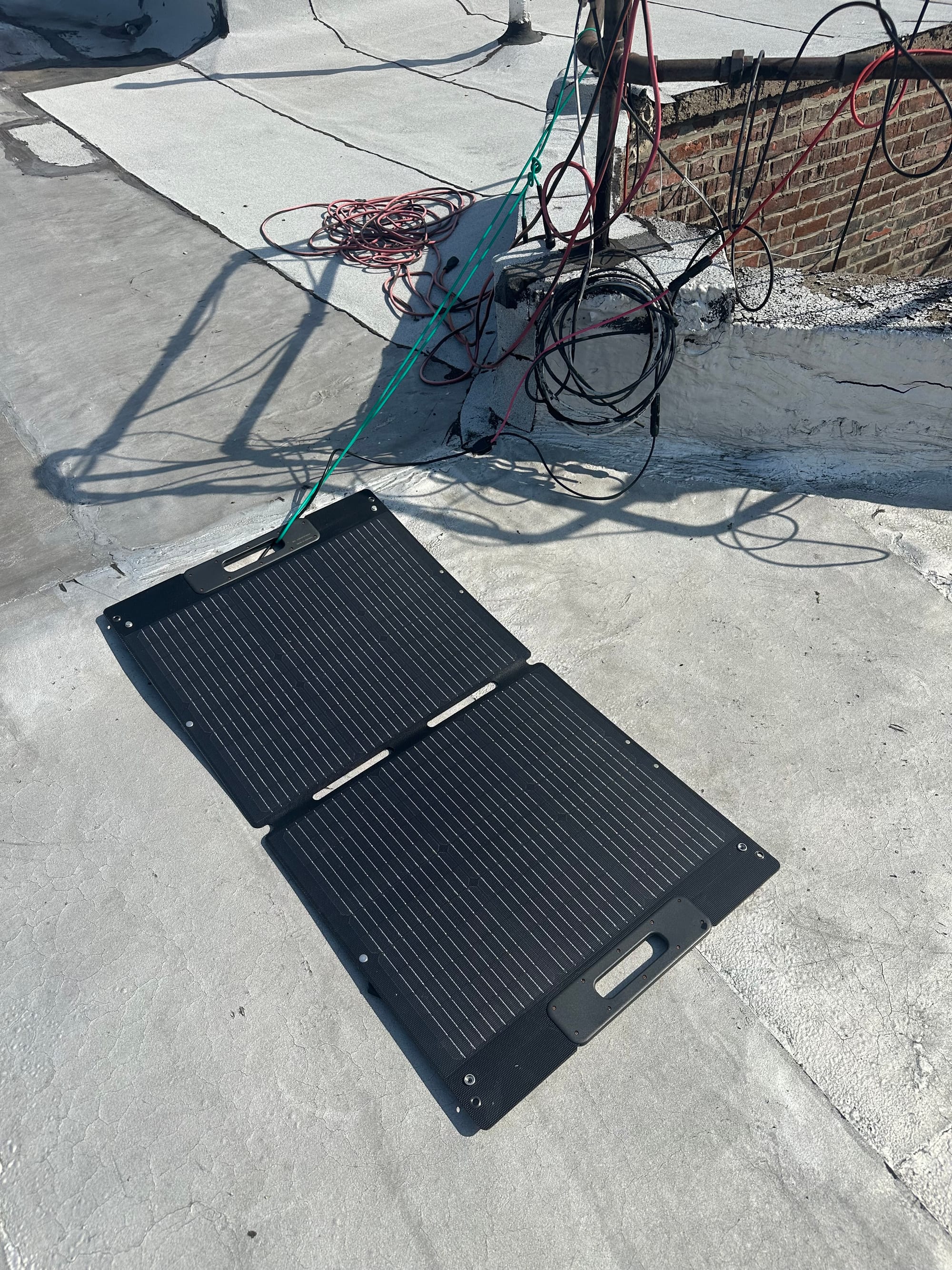
That was over three months ago!
How'd she do?
Last week I caught up with Andrew about how Panel-ope, as I named her, has been performing. Here are the stats:
Production
Over the course of a typical day in June, Panel-ope generated an average of about 400 watt-hours.
For context, a solar panel with a so-called nameplate capacity of 100 watts means that under perfect conditions, the panel will produce energy at a rate of 100 watts per hour. But reality is rarely perfect. So unless it's high-noon in Tucson, you're probably never gonna get 100 watts of production from your solar panel. Up on my roof, on a sunny summer's day, my panel topped out around ~60 watts.
Panel-ope's best single day total was 536 watt-hours. That's enough to fill up over a quarter of Every Electric's 2 kilowatt-hour battery.
Production fell off during rainy September, I'll note, with an average of just 211 watt-hours a day.
In total, Panel-ope delivered 29.6 kilowatt-hours to her battery buddy between June 7th and September 30th. That accounts for 9% of all the energy the battery used to power our A/C unit.
Not too shabby!
Curtailment
Curtailment is an energy term for when you've got wind or solar energy available, but you either can't use it or don't want it, so instead you just let it go to waste.
Here are a couple typical scenarios:
- California at midday in spring. On sunny spring afternoons, California's solar output grows huge while demand for electricity stays low (since it's a comfortable temp, nobody's blasting the A/C). So you end up with more energy than you need, which can actually cause the price of electricity to go below zero, into negative territory. When that happens, the grid operators will pay you to take energy off their hands. But instead of doing that and losing money, the grid operators tell solar farms to cut their output.
- West Texas wind. Many folks don't realize Texas has the most wind energy of any US state, over 40GW of wind on the grid! But they build it out west (where it's windy) while most of their demand is in central and southeastern cities like Dallas and Houston. Because we don't have enough transmission lines in this stupid country, Texas wind farms get curtailed when the lines max out—even though there's plenty of demand for it. We're just physically unable to transport all the power.
Good times!
In my case, Panel-ope's power got curtailed whenever she was generating but the battery was full, so there was nowhere for the energy to go. On average that happened roughly 12% of the time the panel was producing power.
"Why would the battery already be full?" is a reasonable question. To understand what Every Electric is doing with all those batteries, check out our article on how the battery program works.
 Jon
Jon
Now, if you've read the article and still don't get why the battery would be full, the reason is that Every Electric hasn't been accounting for my panel's production in their decision-making. I'm a test case, remember.
But they did map it for me. In the chart below, the pink line shows how much energy the battery could have captured if there had always been room for it. The blue line shows what was actually captured. The difference between the two is what got curtailed.
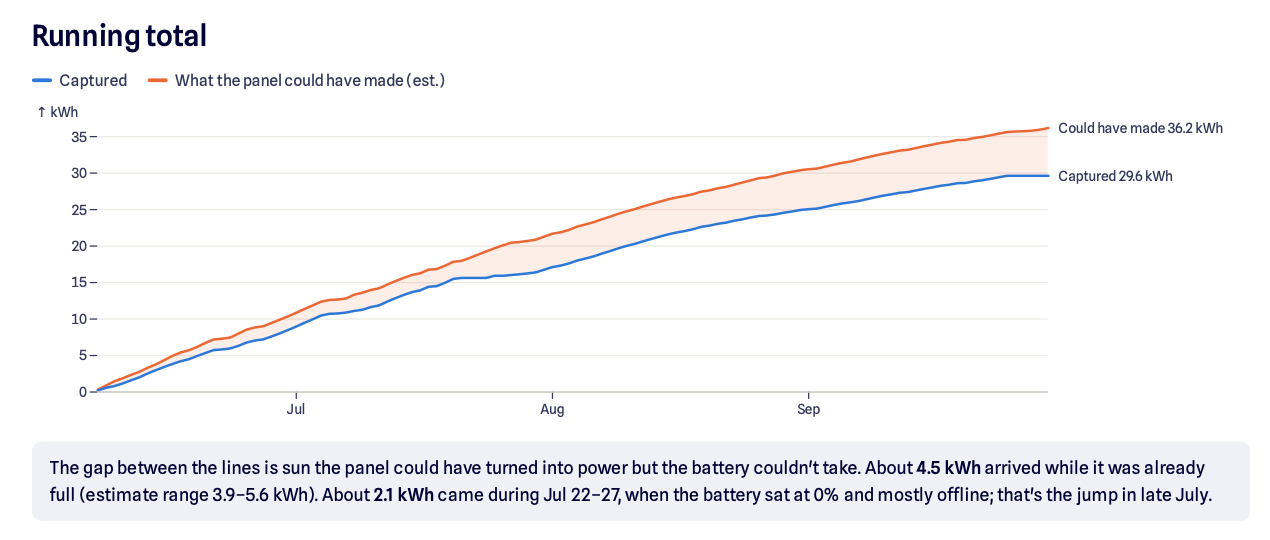
Now that they've got some data, however, Every Electric might change things up next year. For instance, if they only charged my battery to 80% instead of to 95%, there'd be enough room for Panel-ope to do her thing.
And if I got three more Panel-opes, on sunny days the panels could fill up the whole battery.
Panel payback period
Andrew and co. also calculated how long it would take for my solar panel to offset its upfront purchase cost.
Reminder that their battery program is free! I'm just talking about purchasing a solar panel to add to the mix.
A 100 watt panel goes for around $200 these days. You could get the same panel for half the price in China, but this ain't China.
So how long would it take? Well, if I only used the panel in summertime, Panel-ope would pay for herself in approximately... 17 years.
But with year-round use, the payback period shrinks to just 6–7 years. The easiest way to keep using your panel throughout the winter is to plug some appliances into the battery. A router, a lamp, a laptop charger, or even your refrigerator.
Now, 6–7 years might still seem like a long time, but modern panels are built to last 20 years or longer. So a panel can pay itself back three, four, or even five times over the course of its useful life. Sounds like more passive income to me.
What's next for Every Electric?
This summer, Every Electric delivered 2,000 batteries to 1,000 households, putting a cumulative 4 megawatt-hours of additional energy storage on the grid scoreboard. That's the size of a shipping container battery, like the Tesla Megapack—if it were split into a thousand pieces and distributed across NYC. And there's so much room to grow. Andrew told me they plan to scale to 10,000+ batteries in future seasons.
Every Electric will remain a summertime program for now (though the batteries remain functional as backup power throughout the winter), but I can also envision them expanding to more months of the year. How? The likeliest route is if more New Yorkers adopt window unit heat pumps, the year-round solution for electric heating and cooling. Heat pumps are just like A/C units, but they can cool and heat. Nifty.
Guess who wrote a three-part series about heat pumps? Green Juice did, my friend.
 Jon
Jon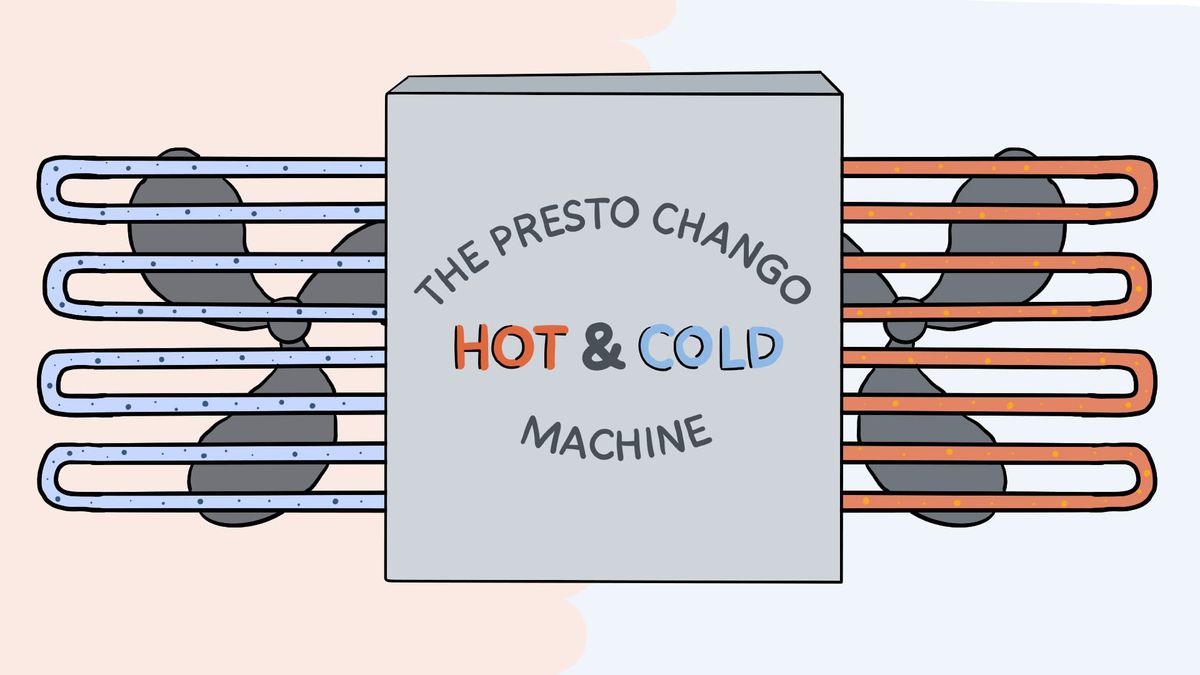
There are some encouraging signs that this will happen sooner than you might think. The global heat pump market is projected to reach $210 billion by 2035, and here in New York City, gas heating is effectively banned in new construction already. I'm also hopeful that Zohran's administration will find effective ways to help existing buildings decarbonize, which is required by Local Law 97.
The other route to expansion would be if batteries in NYC could backfeed. Backfeeding is when you send power into the electric grid instead of drawing it out. In theory, if my neighbors were running the A/C but I wasn't, my battery could feed its stored power to the grid and help them out.
Unfortunately it's not possible to backfeed in NYC without first reprogramming grid infrastructure. And a certain utility company who shan't be named today hasn't exactly made doing so a priority. But it could happen!
Should you get a panel?
In my totally unbiased view, yes! More than one, ideally: Every Electric's 2 kWh battery can handle up to 1,000 watts of panels at up to 60 volts. Here's why:
This summer, Every Electric was called on to respond to at least 13 separate grid events, times when peak loads distress the grid and their extra muscle was needed to help keep the system online. That number is likely to increase in the coming years as more data centers get built, the grid's infrastructure continues to age, and our world is increasingly electrified.
The ability to generate and store your own electricity will become less of a novelty and more of a necessity. During a blackout, having solar panels to quickly charge your battery will ensure your internet stays up and your food stays cold. In winter, charge the battery before a storm, then switch it off in case you need the power. In summer, as more households join the program, the fleet becomes more valuable to the grid and gets called on more often, which can mean bigger payouts over time.
Solar now supplies about 10% of the world's energy, recently surpassing nuclear. That number is gonna keep going up and up. Don't get left in the dark.
And make sure to sign up for Every Electric!


Member discussion