
How to take over your utility
So, you want to take over your local Investor-Owned Utility.
Maybe you're sick of skirting exploding manhole covers.
Maybe you heard they extort local clean energy developers.
Maybe you realized the profit motive—and the double-profit motive—is pulling money out of the grid that ought to be spent making energy cheap and reliable.
Or maybe you just know in your heart that public goods belong in public hands, not squeezed into particle dust by the cold, hard, obsidian mitts of BlackRock.
Whatever your reasons, you've come to the right place: the Green Juice newsletter, where public power rules!™
In this post we'll go over the two available pathways to achieving a takeover, the stage at which most takeover efforts fail, and how you can proactively improve your chances to seize the means of production distribution.
Let's do it!
How to take over your utility
There are really only two pathways to taking control of a private utility. The first is municipalization, when a city or county forces their private utility to sell off all their assets, after which the city or county assumes control of day-to-day utility operations. In New York City, the city council can make the acquisition a ballot measure to be voted on in the next general election.
The second pathway is to create a new power authority, typically done via the state legislature. New York state could pass a law that says, "This specific region, which just so happens to occupy the exact same geography as ConEd's legal service territory, is now a power authority that's allowed to issue bonds to raise money and to build and own energy grid infrastructure. Also, ConEd has to sell the new power authority all their stuff."
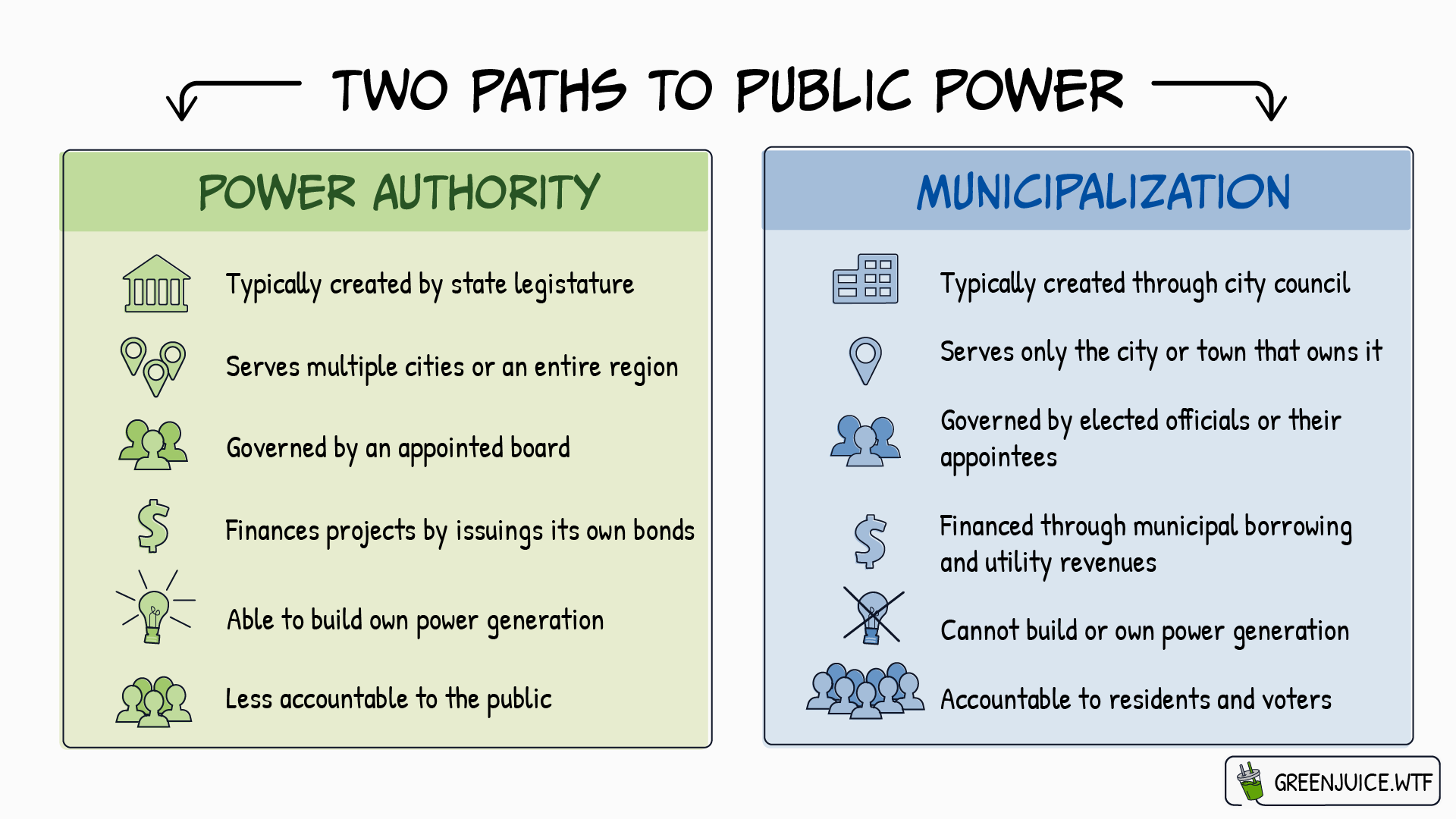
Which is the better strategy, municipalization or creating a power authority? It depends on your situation. When the day comes that New York declares war on ConEd, I hope we're able to pursue the power authority approach. I have two reasons: first, ConEd's service territory isn't limited to NYC: it also includes neighboring Westchester County. So if NYC were to municipalize ConEd, we'd have to leave Westchester out to dry... and we'd probably find ourselves in some very awkward water cooler interactions down at old ConEd HQ. Whereas a power authority could be scoped to include Westchester as well.
Secondly, unlike municipalized distribution utilities, power authorities can be imbued with the power to build energy generation. That means we could build state-owned renewable energy projects right here in New York City, where over 80% of our electricity still comes from fossil fuel-powered sources.
But I wouldn't be surprised if we end up going down the municipalization route. Taking over a utility requires critical support from legislators at either the local or the state level, and I have a real hard time envisioning Governor Hochul getting behind a strong public power push. Zohran Mamdani, on the other hand...
Picking the best pathway for your situation is important. But so is writing a really good charter for your new publicly owned utility. Among other things, the charter determines how your public utility is controlled and who controls it. A power authority controlled by a board whose members are all political appointments made by a centrist governor is why the New York Power Authority has yet to break ground on a single utility-scale solar project three years after the passage of the Build Public Renewables Act.
So what might a better organizational model look like? Well, like the proposed Hudson Valley Power Authority, which, if it succeeds, would replace the rapacious and repugnant Central Hudson Gas & Electric Corp., currently rocking a D- grade on the BBB.

Here's what the HVPA says about governance:
The day to day operations of the Hudson Valley Power Authority will be conducted by the same workers who operate Central Hudson today, from the line workers to the engineers to the billing experts, and more. What will change is Central Hudson’s privately elected Board of Directors will be replaced with a publicly appointed, transparent, and democratic Board of Trustees. This board will be the highest decision-making body, but they’re not the ones who will conduct the day to day operations—that will be done by the full suite of staff below them.
Democracy! That's the ticket.
Awesome, so you've assessed your situation, picked your pathway, and passed a freaking law to take over your local utility.
Congratulations, you've made it to the starting line!
To reach the finish line, all you gotta do is run through a human pyramid of utility lawyers and lobbyists.
How eminent domain works
Until embarrassingly recently, I thought eminent domain meant the government could just take stuff from any persons and companies it didn't like.
That's... not how it works. When you use eminent domain to condemn a utility, you don't just get all of their stuff for free. You actually have to buy all of their crap—even the stuff you don't want!—at a price some judge (probably a Republican) will say amounts to just compensation. You'll get to make your case for what that number should be. But so will the utility, whose army of lawyers will do their best to make the final bill as expensive as they possibly can.
Negotiating the final bill for the utility's assets is the stage at which most takeovers fail. Boulder, Colorado backed off their municipalization effort after more than a decade of costly negotiations with Xcel Energy, their private utility, because Xcel was demanding 80% more money than what their stuff was worth. The utilities can engineer all sorts of ways to inflate the bill because this idea of just compensation comes straight out of the US Constitution. Utility lawyers can argue that "just" means a whole lot more than "what our stuff is literally worth."
So, yeah. That's tough.
But don't despair. Public ownership is possible. There are over 2,000 public power utilities operating in the US today. You've just gotta plan ahead. Which is exactly what we're doing here in New York.
How New York is making takeovers easier
The biggest obstacle to taking over a utility is cost. That final bill is gonna be a doozy. So what can we do today to lower that bill in the future?
Well, if you think about, aren't you kind of already paying that bill? Every month you help pay off the cost of utility assets in the form of your monthly utility bill.
Some clever New York legislators are calling this out directly with a new piece of legislation called the Utility Fair Acquisition Act, which essentially says that in the event of a utility takeover, the public shouldn't have to pay a second time for any infrastructure that we've already paid for.
Sounds downright logical, no? The bulk of your monthly utility bill goes towards paying off existing infrastructure projects. So why should we pay for all that stuff a second time? We already paid for it once! It's ours! That's how paying for stuff works!!
So, step one: pass a law that says you don't have to buy their crap twice.
Step two to reducing that final bill: cut down the utility's obscene guaranteed profit margin.
Another new piece of legislation here in New York (with a confusingly similar name) would do just that. This one is called the Fair Authorized Investment Returns Act, or FAIR Act, and it would cut IOU profits across the state by roughly 3%, down from the industry-wide average of around 9%.
A reduction on utility profits would immediately lower our bills. But there's a secondary effect, too, that has to do with one of the tactics utility lawyers employ to inflate the price of their assets, called the going concern value. The utility basically argues that the state or city isn't just buying their existing stuff—they're buying all their future earnings, too. So in order to make it fairsies, the utility should really be compensated for allllll the profits they're no longer going to be able to make.
Passing the FAIR Act to lower the guaranteed profit margin reduces those future earnings, thus lowering your final bill.
FYI, New York's 2027 legislative session begins on January 1st. Get ready to hear a lot more from me about how to support these bills in the coming months.
I've got one more tactic for you to push in the near-term. NYC's beloved Mayor Mamdani recently appointed the city's first-ever public utility advocate, energy expert Annel Hernandez, who is charged with "pushing for clean and affordable energy for New Yorkers." We here at Green Juice applaud the appointment of Ms. Hernandez! Every city deserves a public utility advocate, and you should absolutely use Zohran's new appointment to fight for an advocate of your own.
Should a municipalization effort take root in NYC, I would hope the public utility advocate does two things:
- Fundraise like crazy for a protracted legal battle
- Build a team of experts to guide the fight and fend off utility lawyers and lobbyists
Because it's not just the utility lawyers you need to contend with. The utility will also spend millions lobbying the public against the takeover. They'll send mailers, wine and dine politicians, hire airplanes to write messages in the sky about the evils of communism... anything to poison your public power campaign.
To combat this, you'll need to do one more thing: build a massive, mighty, motivated movement of public power-pilled people.
How to build a movement
As the good book says, there are no shortcuts. There is however, a surfeit of seething anger towards private utilities and the astonishingly big bills they slip into our mailboxes each and every month.
That anger can be channeled into productive organizing. The key is help people understand that there's a better way. A public way.
In the Hudson Valley, the HVPA crew is hosting a series of town halls up and down the valley, doing the painstaking work of sharing their vision, answering the community's questions, quelling their doubts, and slowly building support.
It's no surprise that the HVPA effort is being led by the Mid-Hudson Valley chapter of the Democratic Socialists of America. If public power is up your alley, the very best thing you can do is join your local chapter of DSA.
Down in the densely populated city, we build power by tabling, canvassing, and organizing rallies. We can host town halls, too. And post memes on social media. And make videos about how ConEd sucks. And make a website. And slowly but surely amass critical support for a publicly owned energy system.
Taking over your local utility is a big hill to climb, to be sure.
But somebody's gotta climb it.
Why not you?
And with that invigorating call to action, #FuckConEd Summer comes to a close. Thank you, reader, for joining us. I learned so much about how ConEd sucks! Green Juice will now be taking a few weeks off to recharge our batteries. See you soon, and thanks again.

Member discussion