
Is balcony solar coming to NYC?!
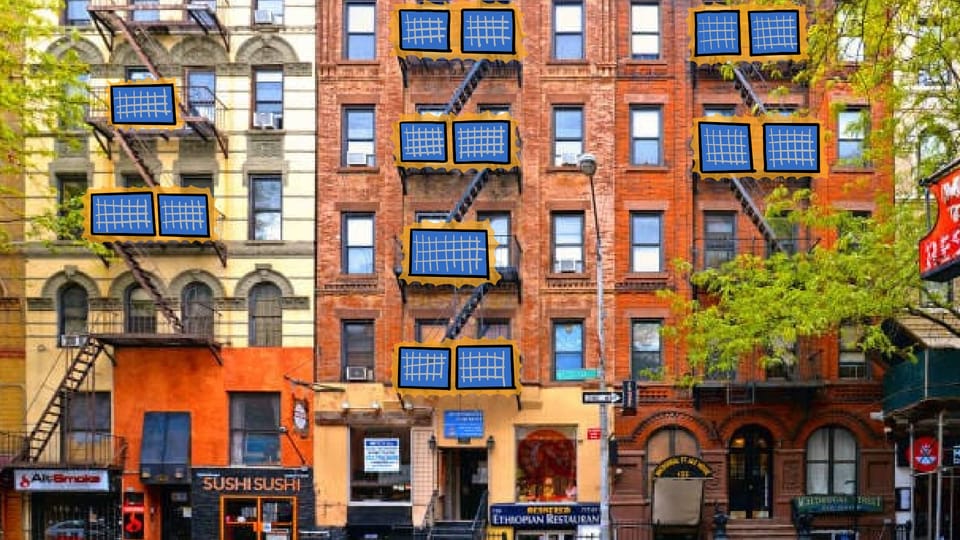
Big news, dudes: balcony solar is coming to New York! Maybe!
Assemblymember Emily Gallagher and Senator Liz Krueger teamed up to introduce the Solar Up Now New York (SUNNY) Act, which would finally make it legal to install balcony solar right here in the Big Apple (and everywhere else in New York state).
Sick!!
But, uh, what is balcony solar, again? And what makes it quote unquote sick?
To find out, let's take a trip to the balcony solar capital of the world: the Federal Republic of Germany.
Balkonkraftwerk: the balcony power plant
Germans, they say, have a word for everything, and their beloved balcony solar is no exception. They call it Balkonkraftwerk, which translates to "balcony power plant"—a pretty neat way to think about solar panels, in my estimation.
For the last few years, Germans have been installing balcony solar panels by the bushel. As of mid-2025, about a million systems were officially registered. Unofficially, the total count has been estimated as high as 4 million. There are only 41 million households in all of Germany! And this craze is only getting started.
So how's it work?
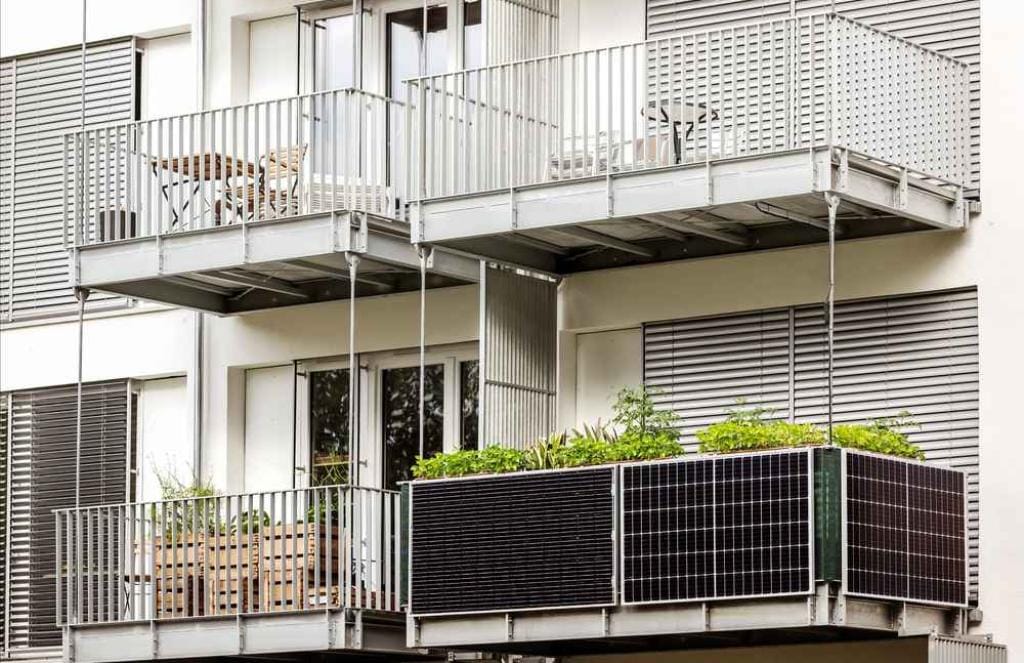
Balcony solar (also known as plug-in solar) is typically sold as a three-part kit. Here's what you get:
- A photovoltaic¹ solar panel that can plug directly into a wall outlet. Panel power and size can vary, but a 400 watt panel is generally about 5 ft x 3 ft, an inch thick, and weighs a hefty 40-something pounds.
- An inverter, or more likely a micro-inverter, converts the DC electricity produced by the panel into AC electricity, which is what our energy grid requires. The inverter is usually attached directly to the back of the panel.
- A mounting system to attach the panel to your balcony. Panels can also be set up on the ground, secured to the side of a house, or draped over a fire escape (??).
Once it's plugged in, the system will start feeding solar power into your home's (or apartment's) dedicated electric meter,³ thereby powering your crap with clean energy and reducing the number of kilowatts you purchase every month.
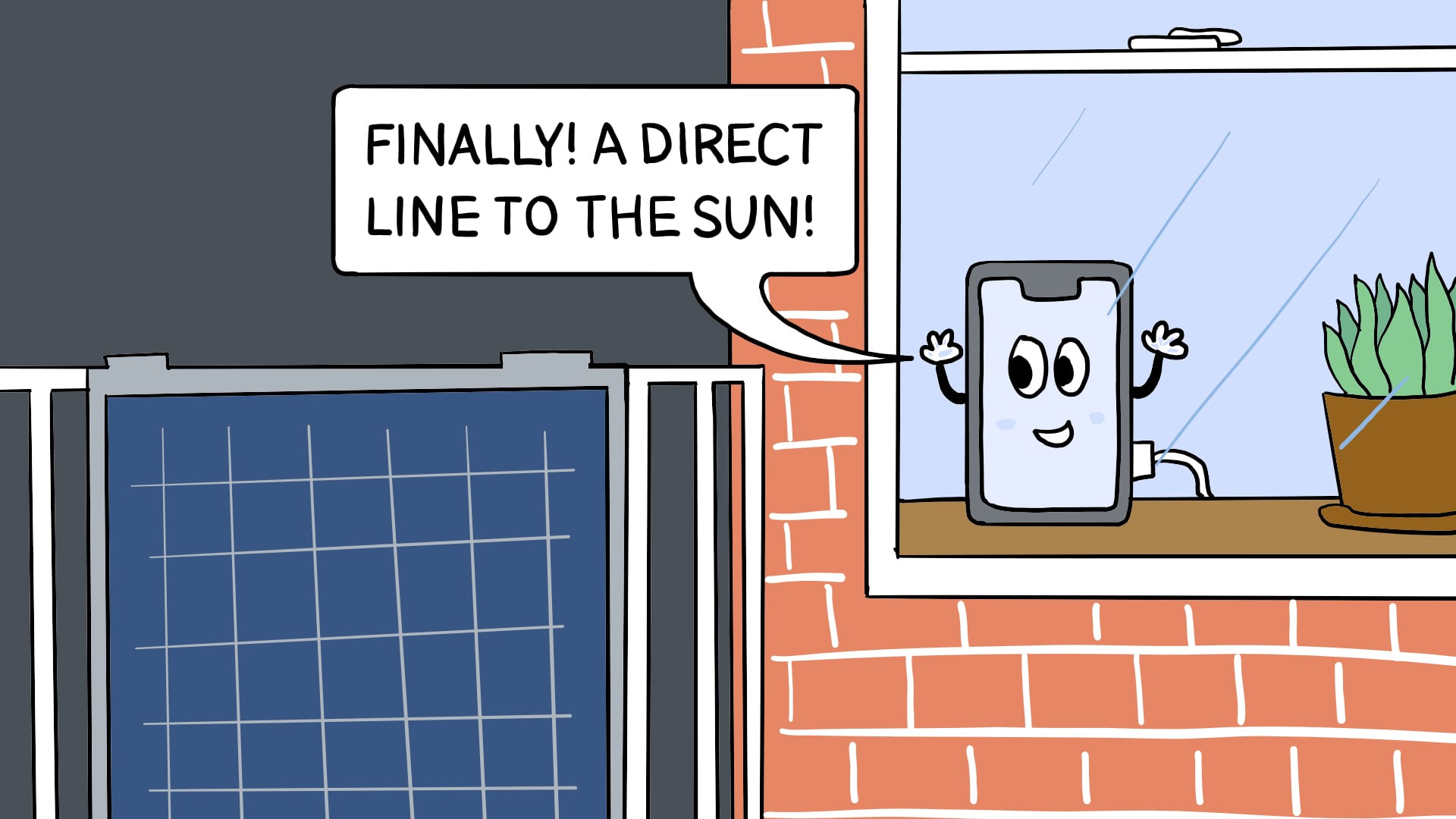
In Deutschland, a fella can pop over to the German equivalent of Home Depot and snag a panel or two for something like €200–400, bring 'em home, plug 'em in, and call it a day.
Contrast that with getting rooftop solar in America, which entails a months-long permitting process, professional installation, and a visit from an electrician to hook up the system to your home's energy meter.
Your standard 4–6 kilowatt rooftop solar array will run the average American roughly $30,000. More than half of that price can be attributed to "soft costs," i.e. permitting fees, installation, and site visits.
Of course, there's a tradeoff. Balcony solar provides way less power than a rooftop system. A typical balcony panel is rated at 400 watts. If you've got room, you can install two panels, netting you 800 watts. Still, that's just a fraction of a full-fledged rooftop system.
Why's it so popular in Germany?
Despite its relatively meager output, balcony solar has a lot going for it. Under normal conditions, 800 watts should produce about 70 kilowatt-hours a month.
Remember when I investigated my own utility bill back in April? That month, our apartment used a total of 126 kilowatt-hours. So 70 kWh would have made a big dent in our consumption, turning money we paid indirectly to natural gas companies into glorious clean energy savings.²
Savings, though, are only half the story. Balkonkraftwerk's rise can be ascribed to a few factors:
- The Russian invasion of Ukraine in February 2022 caused natural gas prices to spike. Before the invasion, Germany got over half its natural gas from Russia. But by September 2022, their supply was entirely cut off. Folks needed a way to produce their own cheap electricity.
- Following years of advocacy from balcony solar enthusiasts, the German government simplified the registration process and made it harder for landlords to interfere with their tenants installing panels.
- The price of Chinese-made panels has continued to plummet, making solar suddenly affordable for a wider demographic.
Natural gas dependence + government reforms + cheap solar panels = widespread balcony solar adoption.
Does that formula work for us here in the U.S.? No, of course not. We're Americans, damnit! We frack our own gas, our government thinks renewable energy gives you adult-onset autism, and we tariff the shit out of those cheap Chinese panels. Let freedom ring!!
So how and why is balcony solar making its way across the Atlantic?
The answer may confuse you.
Balcony solar in the States: thanks, Utah!
The first U.S. state to introduce balcony solar legislation was Utah, that bastion of progressive values.
Except Utah didn't just introduce legislation—they passed it, with near-total bipartisan support. Governor Spencer Cox signed House Bill 340, the Solar Power Amendments, into law in May.
Why Utah?
Because Utah state representative Raymond Ward—a Republican—read about what was happening in Germany in a newspaper and wanted to know why he couldn't buy one. The power of journalism, people!
Cool. So balcony solar is booming in Utah?
Oh, well... no.
While the bill Utah passed does legalize balcony solar, it also stipulates that panels meet certain conditions, including these two:
- Adhere to National Electrical Code standards
- Certified by a nationally recognized testing laboratory, such as Underwriters Laboratories (UL)
Problem is, American standards for balcony solar don't exist yet. There are some relevant standards that could be adapted, but it'll take time, and UL is unlikely to certify the technology until it complies with the National Electrical Code. (Per my understanding... any UL experts out there, please weigh in!)
Therefore, we need to update the code. It's scheduled for an update at the end this year (to take effect in 2026), but so far no one's had any luck. Every recommendation for amending the code to allow plug-in solar has thus far been summarily rejected.
Evidently, one of the major sticking points is the lack of a compatible ground fault circuit interrupter.
Can one of my readers get on that, please?
Look, when I said that balcony solar has succeeded in Germany because of advocacy groups, this is what I meant. For over a decade, advocates and solar companies have been lobbying the German electrical certification body to amend safety regulations to legalize balcony solar. They got started early, so when the country was at last ready to embrace the technology, the technology was ready to be embraced.
Americans just aren't too big on the whole "planning ahead" thing. We're more of a "fly by the seat of our pants" style of people—even when our pants are, say, hooked onto the wing of a cruise missile, or snagged on the side mirror of a driverless taxi, or hung from a meathook at an industrial slaughterhouse.
Anyways.
Can't we just copy/paste Germany's regulations?
Annoyingly, we cannot just steal the regulations Germany came up with. Our grids are built different (their outlets are wired for 230 volts, ours are for 120 volts; we have lower line voltages; we've got different codes for building wiring, etc. etc.).
Besides, we shouldn't gloss over the certification stuff. There are legitimate concerns about the technology if it's not designed specially for the American grid. This article from Canary Media lays out the various concerns in detail (fires, shocks, blackouts, etc).
That's all to say it may be a few years yet until Utahns can bask in their balcony solar self-reliance.
...but does New York have a shot of getting there quicker?
Read part 2 of this series!
 Jon
Jon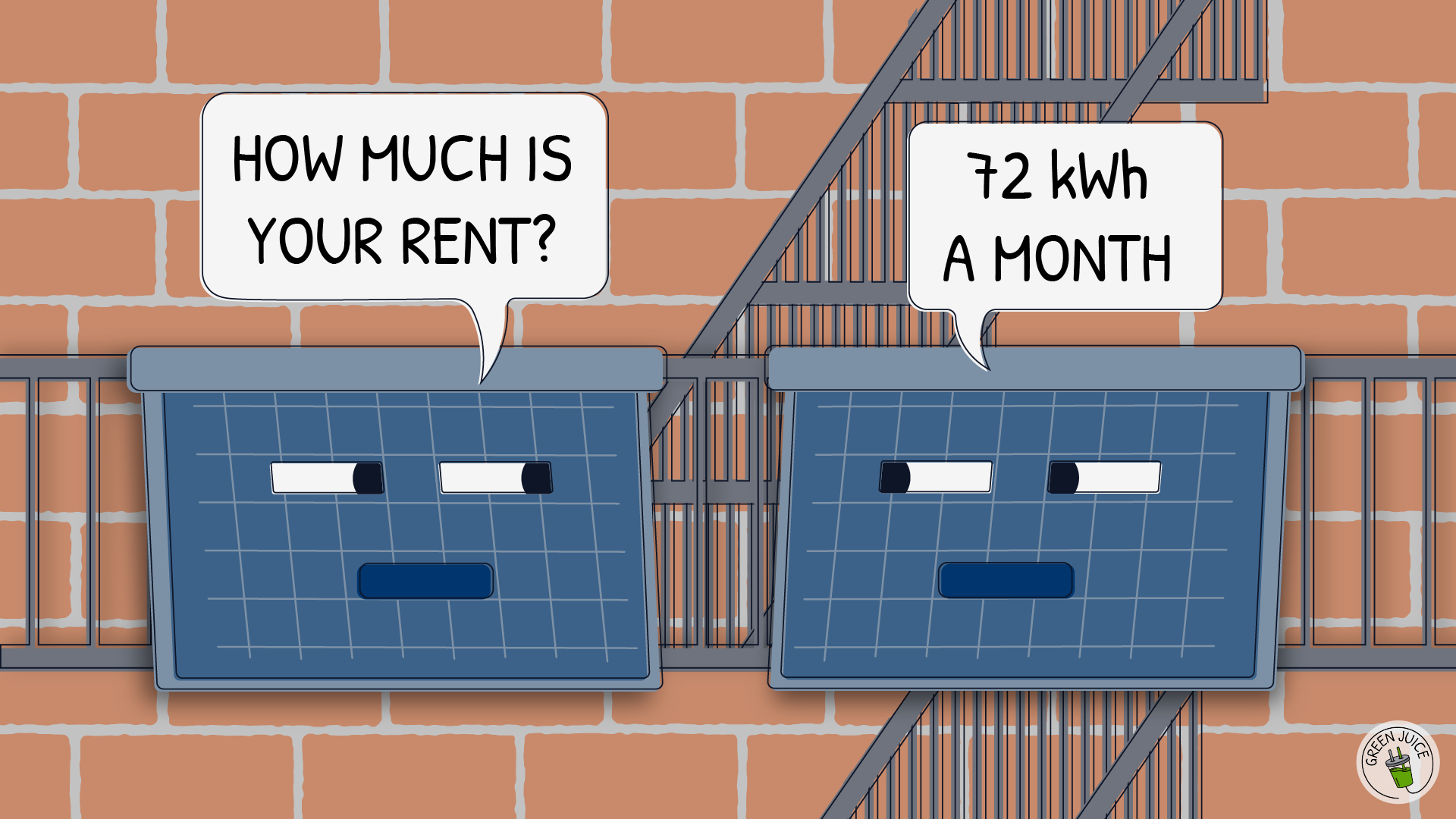
¹Photovoltaic, often abbreviated as PV, is the most commonly used type of solar panel in the world.
²Outside of a few markets, utility companies don't provide customers with power. Rather, they buy power from Independent Power Producers on your behalf. As of 2024, over half the power in America still comes from fossil fuel sources.
³This is an oversimplification for the sake of clarity. In actuality, electricity from the solar panel flows into your home wiring (or into the branch circuit), then flows “backwards” through your meter (or "nets off" into the grid, if there's extra, depending on whether you've got a smart meter or not). The electricity doesn't go straight to your crap first—the grid and meter system mediate flow.




Member discussion