
ConEd's assault on batteries
It's #FuckConEd Summer! We've covered 10 facts about ConEd every New Yorker should know AND why ConEd is responsible for the ground beneath our feet randomly exploding (also available in video).
My partner is traveling this week so I've been talking more than usual to our cat, Abby the Green Juice intern.
Mostly I tell Abby about how ConEd abuses their authority over the electricity grid to obstruct clean energy development here in New York City.
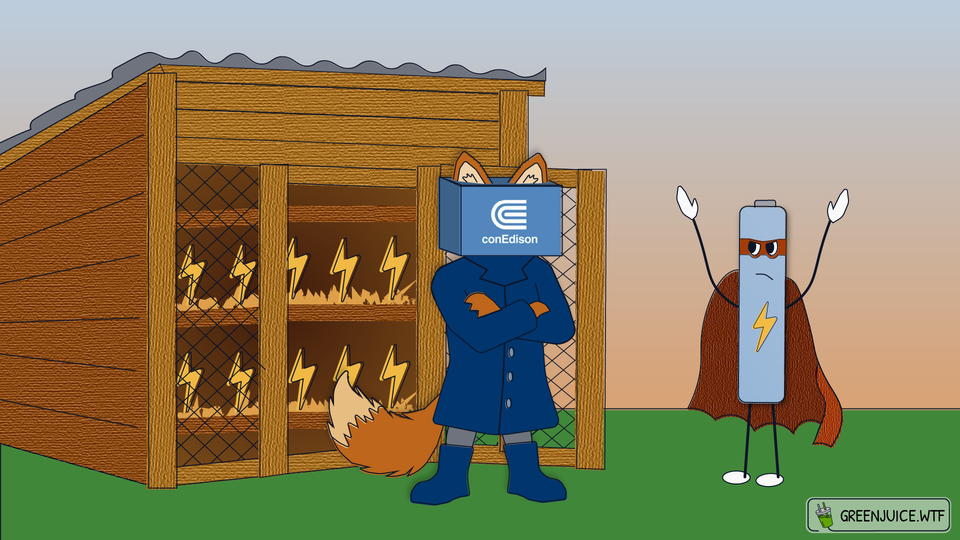
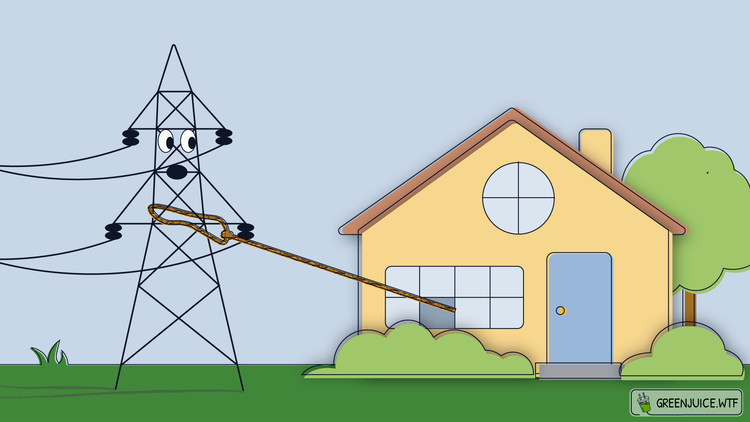
"ConEd gets to referee a game it's also playing!" I say. "The fox is guarding the henhouse, Abby!!" By way of reply she bites my foot and runs away.
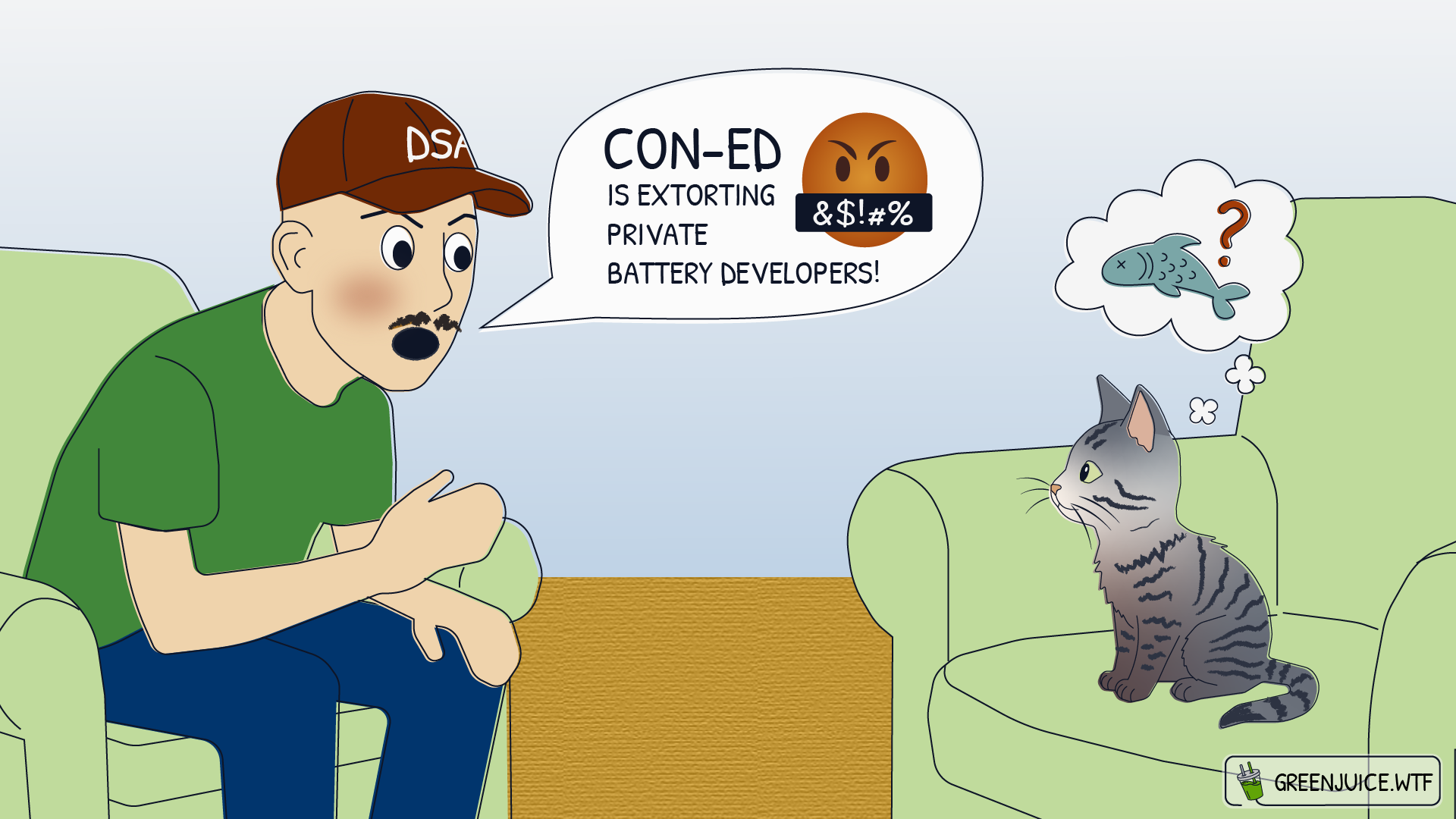
Yesterday, though, a funny thing happened. I ate a gummy bear I found in the back of a drawer and not long after, Abby started talking back to me in perfect English! We ended up having a great conversation about ConEd's clean energy obstructionism.
You can read that conversation below, which I have faithfully transcribed from memory.
ConEd's assault on batteries
🧃JON: Abby, I haven't stopped thinking about this NY Focus article since it came out back in March. The story here is that Con Edison is forcing private battery developers to pay tens of millions of dollars—an average of $21 million per project—just to plug their batteries into the electric grid.
 Colin Kinniburgh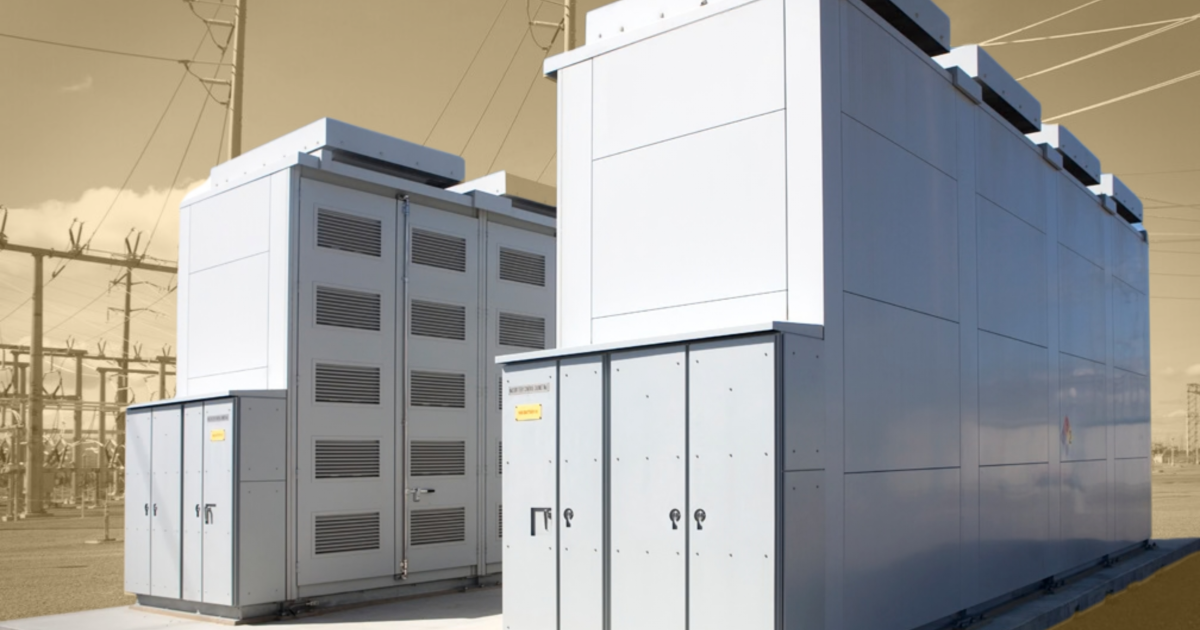
But what really gets my goat is the patently absurd excuse ConEd has reportedly been giving to justify these fees. They're saying that someday, theoretically, there could be so many batteries plugged into the grid that if they all charged up at the exact same time it could hypothetically damage some grid equipment. And therefore, battery developers need to pony up tens of millions of dollars right now so that ConEd can go build a bunch of brand new substations that would prevent this scenario from happening. Of course, ConEd stands to make a handsome profit from building these new substations.
It's just such obvious bullshit! Like, for the scenario they're fear-mongering around to happen, you would need dozens of battery projects to all charge at full power simultaneously in the same small geographic service area with zero coordination between themselves or the system on the back end. It's not just unlikely; it's freaking impossible! I mean, has ConEd heard of NYISO? Y'know, New York's independent grid operator, which already coordinates when batteries can charge and dispatch? NYISO's job is to prevent the very situation ConEd is describing!
🐱ABBY: I am a cat.
🧃: Right, I know that. Even for a human, this is complicated stuff. But what ConEd is *reportedly* doing is, to my mind, obstructionism at best and extortion at worst. So I'd really like you to try and understand what I'm talking about here.
🐱: This is of no consequence to me.
🧃: That's not true, Abby! First off, these battery projects would save consumers billions of dollars. From the article: "State energy officials estimate that a rapid battery buildout over the next few years could yield $2 billion in statewide energy system savings, with much of the benefits concentrated in and around New York City."
Beyond the savings, more batteries on the grid would reduce blackouts and fight climate change, since batteries are the single most effective way to shut down the evil, expensive, inefficient gas "peaker" plants poisoning black and brown communities all over New York City. It's critically important that more batteries get plugged into the grid.
🐱: There is a battery in my floppy fish.
🧃: Yes, Abby! Thank you for engaging! There is a battery in your floppy fish toy, which you played with for almost 30 seconds before never vowing to never touch again.
Much like your floppy fish, I know you're gonna lose interest in this conversation quickly. So let's jump right to the good stuff.
Let's pretend you, Abby cat, are a private battery developer. Your goal is to buy a bunch of batteries, rent some land, and plug your batteries into the grid. Once that's done, y0u can start making money! How? By charging up your batteries when the power grid is quiet—that's when electricity is cheapest—then selling the cheap, stored energy back to the grid when the grid gets congested and prices spike. This is called energy arbitrage and it basically means "buy low, sell high."
🐱: I am a private battery developer.
🧃: Exactamundo. But in order to plug your project into the grid, you've gotta go through ConEd. So you go to ConEd and say, "Hey, I want to build a 5 megawatt battery project on this vacant lot in Bushwick. Can I get a grid interconnection approval?"
Guess what ConEd says?
🐱: What?
🧃: "First, we have to conduct a study."
🐱: Oh. Why?
🧃: Well, ConEd would tell you there's a huge risk to plugging *anything* into the grid without first making sure it's kosher.
But that's ridiculous, unless you're talking about plugging in a new nuclear reactor or something. Rooftop solar, small battery projects—these things pose very little danger to the grid. In fact, as we've discussed, batteries help keep the grid balanced by storing energy when there's a surplus and providing it when there's not enough.
🐱: Hm. So then what happens?
🧃: Then you fork over $750 to ConEd to do an initial screening. If you "fail" the screening, you pay $2,500 for a supplemental screening. And if you "fail" that, which you will, you pay up to $8,000 for ConEd to conduct a two-month engineering study.
Once the study is done, ConEd hands over your bill: $21 million to plug in, on average.
🐱: And ConEd just gets to keep the $21 million?
🧃: The money goes toward building new infrastructure that ConEd then owns and earns a profit on forever—all charged to us ratepayers. So you pay $21 million and ConEd gets a new asset that guarantees them decades of profitable returns.
🐱: So ConEd orders and conducts the study that determines how much money I have to pay them? That sounds shady.
🧃: Now you're getting it. ConEd is in charge here. There's no third-party involved, no independent check on their analysis. This is what I meant when I said ConEd gets to referee a game it's also playing. The fox is guarding the henhouse!
🐱: Is this a new phenomenon? Why is it in the news now?
🧃: Another tremendous question, Abs. ConEd conducting these studies isn't new—but they made a major change to their methodology in August, 2025.
Previously, ConEd looked at how your project would interact with the local distribution equipment. Those results might have also been bullshit—BATTERIES ARE GOOD FOR THE GRID—but the fees they charged were closer to $1 million per project.
The new version of the study is what's multiplying fees up to 60x. Because in the new version, ConEd doesn't just look at your project—they look at what would happen if your project plus all the other existing and queued projects in the area all charged simultaneously at full power. ConEd is inventing an extremely unlikely if not outright impossible scenario and charging you as if it's a certainty.
🐱: So ConEd is just ripping developers off because they can?
🧃: Well, I'd argue there's a little more to it. But none of it is good. I mentioned that batteries can shut down natural gas peaker plants. ConEd happens to be heavily invested in the natural gas business. They not only serve gas to a million customers, but Con Edison Transmission, a ConEd subsidiary, owns a stake in the Mountain Valley Pipeline—a 300-mile gas transmission pipeline in West Virginia—as well as a major stake in a company called Honeoye, which operates a natural gas storage field in upstate New York.
Batteries are a threat to ConEd's lucrative gas business. The more batteries on the grid, the less dependent on gas our society becomes. So it's not just about pocketing extra cash—ConEd is strongly incentivized to obstruct battery adoption. Solar, too, because solar makes batteries even more effective.
🐱:Wow, fuck ConEd.
🧃: This is what I've been saying.
🐱: But wait, isn't your whole thing "public power"? What do you care if these private developers have to pony up?
🧃: Gosh, you're one astute kitty. Well, two reasons. One is that at this point, I'll take any renewables I can get, privately owned or otherwise. We desperately need to get off fossil fuels.
The second reason is that pointing out how shady and selfish and obstructive ConEd is helps make the case for public ownership. Because if ConEd were publicly run, we wouldn't do any of this shit. We'd make it easier for batteries to plug into the grid. In fact, we'd install them ourselves! We need to put batteries everywhere, Abby! BATTERIES EVERYWHERE!
🐱: I deserve a treat now.
🧃: You do. And so do I.
Member discussion