
Crikey! 40% of Aussies have rooftop solar
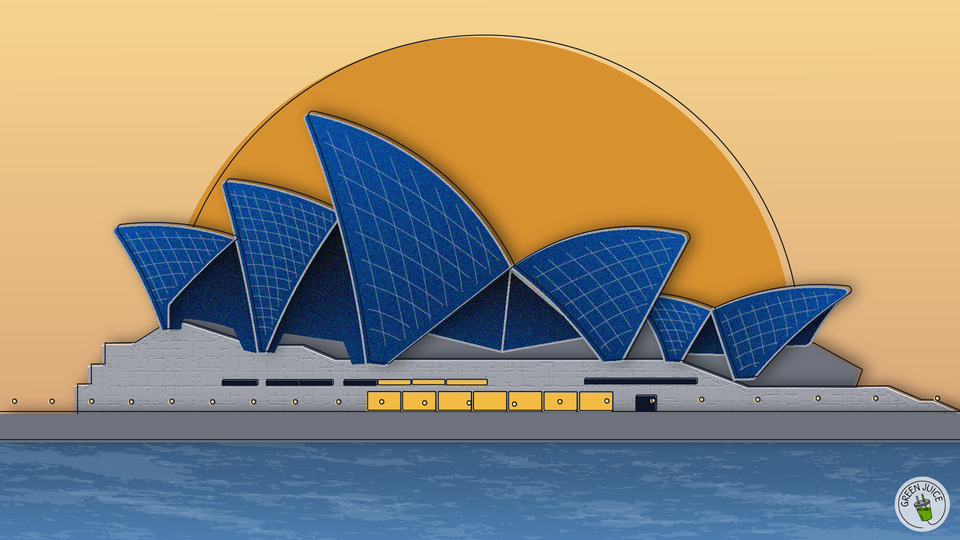
You read that right, m8: 40% of Australian homes are now bedazzled with rooftop solar panels.
That's more than 4 million homes (and small businesses) collectively generating 27 gigawatts, or for 13% of the country's total power output. And they're expected to throw another 10 GW of rooftop solar on the barbie (the roof) by 2030.
By contrast, a scant 7% of American homes have rooftop solar installed.
What gives? Do Aussies care more about climate change than Americans? Are they, dare I say, more ruggedly independent than we?
Nawwwrrrrr!
It's simply way cheaper and way easier to get it done Down Under.
Let's compare the processes and relative costs of these two standout former British colonies.
FYI, I'll be quoting heavily from this meaty podcast interview with Saul Griffith, an Australian energy expert, author, scientist, inventor, entrepreneur, and organizer.
How to get rooftop solar
1. Start with a quote
No matter where you are, the first step to getting rooftop solar is to procure a quote from an installer.
In Australia:
Pull up the Solar Choice website and enter your address. Upload an electricity bill if you've got one handy. Within 10 minutes, you'll have five quotes from pre-vetted local vendors.
Quoth Saul:
[It's] pretty impressive, because the majority of rooftop solar in Australia is installed by what they call “mom and pop,” which means small companies with a couple of trucks, and they’ve all plugged into these online systems and they will all end up bidding on your home. The recommendation is to always ignore one or two of the lowest bids.
In America:
It's getting easier to get a quick quote in the U.S. We have online marketplaces now, too, like Energy Sage. But many areas are still serviced by just a few large outfits, which reduces cost-competitiveness.
2. Permitting
In both the U.S. and Australia, a permit is required to install your rooftop solar panels. That's where the similarities end.
In Australia:
After you click on a quote you like, the installer will call you up to schedule an in-person visit. This can happen as soon as the following day, though it can sometimes take up to a couple weeks.
Adorable fact: in Australia, rooftop solar installation tradespeople are nicknamed "tradies".
During their site visit, your tradie will refine your quote. Now's the time for add-ons. You can add a battery, an EV charger, and/or upgrade your electric panel to a three-phase connection, which allows for even bigger rooftop systems.
The biggest difference, however, is that your tradie can get your permit over the phone from your job site. Buzzing!
In America:
You're looking at 60–90 days to get that same permit. The U.S. is highly decentralized: every city and town does their own thing with regard to permitting. Installers, therefore, must navigate endless variations in process and paperwork. And much of the permitting approval process is still done by hand, presumably by octogenarian civil servants who refuse to ever retire.
50% of customers pull out because if you’ve got 60 or 90 days to think about a purchase decision, you change your mind. There’s a huge amount of sales that fall off during that period.
3. Interconnection approval
Interconnection refers to getting hooked up to the giant electricity grid from which we all draw power. Solar panels generate energy (duh) and feed it into the grid, so system operators need to know there's gonna be additional load, even if it's relatively insignificant. The grid is a surprisingly delicate machine that must be perfectly balanced at all times.
In Australia:
Rooftop solar interconnection is guaranteed by law within 24 hours.
In America:
Rooftop solar interconnection approval takes—you guessed it!—60–90 days.
But hey, at least that's faster than getting approval for a new solar farm. The interconnection queue for utility-scale generation projects in the U.S. is over five years long. There are more than 10,000 projects—95% of which are for renewable energy—sitting around in this interminable line. But that's a whole separate can of worms.
4. Inspection
Site inspections take place in both the U.S. and Australia.
In Australia:
In Australia, the great majority [of homes] are inspected, but we don’t have pre-inspections. We do the inspection statistically and we have a training and certification process for all of our installers.
In America:
Inspections are generally required before and after installation, which can hold up your installation even further, though this too varies by jurisdiction.
5. Installation
Right, so how long does it take, on average, to get a rooftop solar system installed?
In Australia:
[The installers] will probably show up the next morning before 7 am and have a look at your roof. Depending upon their backlog, they’ll be on your roof within 48 hours. Or maybe it’ll be a week, or maybe it’ll be two weeks because they’re booked up with other people. Each crew can do one solar system or two solar systems a day.
In America:
Timelines vary, but you should probably budget around six months.
What's it gonna cost?
It's clearly much easier to get rooftop solar installed in Australia. But is it any cheaper?
It's about five times cheaper, yeah.
In Australia:
The average price for rooftop solar is under 60 cents U.S. per watt installed.
That includes your interconnection as well as the cost of the inverter, the machine that turns the Direct Current (DC) electricity made by solar panels into Alternating Current (AC), i.e. the type of power used by your home appliances and the electric grid.
In America:
The average price for rooftop solar is $2.50–$3.50 per watt installed.
Crunching the numbers...
The average size of a rooftop system is about 7 kilowatts.
$.60 a watt x 7,000 watts = $4,200
$3 a watt x 7,000 watts = $21,000
That's a lot of dosh! (Australian slang for money I just googled)
Payback period
The beautiful thing about rooftop solar—about basically any clean energy technology, actually—is that eventually it pays for itself. That's because the fuel is freely given to us by the Sun God, Ra.
How long your payback period takes will depend on the price of electricity and price of your installation.
In Australia:
Electricity is expensive and installations are cheap, so the average payback period is just 3–6 years. Since these panels last 25 years or more, you'll be making money on your investment in short order.
In America:
You're looking at 10+ years to break even. It was better when Biden's federal tax credit was a thing, but Trump ripped that legislation to shreds the second he took office.
3 free hours of electricity every day
Starting summer 2026, many Australians will receive fully free electricity for a minimum of three hours every single afternoon. The Solar Sharer program is meant to encourage energy use when tons of solar power is being fed into the grid. All you need to participate is a smart meter.
What can you do with three free hours of energy?
- Charge your Electric Vehicle and never pay for fuel again
- Run your washer, dryer, dishwasher, etc. With smart appliances, you can often schedule them remotely.
- Blast the A/C like there's no tomorrow
- Indulge your electrocution fetish
How can we be more like Australia?
I never thought I'd ask this question. In New York, Australians are best known for opening expensive, austere coffee shops and being 1.5x larger than normal humans. Nothing you'd want to emulate, really.
But they've got this rooftop solar thing figured out. So how can we get closer to the Aussie approach?
Let's count the ways.
1. Scare your state's Public Utility Commission (PUC)
Every state has a Public Utility Commission (PUC) that's supposed to regulate the local monopolistic utility companies. For a largely unknown entity, PUCs have tremendous power: just 200 people oversee over $200 billion in utility spending each year in the U.S.
PUCs are generally comprised of nerds who don't like being yelled at, so if you can rile up some townspeople and show up en masse to their next public hearing, you may be able to push them to make the interconnection process fast and automatic—just like in Australia.
2. Lobby your state lawmakers
Permitting reform is already a thing. Catch the wave! Advocate for statewide permitting uniformity, so installers don't waste countless hours on paperwork. Advocate for switching to software, like SolarAPP+, specifically designed to expedite rooftop solar permitting.
3. Lobby your local Authority Having Jurisdiction (AHJ)
If you've never heard of an AHJ, you're not alone. An Authority Having Jurisdiction (AHJ) refers to the organization, office, or individual who has legal authority to enforce codes, standards, and regulations and to approve installations.
In the U.S., we have more than 10,000 AHJs, and they all play by their own rules. As Saul Griffith puts it,
Every single [AHJ] has a different set of rules. You might be in a certain place in Santa Fe, New Mexico where they believe that you can only paint your houses a certain color that looks like red dirt and therefore you can’t have solar panels. It’s that AHJ jurisdiction problem, which enables approximately infinite permutations of NIMBYism.
If you don't find a warm reception with your state lawmakers, you might have more success lobbying your local AHJ. They, too, can institute permitting reform.
Easy process = lower costs
Guaranteeing interconnection and speeding up permitting is a surefire way to lower costs. Because if the process is quick and easy, more people will adopt it. Rooftop solar is highly visible. It's a great talking point for neighbors. As Saul puts it,
You see your neighbor get it, you ask your neighbor, “How do you like your solar?” Neighbor says, “It’s bloody good, mate. Government helped me buy it. Now I’ve got free driving everywhere. I haven’t paid an electricity bill in months.” Then they’re like, “That’s a good idea, I want in on that.” Then they buy some.
Bonza!
For making it to the end, here's your treat: 125 Australian slang words and phrases.
And please subscribe to Green Juice!
Member discussion